Casio CT-S200 Touch Sensitivity: What Is Missing?
Buying Guide Notes · First published:
Compiled from public sources · Written using published specs and user feedback.
As an Amazon Associate I earn from qualifying purchases.
Pros
- + Portable 61-key format with handle and standalone sounds
- + 400 tones and 77 rhythms for musical exploration
- + USB-MIDI and documented headphone and pedal connections
Cons
- - No touch response from the CT-S200 keybed
- - Full-size keys do not establish weighted piano action
- - Apps and accessories cannot be assumed to add missing sensors
Sources and verification status
Verification status: compiled from public sources
Data updated:
Verified on:
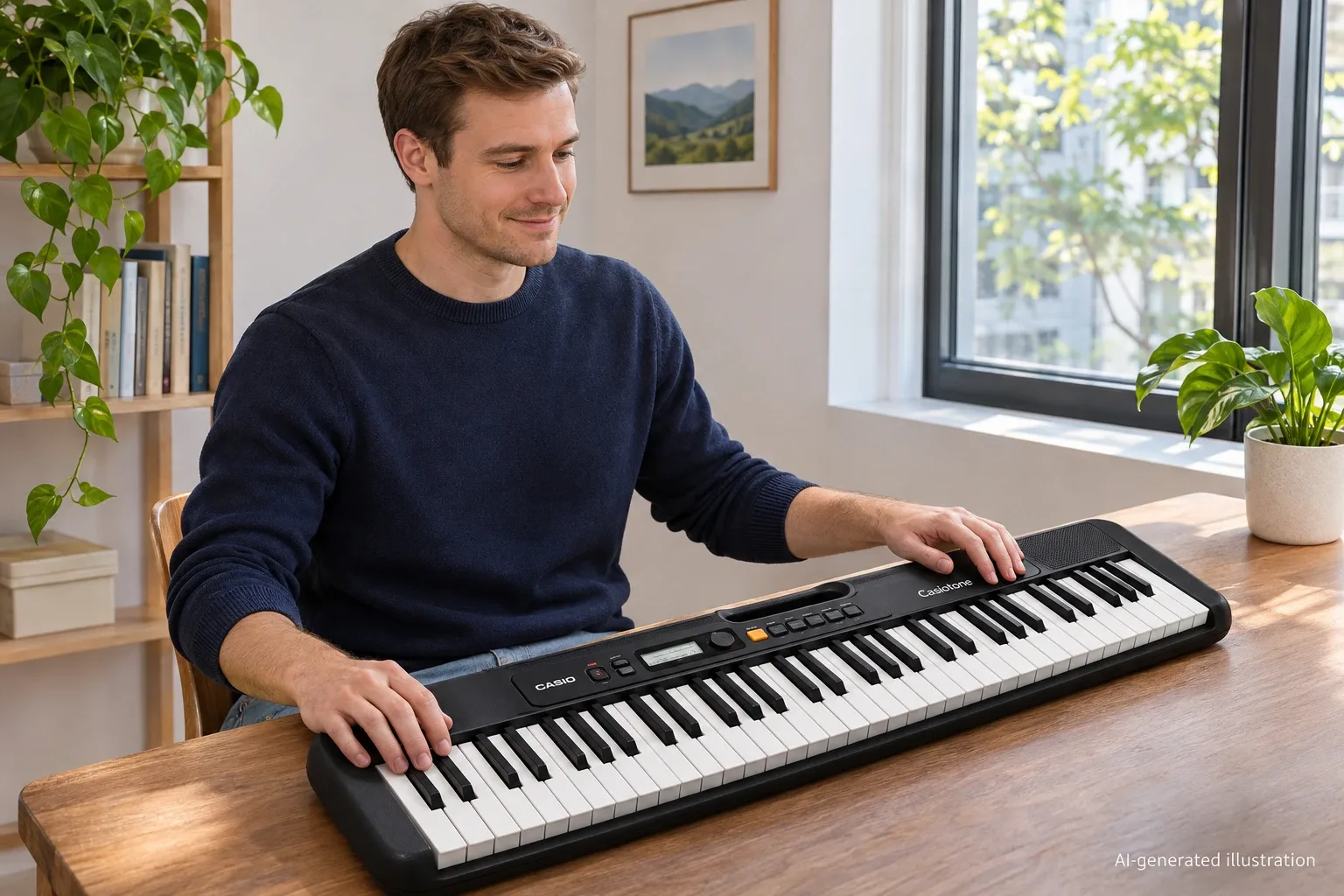
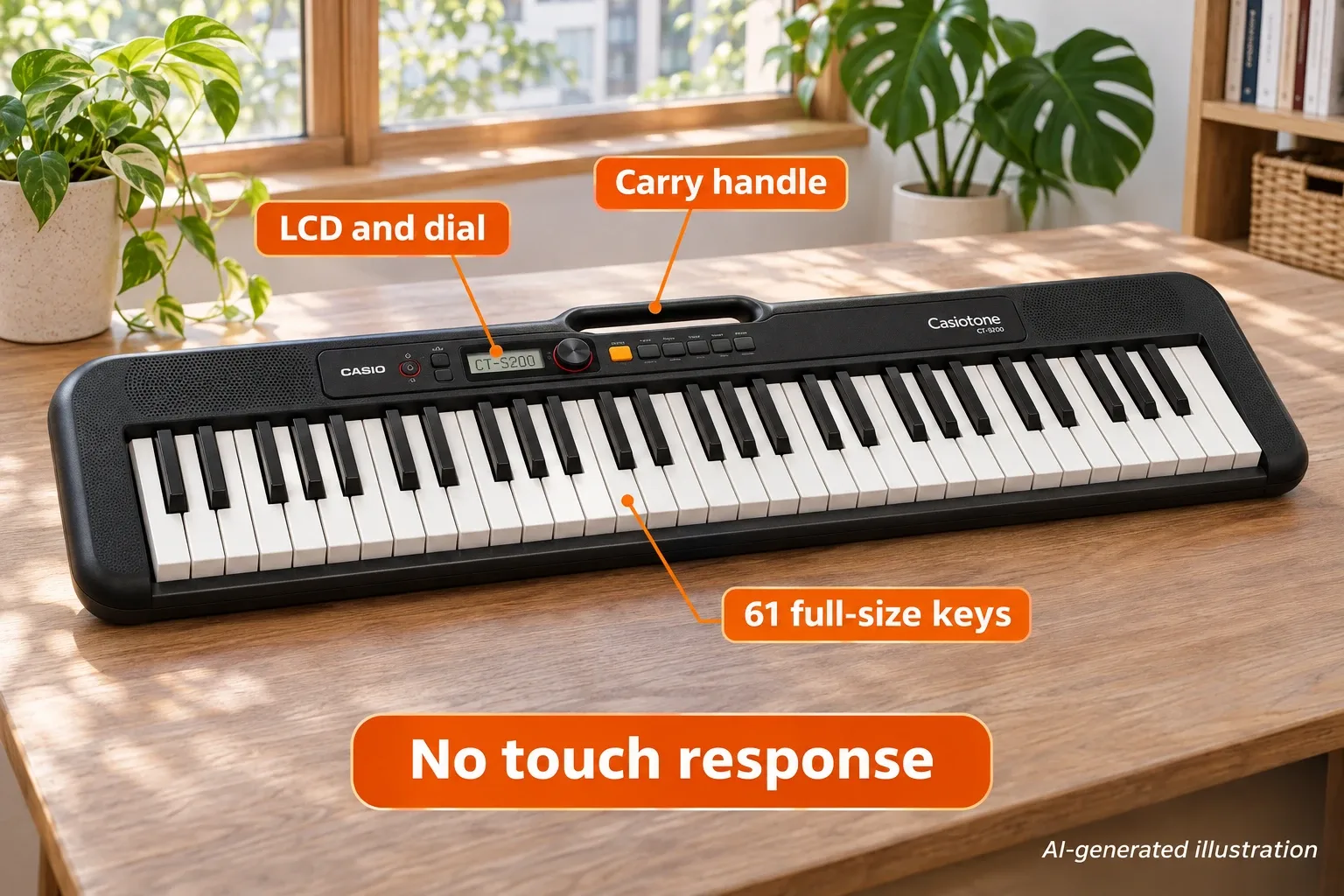
The Casio CT-S200 does not have touch-sensitive keys: striking a key harder does not provide the playing-dynamics response you may expect from a piano. Its full-size keys, USB-MIDI connection and adjustable volume do not change that limitation. If touch response is important to your lessons, compare a model that explicitly includes it before buying.
Quick Verdict: Choose the CT-S200 for portable music making, rhythms and casual exploration when touch response is not a requirement. Skip it as a purchase intended specifically for learning expressive piano dynamics; the nearby CT-S300 is a more relevant starting point for that feature comparison.
This guide is compiled from public sources, checked November 15, 2026. We have not played, unboxed or measured this keyboard. The selected US new offer is the black CT-S200BK, ASIN B07VSTXH3T, rather than a stand-and-bench bundle or a refurbished unit.
Does “full-size” mean the keys respond to pressure?
No. Full-size describes the key format. Touch response describes whether the instrument responds to how forcefully you strike a key. Weighted action describes a separate aspect of the key mechanism’s resistance. Those terms are easy to blur in a shopping summary, but they answer different questions.
Casio’s CT-S200/CT-S300 brochure explicitly identifies touch-responsive keys as an addition on the CT-S300. The CT-S200 should therefore be purchased with the understanding that its keyboard does not offer that feature. A search snippet, a retailer’s loosely worded description, or an automated product summary is not a reason to assume otherwise.
The Amazon page we checked included an automated highlight suggesting a weighted feel. We did not treat that as a verified weighted-action specification. Its existence illustrates why a buyer should match the exact model to the manufacturer’s documentation, especially when the feature determines whether the instrument suits a lesson plan.
What should you compare before ordering?
| Choice | Price status on November 15, 2026 | Relevant distinction | Best fit | Reason to skip |
|---|---|---|---|---|
| CT-S200BK selected US offer | $169.99 new, sold by Austin Bazaar and shipped by Amazon | 61 full-size keys, without touch response | Portable sounds and rhythms without that requirement | Does not provide strike-sensitive playing dynamics |
| CT-S300 | Current Amazon price and offer not independently confirmed here | Casio specifies two touch-sensitivity levels plus off | Buyer who wants this feature in a similar portable format | Touch response alone does not establish weighted piano action |
| A weighted digital piano | Exact model and price not checked | A different key-action category to assess | Student whose teacher requests weighted action | Usually a different space, portability and budget decision |
| A keyboard you already own | No new purchase | May already support basic notes and rhythms | Trying an interest before committing | Check its actual limitations against your intended lessons |
The alternatives are feature directions, not a current price ranking. We are not claiming the CT-S200 is the cheapest option or that the CT-S300 is always more expensive. Compare the exact offers available when you buy; model numbers do not establish a price hierarchy.
Can a setting or an app add touch response?
Do not buy the CT-S200 expecting a sensitivity switch to reveal a missing feature. Casio’s guide describes a MIDI Out Velocity setting, which specifies the velocity of outgoing note messages. Selecting an output value is different from obtaining a changing response from how you strike each key.
USB-MIDI also means something different from a more expressive physical keybed. It provides a way to exchange musical control information with compatible equipment and software. A connection can be useful without turning this keyboard into a different instrument. We did not test a DAW, app, phone adapter or software workaround, and cannot promise an accessory will supply the missing key-sensing behavior.
For a buyer, the practical test is a question to ask before ordering: do you want to trigger notes and explore sounds, or do you need your finger strikes to control musical expression? If it is the latter, start with hardware that explicitly supports touch response rather than shopping for an app to compensate afterward.
What does the CT-S200 still offer?
What Stands Out
It offers a self-contained way to explore music. Casio lists 400 tones, 77 rhythms and 60 built-in songs. That is a different appeal from a narrowly focused piano substitute: a buyer can be interested in accompaniments and sound selection without requiring a piano-style dynamic response.
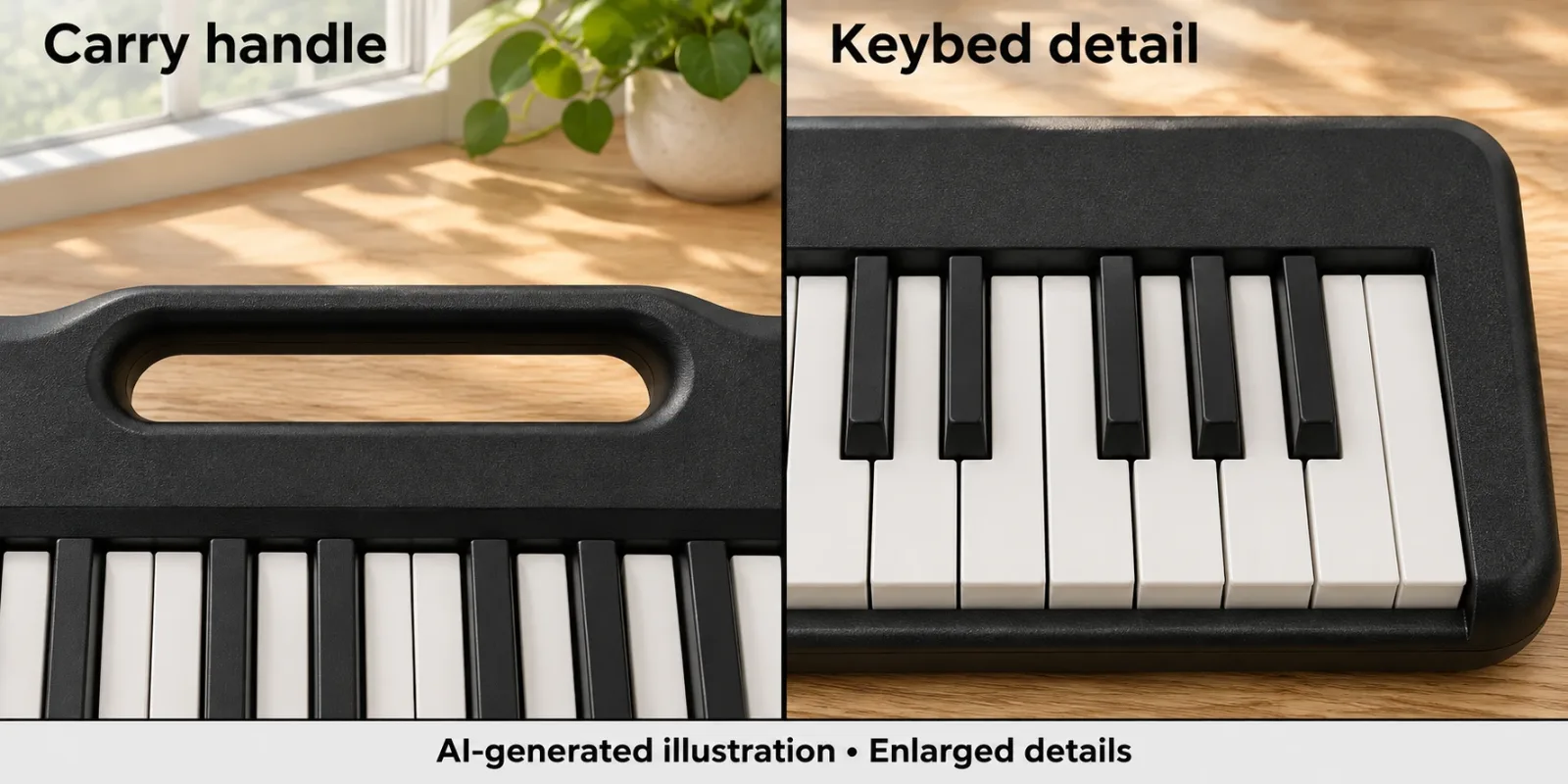
Its size is manageable for a portable setup. The official body dimensions are 930 × 256 × 73 mm without the music stand, and listed weight is about 3.3 kg. Its carrying handle is a practical feature when moving it between a shelf and a table. Measure the intended desk rather than assuming “portable” means it fits a small laptop surface.
It has ordinary private-practice and connection options. The documentation identifies a headphones/output connection, audio input, pedal jack and micro-B USB port. Decide which of those you will actually use. A sustain pedal, headphones and the right connection cable are separate buying checks, not evidence of touch response.
The selected Amazon listing includes a power supply and music rest. Do not transfer that package description to every bundle, used listing or regional offer. Battery operation is another option, but the stated runtime is conditional; it is not our measurement or a promise for every battery and playing style.
Where does it fall short for a beginner?
Where It Falls Short
Your learning goal may outgrow the keybed first. Someone following lessons that require contrasting soft and loud attacks needs to evaluate touch response early. Buying the CT-S200 because it has many tones does not resolve that mismatch. Discuss the specific model with a teacher if one is choosing exercises for you.
Touch response and weighted action remain separate upgrade questions. The CT-S300’s official two-level response is relevant, but it should not be presented as proof of acoustic-piano resistance. If a teacher requests an 88-key weighted instrument, compare that category directly instead of assuming a sensitivity feature settles everything.
The small controls require an interaction choice. The CT-S200 uses a display and dial rather than a large control surface for every function. That can suit a compact instrument, but a buyer who wants immediate dedicated access to many sounds should examine the panel and manual first. We have not timed menu navigation or judged button feel.
What do owners say about the missing feature?
The comments below describe individual preferences and earlier purchases, not a consensus about every beginner. Their dates are taken from the public comment timestamps; neither identifies our current seller’s specific unit.
- Enjoyment beyond piano dynamics. On October 24, 2025, Aggravating-Hold9116 said they owned a CT-S200 and particularly enjoyed importing MIDI song files for practice and its groovebox-style mode. That is a useful example of a satisfied owner whose priorities extended beyond acoustic-piano imitation. We did not test their app setup. Owner’s comment.
- A reason to replace the keyboard. On June 1, 2023, labaroobaroo said they bought a CTS200, disliked the lack of touch sensitivity and promptly moved to a model such as the CTS300. This is a clear account of a feature mismatch, not a claim that the CT-S200 was defective. Owner’s comment.
These experiences can coexist. A sound-and-rhythm hobbyist and a student focused on dynamic piano playing can reasonably value the same keyboard differently. Neither comment supplies controlled evidence about durability, latency, loudness or sound quality.
Who should buy it, and who should skip it?
Consider it for a portable instrument where sounds, accompaniments and uncomplicated standalone use matter more than velocity-sensitive playing. It can also suit a gift when the recipient understands the limitation and wants this particular format.
Skip it if the purchase is supposed to solve a current frustration with non-sensitive keys. Also pause if “piano-like” means weighted action, a full piano range or a teacher’s specific equipment requirement. Resolve those needs with the exact specifications before choosing a color or an accessory bundle.
How we researched this guide
We matched the selected Amazon new offer to Casio’s model documentation, its CT-S200/CT-S300 comparison brochure, the CT-S200 user guide and the CT-S300 feature page. We then read dated public owner comments and inspected Google’s natural text results for the touch-sensitive-keys question. We did not conduct playing, key-force, MIDI-latency, speaker or battery testing.
Our conclusion is a suitability judgment: buy the features you need in the physical instrument. An impressive tone count, app support or a high customer rating cannot replace a missing feature that matters to your own use.
Sources
- Casio CT-S200 official model information and dimensions, with regional package details kept separate from the selected US offer.
- Casio CT-S200 user guide.
- Casio comparison brochure: CT-S200, CT-S300 and LK-S250.
- Casio CT-S300 US specifications.
- Selected CT-S200BK US Amazon new offer, checked November 15, 2026. Individual owner sources are linked beside their summaries.
FAQ
Does the Casio CT-S200 have touch-sensitive keys?
No. Casio’s comparison brochure identifies touch-responsive keys as an addition on the CT-S300. The CT-S200 should not be purchased expecting strike-sensitive playing dynamics.
Are full-size keys the same as weighted keys?
No. Full-size refers to the key format, weighted action concerns physical resistance, and touch response concerns how the instrument responds to your strikes. These are separate purchasing checks.
Can MIDI Out Velocity add touch response?
The CT-S200 guide provides a setting for outgoing MIDI note velocity. Setting an output value is different from adding key sensors that track changing strikes. We did not test a software workaround.
Does the CT-S300 provide touch response?
Yes. Casio’s current US CT-S300 specifications list two sensitivity levels and an off option. This does not establish that it has a weighted piano action; its current Amazon offer was not independently confirmed for this guide.
What comes with the selected CT-S200BK listing?
The US listing checked November 15, 2026 includes a power supply and music rest. Do not assume a stand, bench, sustain pedal or headphones are included in this particular offer; other bundles have different contents.