Coleman Triton Low Simmer: What Buyers Should Know
Quick Verdict
The standard Triton offers two adjustable burners, but low-flame reports vary. Check version, ignition, size and cooking fit before buying.
Buying Guide Notes · First published:
Compiled from public sources · Written using published specs and user feedback.
As an Amazon Associate I earn from qualifying purchases.
Pros
- + Two independent burner controls
- + Removable grate and side wind guards
- + Straightforward standard model without an electronic ignitor
Cons
- - Low-simmer owner experiences vary
- - Fuel and lighting source require planning
- - Outdoor-only and too heavy for ultralight hiking
Sources and verification status
Verification status: compiled from public sources
Data updated:
The Coleman Triton has independently adjustable burners and manufacturer-claimed improvements to low-heat control, but owner experiences with simmering are mixed. Buy it for straightforward two-burner outdoor cooking if you can accept some uncertainty at the lowest settings; do not treat its 22,000-BTU headline as proof that it will gently simmer every sauce.
Compiled from public sources, checked November 13, 2026. We have not cooked on this stove or measured its flame stability. AI-generated illustrations show an unlit, disconnected stove; they are not operating instructions or test results.
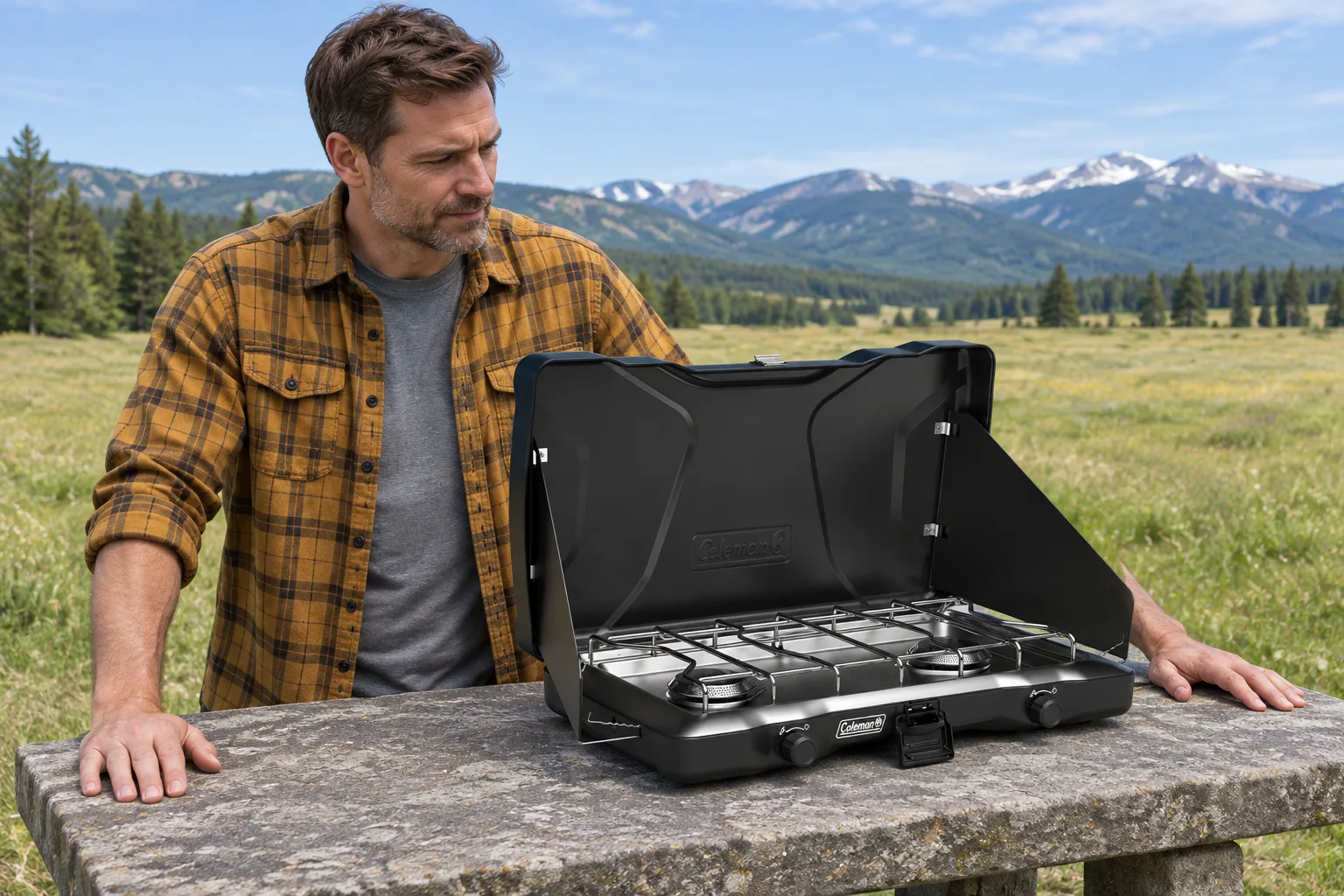
AI-generated illustration: a camper beside an unlit Coleman Triton at approximate manufacturer scale, with both hands resting separately on the table.
Quick verdict: who should buy the standard Triton?
The plain Coleman Triton, ASIN B09HN1C1YJ, is a candidate for car campers who want two adjustable propane burners without a built-in push-button ignitor. At our check, Amazon.com showed a new $129.99 offer sold and shipped by Amazon.com, with 4.7 stars from 3,747 ratings. These are listing observations, not our performance score, and offers can change.
The strongest reason to choose it is a simple cooking layout: separate controls, side wind guards and a removable grate. The reason to hesitate is equally specific: if low, steady heat matters more than boiling or frying, the available owner accounts do not establish consistent performance across current units. A good return policy is more useful than an unsupported promise that a valve adjustment will fix everything.
What do the specifications actually tell you?
| Choice or feature | Price at our check | Key specifications | Best for |
|---|---|---|---|
| Standard Triton, B09HN1C1YJ | $129.99 new Amazon offer | 22,000 BTU total; two independent controls; match lighting | Campers comfortable carrying an ignition source |
| The same stove on Coleman's site | $119.99 displayed, out of stock | Official SKU 2157352; model 5461 | Checking manufacturer specifications, not an available brand-direct offer |
| A different stove chosen for gentle cooking | Not price-verified here | Compare documented burner range, support and return terms | Buyers whose main task is delicate sauces or extended simmering |
Coleman's current standard Triton page gives an outside size of 23 × 13.75 × 5.75 inches and weight of 10.55 pounds. Use these as storage specifications, not the space required around an open, operating stove. It is a car-camping appliance rather than an ultralight backpacking burner.
The brand specifies space for a 12-inch and a 10-inch pan. That is useful planning information, but pan handles, skillet shape and your actual cooking arrangement still matter. Two large pans can be less comfortable than the bare diameter figures suggest. We did not check fit with cookware in person.
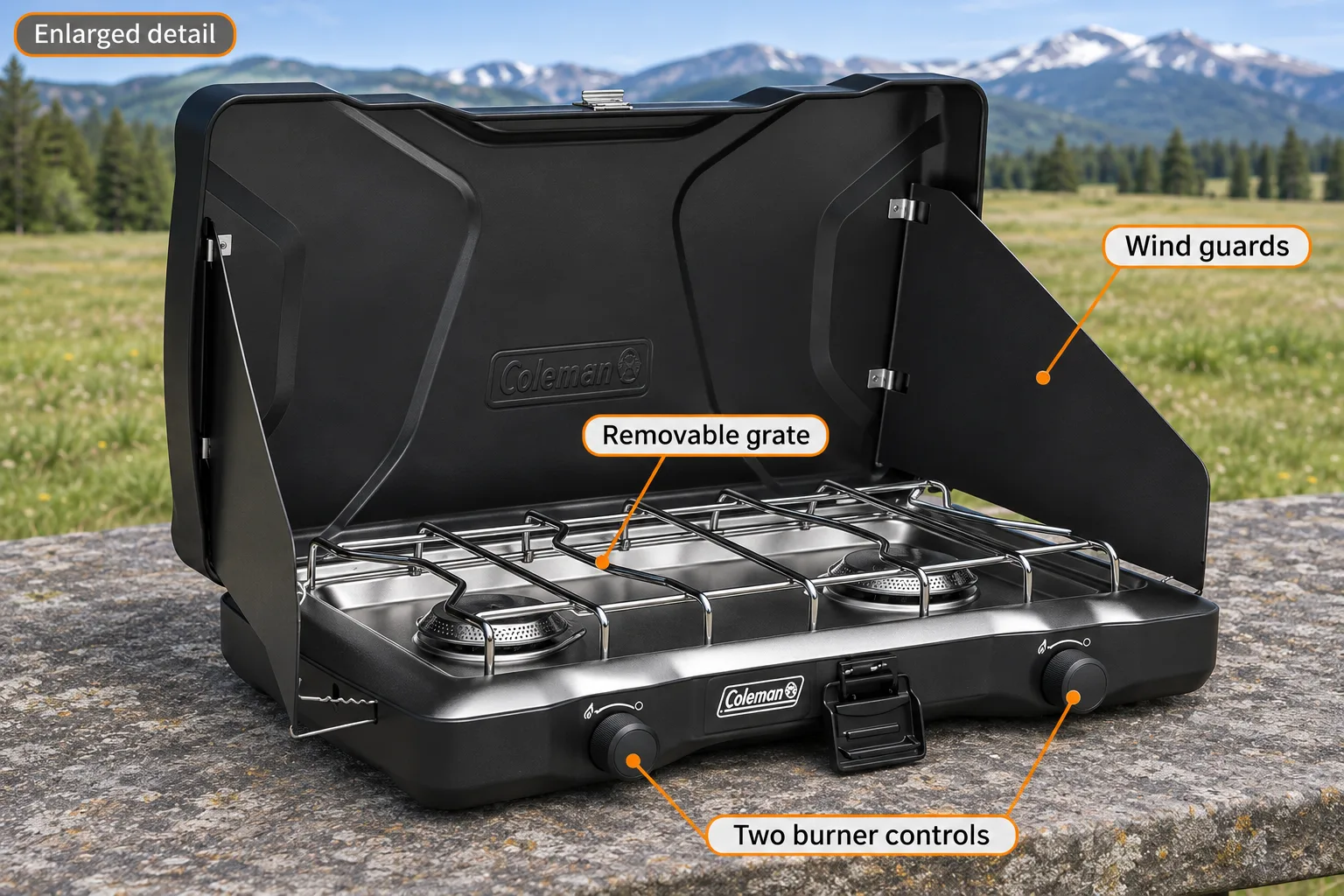
AI-generated illustration: enlarged unlit Triton detail with orange labels for two burner controls, removable grate and wind guards.
Does 22,000 BTU mean it simmers well?
No. Heat output and low-end control answer different questions. The 22,000-BTU figure is total output, not the output of each burner and not a minimum setting. It says little on its own about how smoothly the flame changes near the low end of the knob's travel.
Coleman describes improved knob rotation for more precise temperature and simmering control. That is a relevant manufacturer claim, but it does not provide a measured minimum output, an independently verified flame-stability curve or a guarantee for every pan. We found no basis to turn that claim into a promise of restaurant-style sauce control.
The two independent controls are still useful. You can cook on one burner while using the other for a separate task. Wind guards can help shelter the cooking area, although outdoor wind remains a variable. Neither feature removes the need to judge the actual flame and food during ordinary use according to the manual.
What owners say about low heat
- A favorable report after a trip. In a July 9, 2024 discussion comparing the standard and push-button versions, the poster linked the standard stove's exact Amazon ASIN and chose the less expensive non-ignitor option. On July 28, 2024, B_Huij reported that it simmered well during several days of camping. That is a useful individual experience, not a measured test or assurance about every manufacturing revision.
- An older Triton with the opposite experience. On May 27, 2019, reddilada described a Triton that was essentially off or very hot and failed after about a year. The commenter allowed that it might have been a bad unit and preferred a Camp Chef replacement. The precise current SKU was not established; this older account cannot demonstrate the failure rate or flame behavior of today's ASIN.
These reports explain the buying concern without establishing a consensus. The newer positive account is closer to the selected listing, while the older complaint is worth preserving with its age and model limitation. We would not average them into a reliability score or call either person wrong.
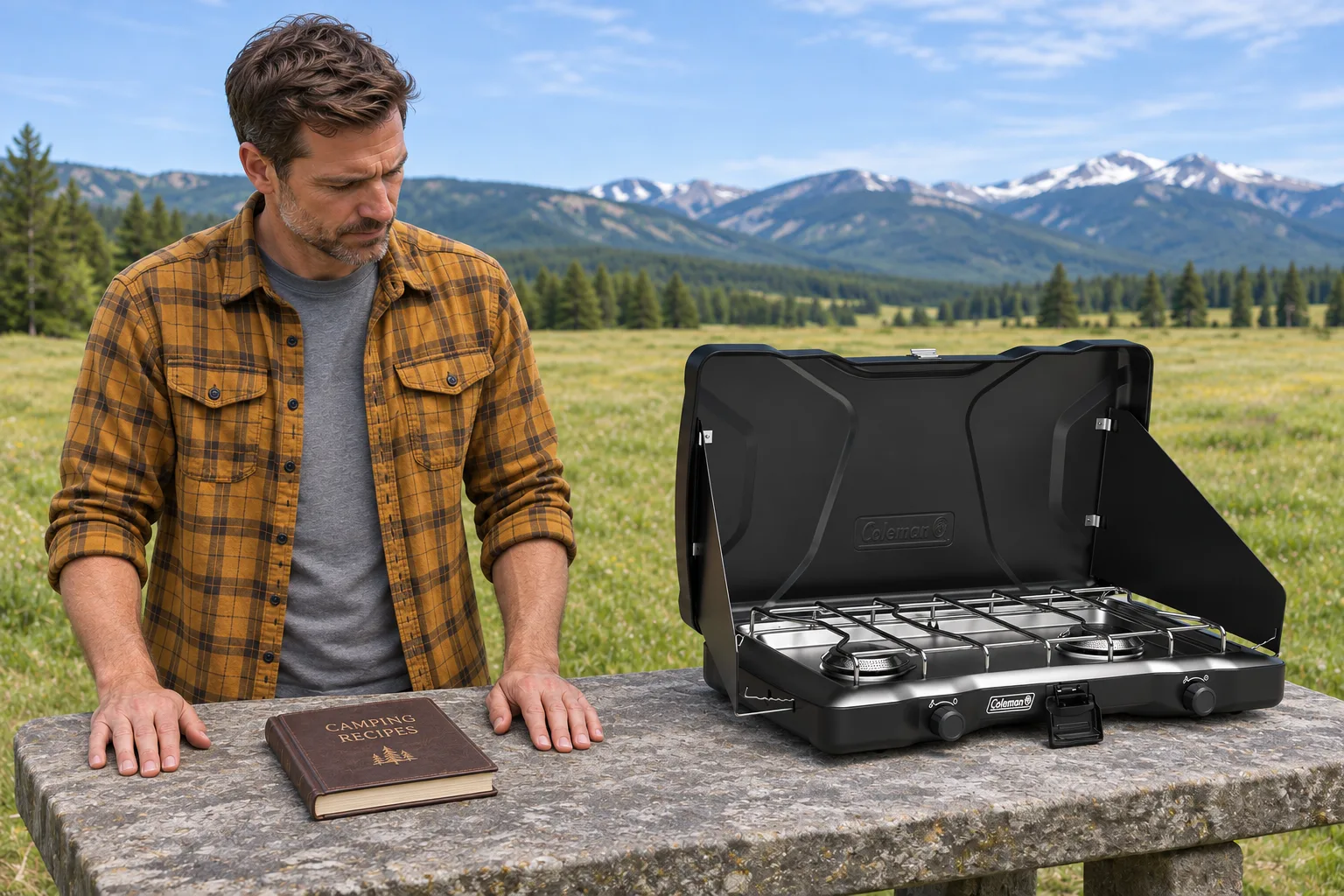
AI-generated illustration: the same camper planning meals beside an unlit Triton; no fuel connected and no performance test.
Which version has push-button ignition?
The standard stove selected here does not have the Triton+ push-button feature. Coleman lists the standard as SKU 2157352, model 5461. Its product specifications and linked 5461-series manual describe match/flame ignition. Do not assume a missing button is a defect or that an Amazon comparison card for a different version describes your order.
The distinction matters for gifts. Someone accustomed to a household gas range may expect ignition built into the control. Confirm that expectation before choosing the standard version. The convenience of a push-button model is a separate purchase decision; it would not itself prove better low-flame control.
We have not verified a current Triton+ purchase offer for this article, so we are not presenting it as a priced alternative. Matching the exact standard ASIN avoids mixing specifications from similarly named models.
What if it will not hold the low flame you need?
If a newly purchased stove behaves poorly, use the manufacturer's troubleshooting and support route and the seller's applicable return process. We are not recommending valve disassembly, regulator modifications or home lubrication based on forum advice. Those suggestions are not evidence that a new stove will meet your cooking needs safely.
Before purchase, decide what “simmer” means for your meals. Reheating a robust soup is a different requirement from keeping a small dairy sauce barely bubbling. A stove can satisfy the first task and frustrate the second. If delicate cooking dominates your trips, prioritize a documented low-heat design and reliable support, even if a different stove offers a less impressive maximum-output number.
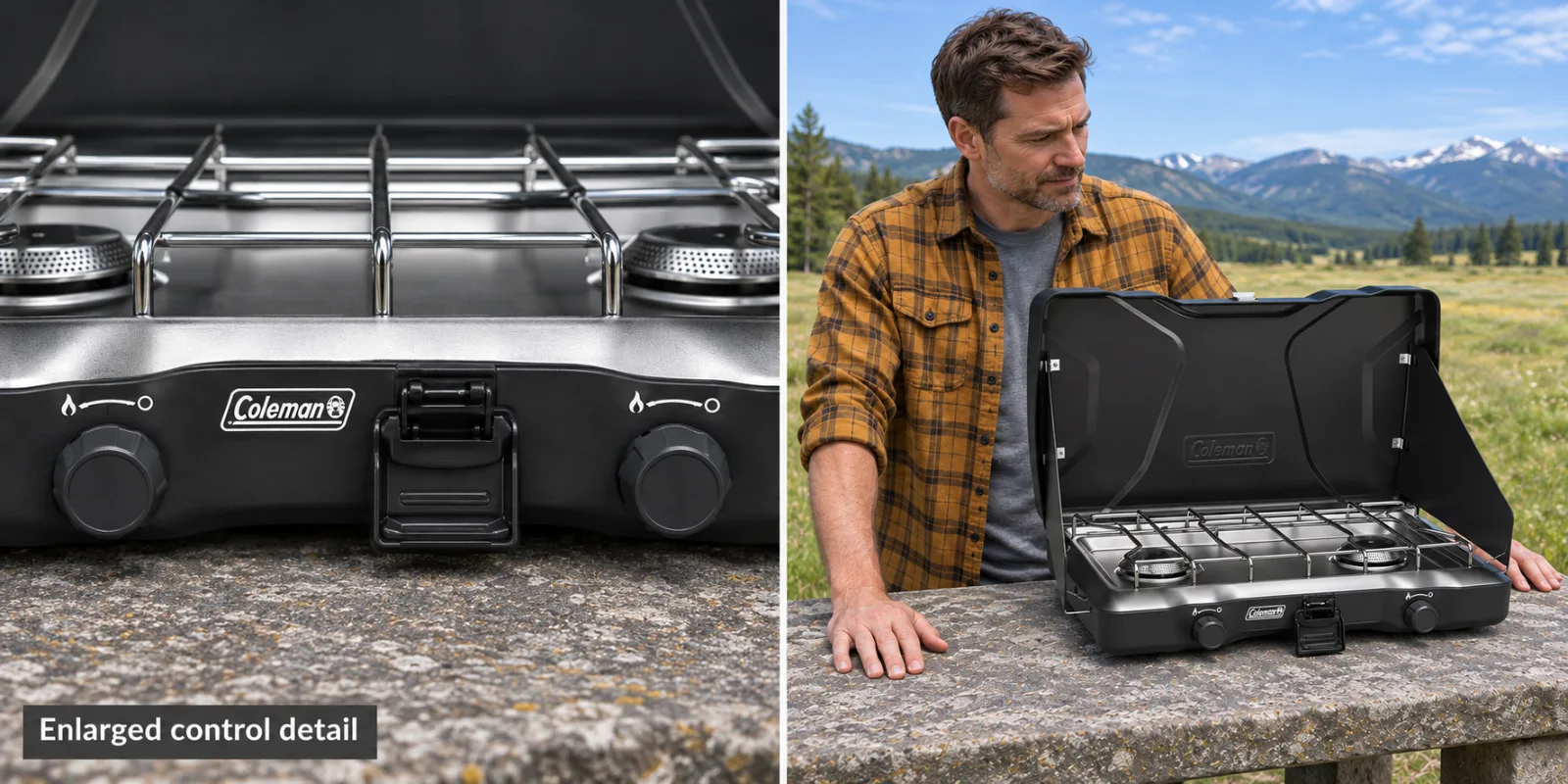
AI-generated illustration: two panels show enlarged control detail and whole-stove placement; not operating instructions.
What else should you budget and plan for?
Coleman specifies a 16-ounce propane cylinder sold separately, with up to one hour of runtime on high under its stated conditions. Actual consumption depends on settings and use. The listed runtime is not a promise that one cylinder will cover an entire weekend's meals.
The removable chrome-plated grate is a practical cleaning feature. Allow everything to cool and follow the manual rather than treating the whole appliance as dishwasher-safe. Plan storage for the stove, fuel and an appropriate lighting source; none of the illustrations establishes what accessories are in the retail box.
The official 5461-series manual is explicit that the stove is for outdoor use only. Do not use it inside a house, camper, tent or vehicle. Its combustion and clearance requirements still apply during rain or cold weather. A garage or enclosed shelter is not a workaround for those instructions.
Who should skip it?
Skip the standard Triton if you need indoor backup cooking, built-in push-button ignition or a lightweight hiking setup. Also pause if you would be disappointed by any uncertainty about very gentle heat. Those are fit issues, not reasons to assume every owner has a faulty stove.
For general car-camping breakfasts and simple meals, it remains a reasonable candidate with clearly separated burners and a conventional layout. For gifting, check the recipient's fuel preference, cookware and storage space first. A stove that suits their existing routine is more valuable than a speculative upgrade in maximum power.
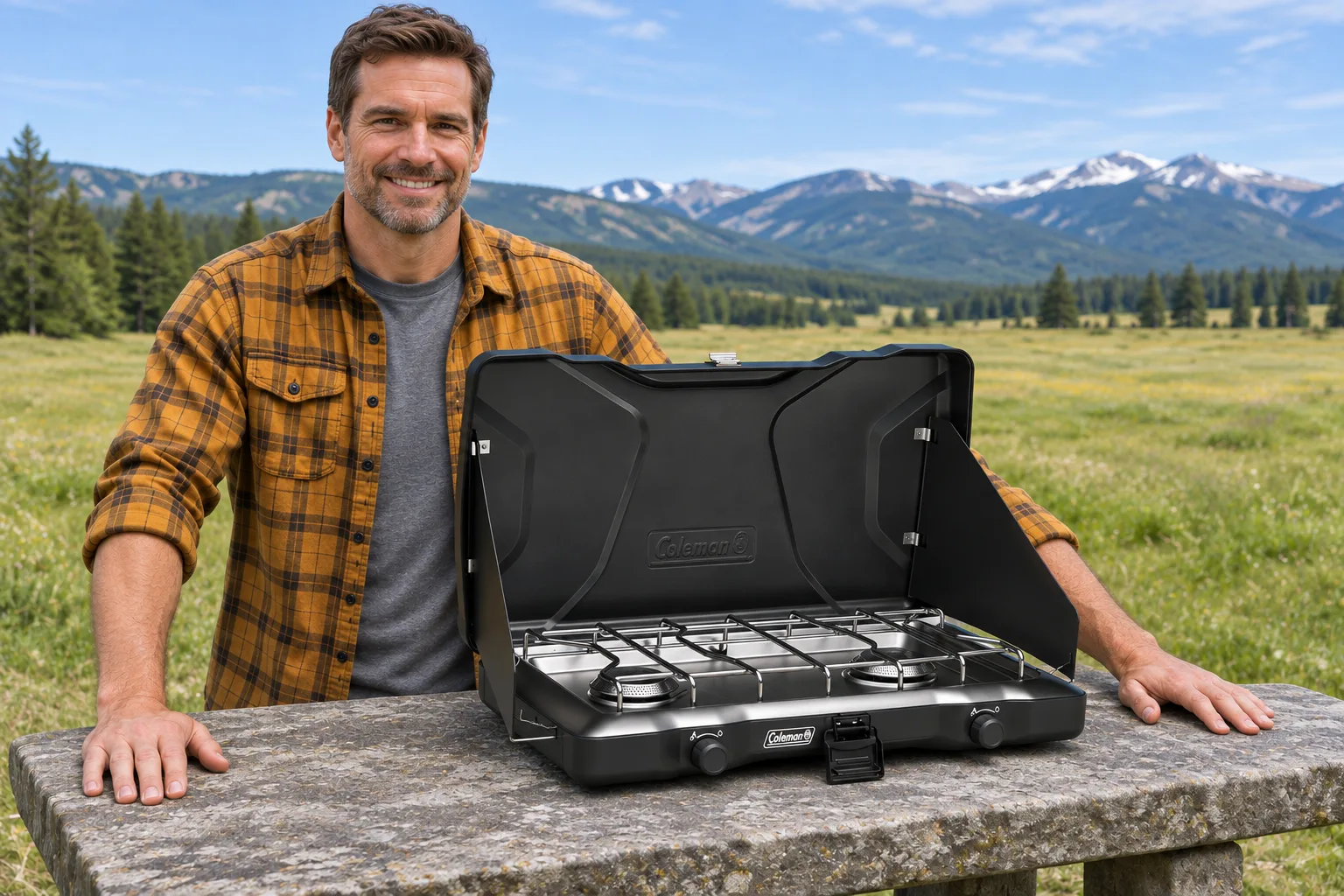
AI-generated illustration: the same camper and unlit Triton at approximate manufacturer scale, with separate connected arms and hands.
How we researched this
We checked the precise Amazon listing and new offer, Coleman's standard Triton product page and its linked 5461-series manual. We also read both dated Reddit experiences and retained the important age and model differences. Our recommendation weighs documented controls, ignition, size and cooking fit; it does not rely on personal cooking, leak, wind or durability testing.
The practical conclusion is conditional: choose the standard Triton for its basic two-burner arrangement, and treat low simmer as something the evidence supports for some owners rather than a guaranteed result. Consult the current listing for the offer and the manufacturer's instructions for operation.
FAQ
Can the Coleman Triton simmer on low?
Coleman claims improved knob rotation for precise temperature and simmering control. One dated owner report was positive, while an older Triton owner reported poor low control. We have not measured minimum output or tested a current unit, so a consistently gentle simmer is not guaranteed.
Does this Triton have push-button ignition?
No. The standard Triton selected here is ASIN B09HN1C1YJ; Coleman lists SKU 2157352 and model 5461 with match/flame ignition. Do not substitute Triton+ ignition specifications.
Is propane included with the stove?
Coleman specifies a 16-ounce propane cylinder sold separately. It lists up to one hour of runtime on high under its conditions, not a guaranteed full weekend of cooking.
How big is the standard Triton?
Coleman lists outside dimensions of 23 × 13.75 × 5.75 inches and a weight of 10.55 pounds. These are storage specifications, not operating clearances around an open stove.
Can I use it indoors during a power outage?
No. The official 5461-series manual says outdoor use only and warns against use in houses, campers, tents and vehicles because of carbon monoxide and other hazards. Follow its clearance and operating instructions.