Escali Arti Hold Function: A Guide for Large Bowls
Quick Verdict
Hold helps you read a captured weight after removing an oversized item. It does not provide an unobstructed live reading while you pour, increase capacity or improve the sensor’s accuracy.
Good for
- Bakers needing occasional capture-and-remove readings
- Buyers who value a slim general kitchen scale
Not for
- Buyers needing a visible live display beneath large bowls
- Users whose primary task is tiny ingredient doses
Buying Guide Notes · First published:
Compiled from public sources · Written using published specs and user feedback.
As an Amazon Associate I earn from qualifying purchases.
Pros
- + Hold retains a captured reading after removal
- + Slim glass platform and touch controls
- + Published model-specific manual and tolerances
Cons
- - Captured reading lasts only five seconds
- - Large bowls can still hide the fixed display
- - Whole-gram display is not a precision-dose guarantee
Sources and verification status
Verification status: compiled from public sources
Data updated:
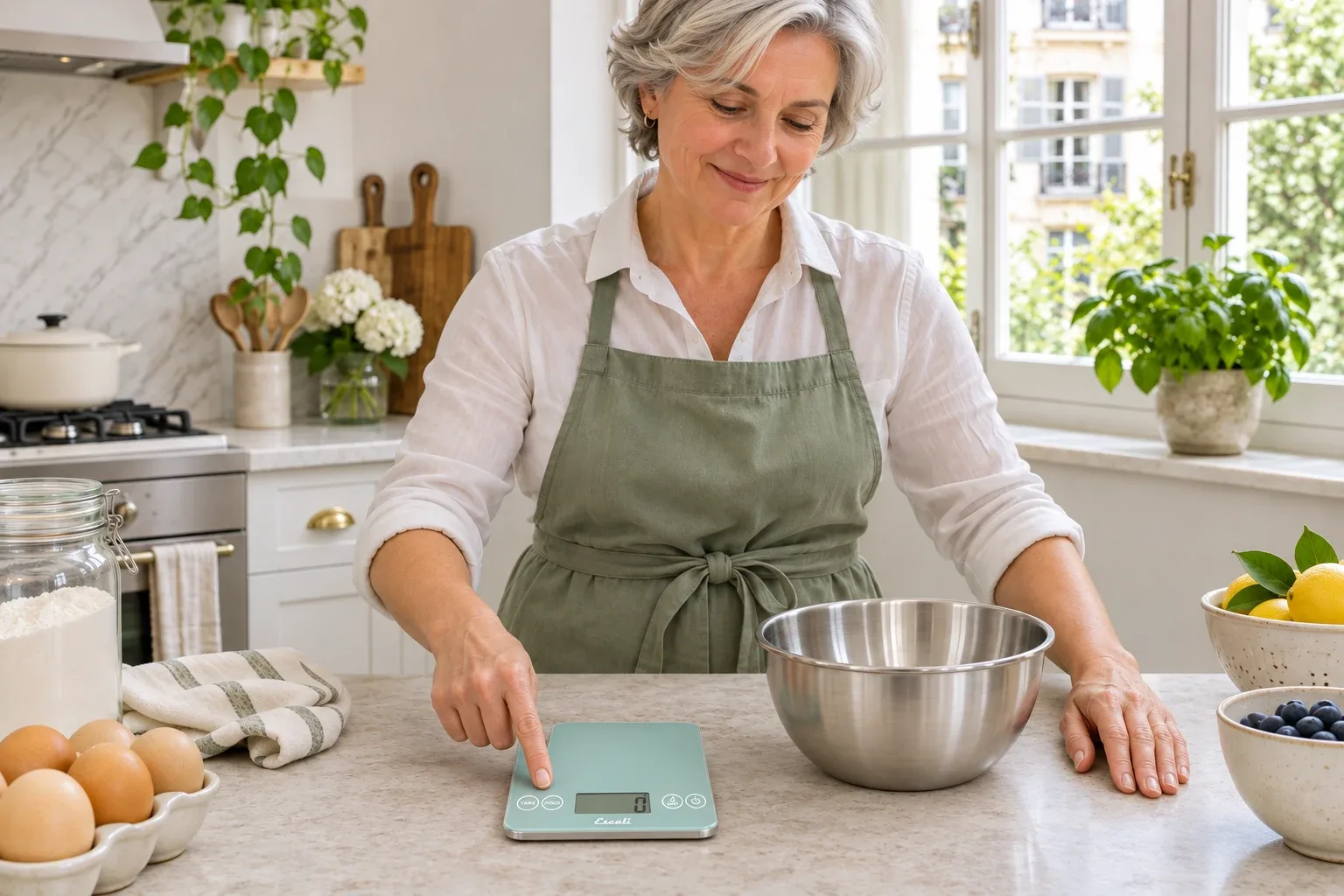
The Escali Arti Hold function lets you weigh a large item, remove it and then read the captured weight for five seconds. Escali's model-157 manual says to press HOLD before placing the item, wait for the stable-weight beep and then remove it. This can help when a bowl hides the display, but it does not provide a continuously visible reading while you add ingredients.
Checked November 14, 2026. This guide is compiled from public sources, not a weighing test. The Classic Teal Arti, ASIN B0CXRZLMR6, showed a new $34.95 offer sold and shipped by Amazon.com, with 4.3 stars and 1,579 listing ratings. It is the 15-pound Arti family, not an Arti XL or a finer-resolution laboratory scale. Price, supply and pooled color ratings can change.
AI-generated illustration — Classic Teal 157CT example, with scale proportions corrected before publication.
Is Hold a good solution for a bowl that hides the screen?
It depends on whether you need the final weight or a live view while pouring. Hold is useful when you can place the entire item, allow the scale to settle and lift it away. It is less convenient when your recipe involves gradually adding flour or water and watching the number approach a target.
| Weighing approach | Checked price status | How you read the weight | Best for |
|---|---|---|---|
| Arti 157 in Hold mode | $34.95 for checked Teal offer | Remove the item, then read the captured value for five seconds | A finished item or container obscuring the display |
| Same Arti in ordinary mode | Same scale price | Read the live display while the load remains in place | Bowls that leave the screen visible |
| Scale with a pull-out or remote display | No exact alternative priced here | Display can be positioned away from the bowl | Frequent ingredient-by-ingredient additions under large bowls |
Buying Hold to solve an occasional blocked reading is reasonable. Buying it as though the display physically moves out from under a bowl is a different proposition. If the blocked screen is your daily frustration, compare that workflow before deciding which type of scale to purchase.
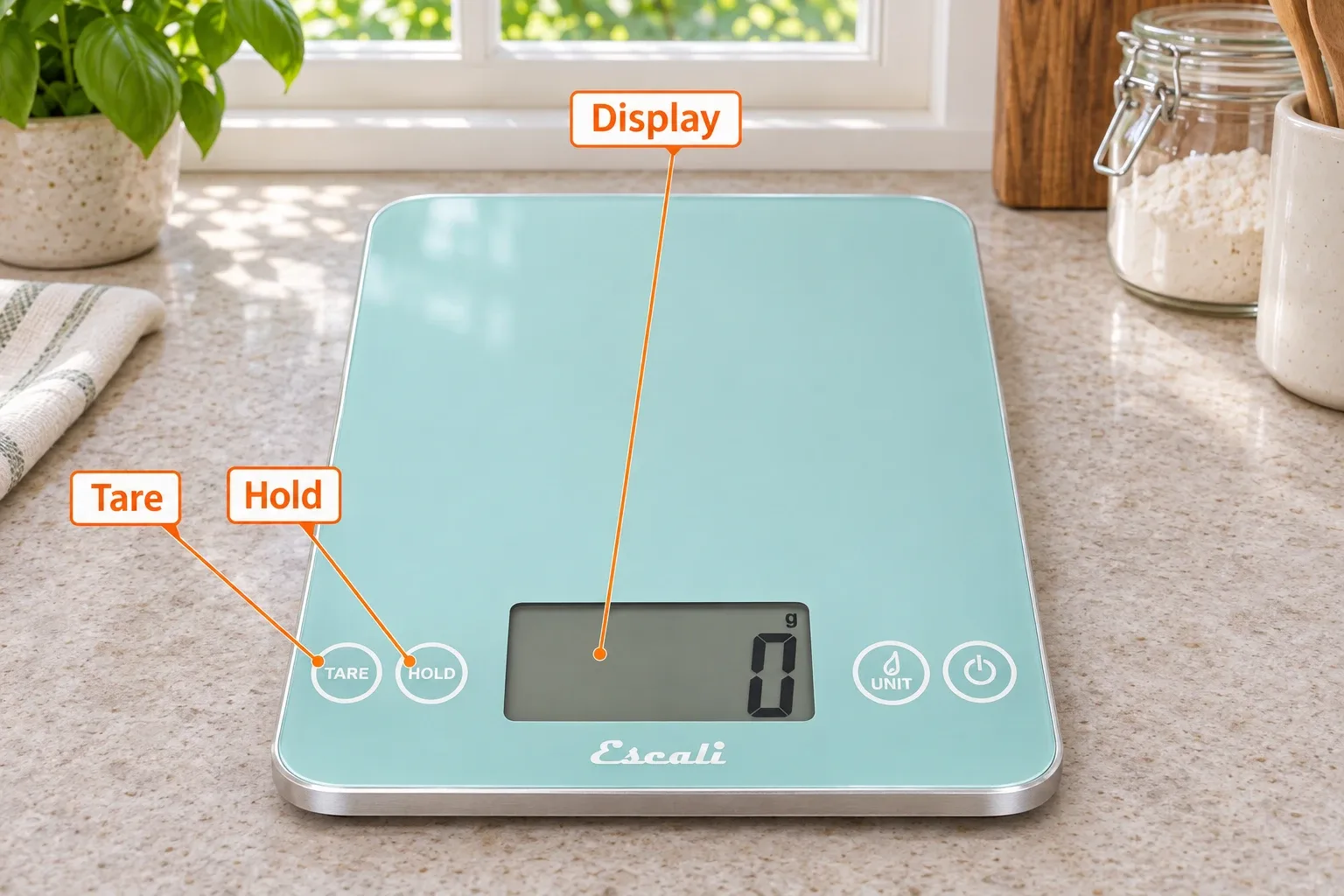
AI-generated illustration — Enlarged controls, not a weighing accuracy test.
How does Escali say to use Hold?
The official Arti 157 manual gives a short sequence: press HOLD, place the item on the scale, wait for the beep indicating a stable weight, then remove the item. The reading remains for five seconds after removal.
Choose the intended units before you start and use a stable, level surface. An unexpected reading is not a reason to press down on the platform or hold the bowl while the scale is measuring it. External support changes the load the scale is actually receiving.
For a buyer, the five-second window is worth noticing. It provides time to read a value, not a permanent record or an app log. If you need to copy several weights into a recipe notebook, decide whether lifting the item and recording each value suits the way you work.
How is Hold different from Tare?
Tare subtracts a container's displayed weight; Hold retains a captured reading. They address separate problems. A zero display after taring a bowl does not mean the bowl has become weightless, and it does not increase the platform's maximum load.
The Arti's listed maximum is 7,000 grams or 15 pounds. Plan for the total physical load, including a heavy mixing bowl and its contents. If the scale shows its overload warning, remove the excessive load rather than trying another button sequence to make it weigh more.
For recipes with multiple ingredients, taring between additions can be useful when you can see the screen. If a large bowl hides it, remember that Hold is a capture-and-remove workflow, not an automatic solution for watching each addition. We have not tested a specialized combined Hold-and-Tare shortcut and do not supply one here.
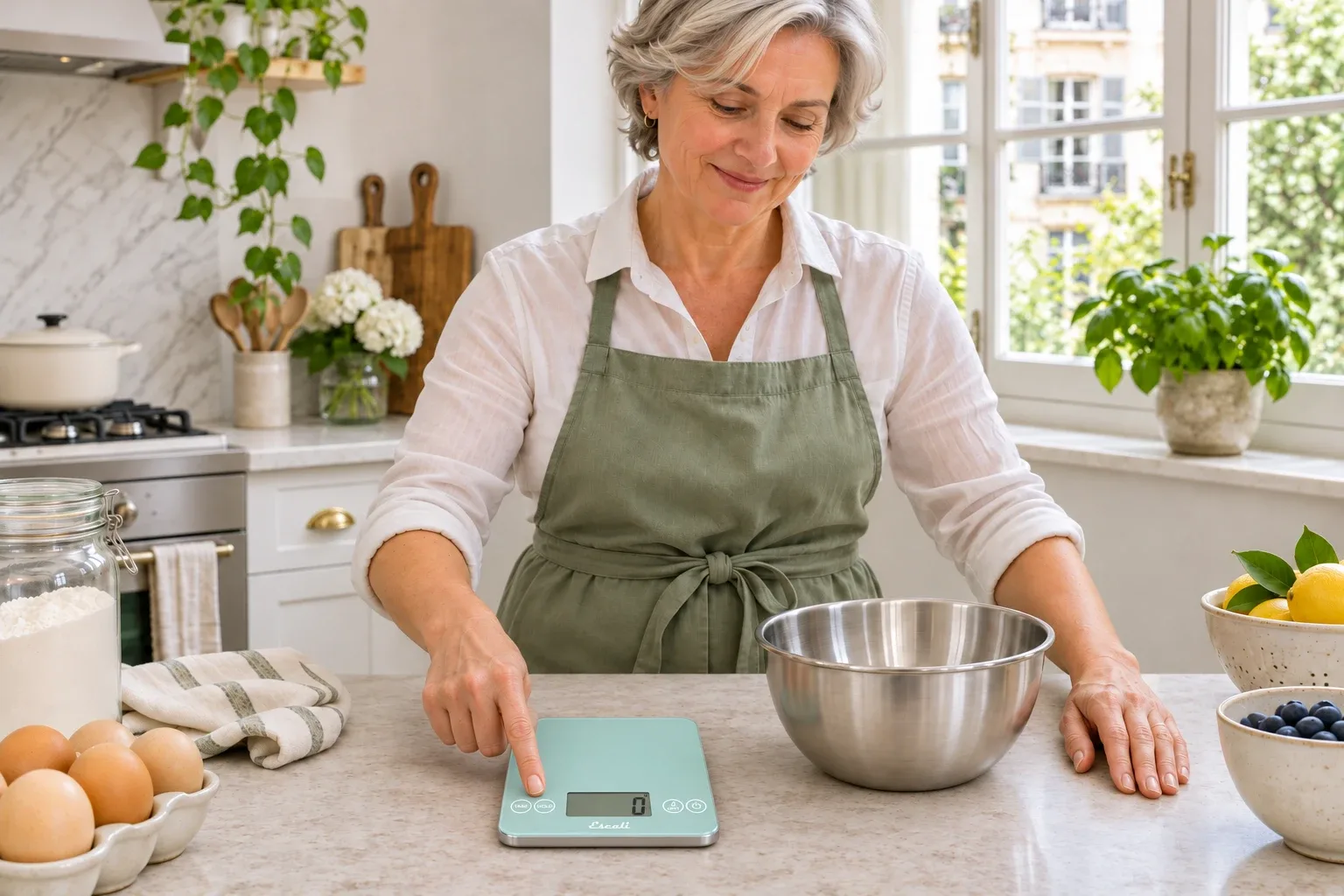
AI-generated illustration — Illustrated control access; not proof of a captured measurement.
Does Hold make the Arti more accurate?
No. Holding a number on screen is a display function, not an improvement to the sensor or a calibration certificate. The Arti displays whole-gram increments, which should not be confused with guaranteed one-gram accuracy for every load.
Escali's current model-157 troubleshooting page lists tolerances of ±2g from 2–1,000g, ±5g from 1,001–3,000g and ±10g from 3,001–7,000g. That distinction matters when selecting a scale for a few grams of yeast or another small dose.
If tiny quantities are central to your recipes, choose an instrument suitable for that range rather than interpreting more display digits as proof of accuracy. A separate precision scale may be a better complement to a household kitchen scale. No particular alternative model or current offer has been verified for this guide.
What stands out about the physical design?
The checked listing describes a smooth glass platform with touch controls and a 9 by 6.5 by 0.75-inch footprint. That slim shape can be appealing in a crowded kitchen, especially if you want a scale that can be put away between uses.
The controls remain fixed at the front. That is precisely why a large mixing bowl can still obstruct the view even though Hold is available. The body dimensions are not a promise that every bowl with a wider rim can be placed securely or that its bottom will clear every control.
What stands out: Hold offers a practical way to read an otherwise hidden final weight without adding a pull-out display assembly. Where it falls short: the extra lifting step may interrupt active mixing, and a flat touch-control surface does not give the same tactile feedback as raised mechanical buttons.
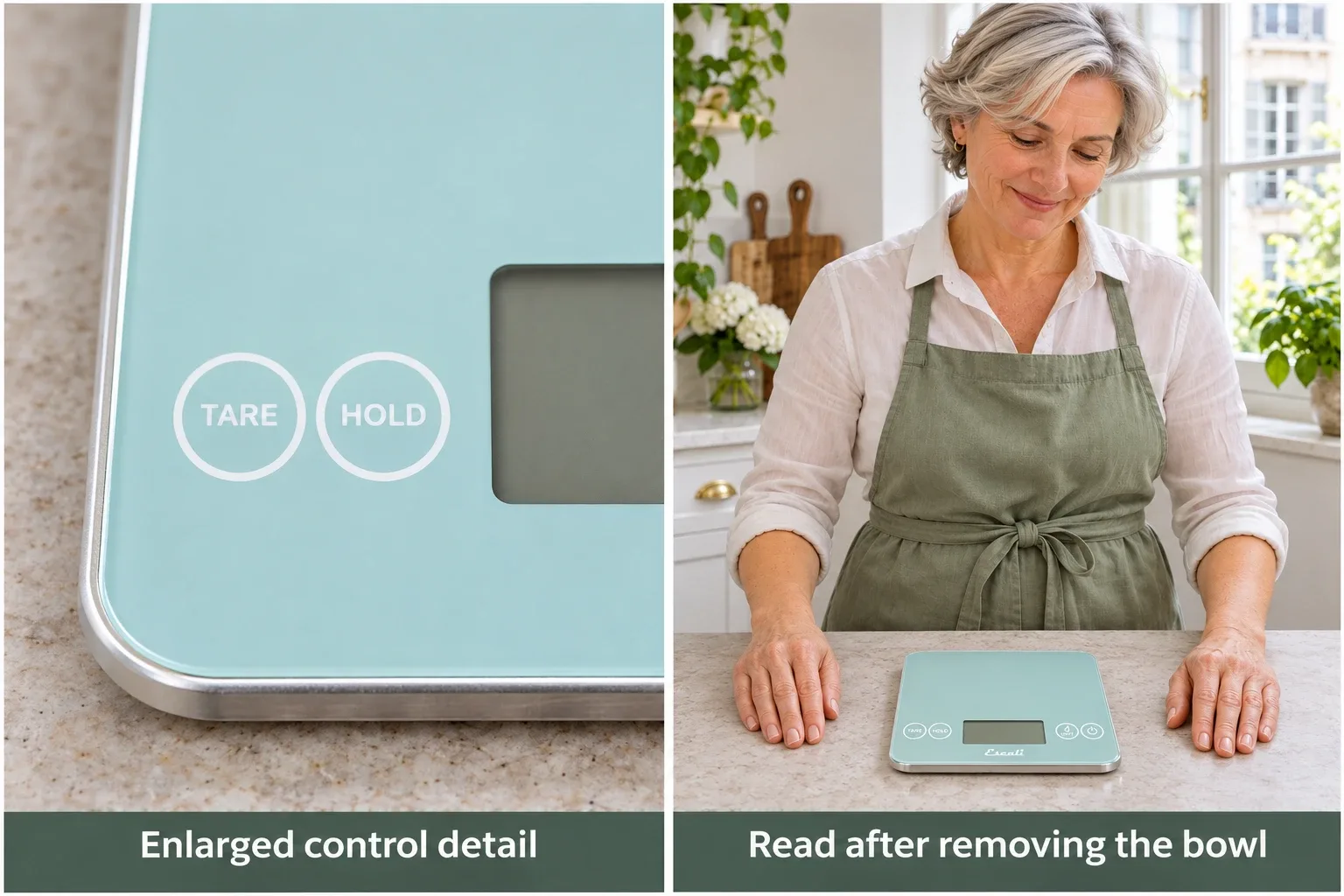
AI-generated illustration — Enlarged controls and capture-and-remove concept; close-up not to scale.
What do owners say about large bowls?
On May 5, 2026, danielfletcher on Reddit described using an Escali Arti. The exact color, purchase date and ASIN were not identified. These are different aspects of one person's account, not several independent reviews or a current Teal durability test.
- Easy storage was the attraction. The owner liked the Arti's easy cleaning and slim shape, and described storing it sideways in a cupboard.
- A large bowl still made viewing awkward. They specifically said a big eight-quart mixing bowl was not ideal for seeing the flat scale's display. They nevertheless preferred avoiding the thickness and mechanism of a pull-out-display option.
- Button-cell power was a compromise. They wished it used AA batteries rather than CR2032 cells, while still considering the trade-off acceptable. The official manual specifies two CR2032 batteries; the owner's battery-life experience is not a guarantee for a new scale.
This is useful feedback because it describes the actual compromise behind the keyword. The presence of Hold does not mean screen visibility stops mattering. We did not find a reliable exact-157CT owner comparison that measures how convenient Hold is against a pull-out display.
Who should buy it, and who should choose another layout?
Consider the Arti if you want a slim general kitchen scale and occasionally weigh something that hides the screen. Hold is most persuasive when the complete object can be set down, captured and removed without disrupting the task.
Skip it if you need an unobstructed live display under a large bowl throughout dough mixing, or if your main task is measuring tiny ingredient quantities. A different display layout or a suitable precision scale addresses those needs more directly.
If you already own an Arti, learning the documented Hold sequence may solve an occasional reading problem without buying another scale. If the weight continuously drifts rather than settling, follow the manufacturer's model-specific troubleshooting guidance instead of assuming Hold will correct the underlying behavior.
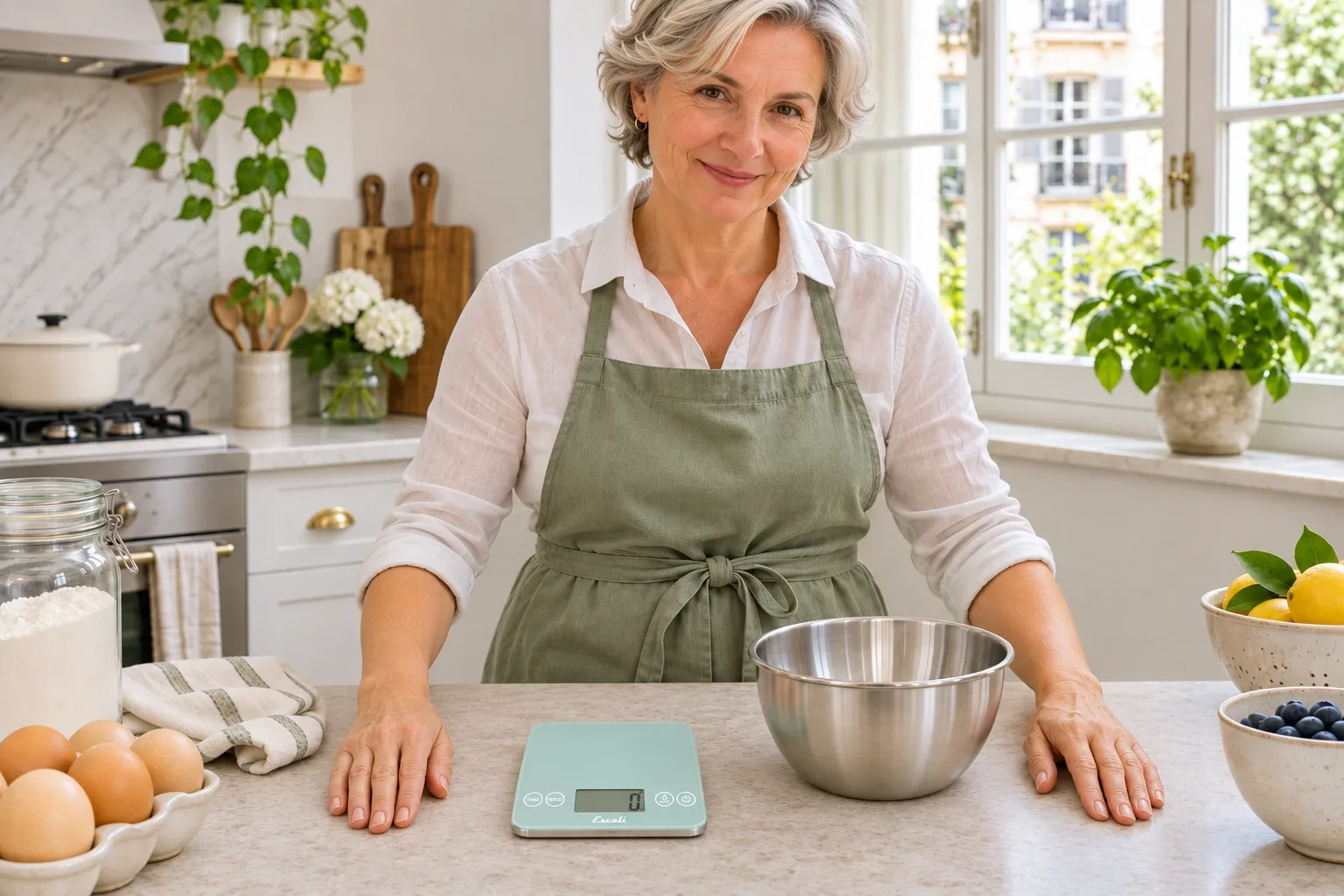
AI-generated illustration — Same 157CT illustration; no calibration test was performed.
How we researched this guide
We checked the current Teal Amazon offer, the manufacturer's Arti 157 manual and troubleshooting guidance, and the dated owner account linked above. The older Primo article on this site covers a different scale and does not establish Arti Hold behavior. We did not weigh calibration masses, compare sensor accuracy or test a combined-button shortcut.
Sources: official Arti manual and download, model-157 troubleshooting, and checked Classic Teal offer.
FAQ
How long does the captured reading remain?
The model 157 manual says the captured reading stays visible for five seconds after the item is removed. It is not a permanent saved-weight log.
Does Hold increase the maximum load?
No. The listed maximum is 7,000g/15lb and includes the physical bowl and contents. Taring a bowl does not remove its physical load.
Does a 1g display mean exact 1g accuracy?
No. Resolution and accuracy differ. Escali publishes load-dependent tolerances; Hold does not improve sensor accuracy or make this a laboratory scale.
Can I rinse the glass scale in the sink?
No. The official manual says the scale is not waterproof. Follow model-specific care instructions rather than treating the glass top as permission to immerse it.
Which batteries does the model157 manual specify?
It specifies two CR2032 lithium button cells. Do not assume the AA batteries used by a different Escali model apply to Arti.