Hatch Restore 3 vs Loftie: Weekday & Weekend Alarms
Quick Verdict
Both support selected repeat days. Hatch integrates gradual sunrise; Loftie prioritizes two-stage sounds and on-clock controls. Both require app setup.
Good for
- Buyers wanting separate workday and weekend schedules
- Hatch buyers who specifically want integrated gradual light
- Loftie buyers who prefer on-clock alarm management
Not for
- Anyone requiring an app-free initial setup
- Expecting Loftie Clock to include the separate Lamp
- Buying solely on popularity despite current low ratings
Buying Guide Notes · First published:
Compiled from public sources · Written using published specs and user feedback.
As an Amazon Associate I earn from qualifying purchases.

Pros
- + Both document selected repeat days
- + Hatch combines light and sound in one device
- + Loftie provides on-clock schedule controls
Cons
- - Both need initial app setup
- - Loftie Clock is not a sunrise lamp
- - Current ratings fall below the preferred 4.2-star threshold
Sources and verification status
Verification status: compiled from public sources
Data updated:
Both Hatch Restore 3 and Loftie Clock can repeat alarms on selected weekdays, so you can keep workday and weekend wake times separate. Choose Restore 3 if an integrated gradual sunrise matters; choose Loftie for its two-stage sound alarm and on-clock scheduling controls. Neither purchase means you can skip initial app setup, and Loftie Clock’s nightlight is not a built-in sunrise lamp.
Checked November 14, 2026. This comparison is compiled from public sources, not our alarm-reliability, sleep or app tests. We verified new US ZIP 10001 offers: Restore 3 Putty B0DLLSCVZW, $169.99, sold by Hatch Baby, Inc. and shipped by Amazon; Loftie Black B09253XYX3, $199.99, sold and shipped by Loftie, Inc. Both were in stock. Amazon showed 4.1 stars/3,440 ratings for Hatch and 3.8 stars/996 ratings for Loftie. These user-requested products fall below our preferred 4.2-star threshold; Loftie also falls below 1,000 ratings.
AI-generated illustration — A fictional woman plans weekday and weekend wake times beside a Restore 3 Putty; no app setup or alarm test is shown.
Which clock solves the weekday-versus-weekend problem?
The useful requirement is a recurring schedule: for example, one alarm on Monday through Friday and another on Saturday and Sunday. That differs from remembering to turn an everyday alarm off each Friday. Both brands document selecting the days on which an alarm repeats, but the way you manage those selections differs.
| Choice | Checked new price | Scheduling and light distinction | Best for | Main drawback |
|---|---|---|---|---|
| Hatch Restore 3 Putty | $169.99 | Selected repeat days in app; integrated gradual sunrise | Buyers who specifically want light before sound | Phone needed for configuration; premium content costs extra |
| Loftie Clock Black | $199.99 | Each alarm has its own selected days; controls on clock and app | Buyers prioritizing two-stage sounds and hardware scheduling | Nightlight does not reproduce a gradual sunrise |
| Loftie Clock plus separate Lamp | Bundle price not checked | Separate Lamp supplies gradual sunrise | Buyers already committed to the Loftie system | Additional hardware and cost; not included in this Clock offer |
| Keep an existing suitable alarm | No new purchase priced | Verify its repeat-day settings first | Buyers who only need weekends excluded | Existing model may lack the schedule or display they want |
The checked Clock costs $30 more than Restore 3 before tax. That is a same-day comparison of two offers, not a historical discount or a claim that either is the least expensive way to schedule an alarm.
Hatch Restore 3: View Current Offers on Amazon →
Loftie Clock: View Current Offers on Amazon →
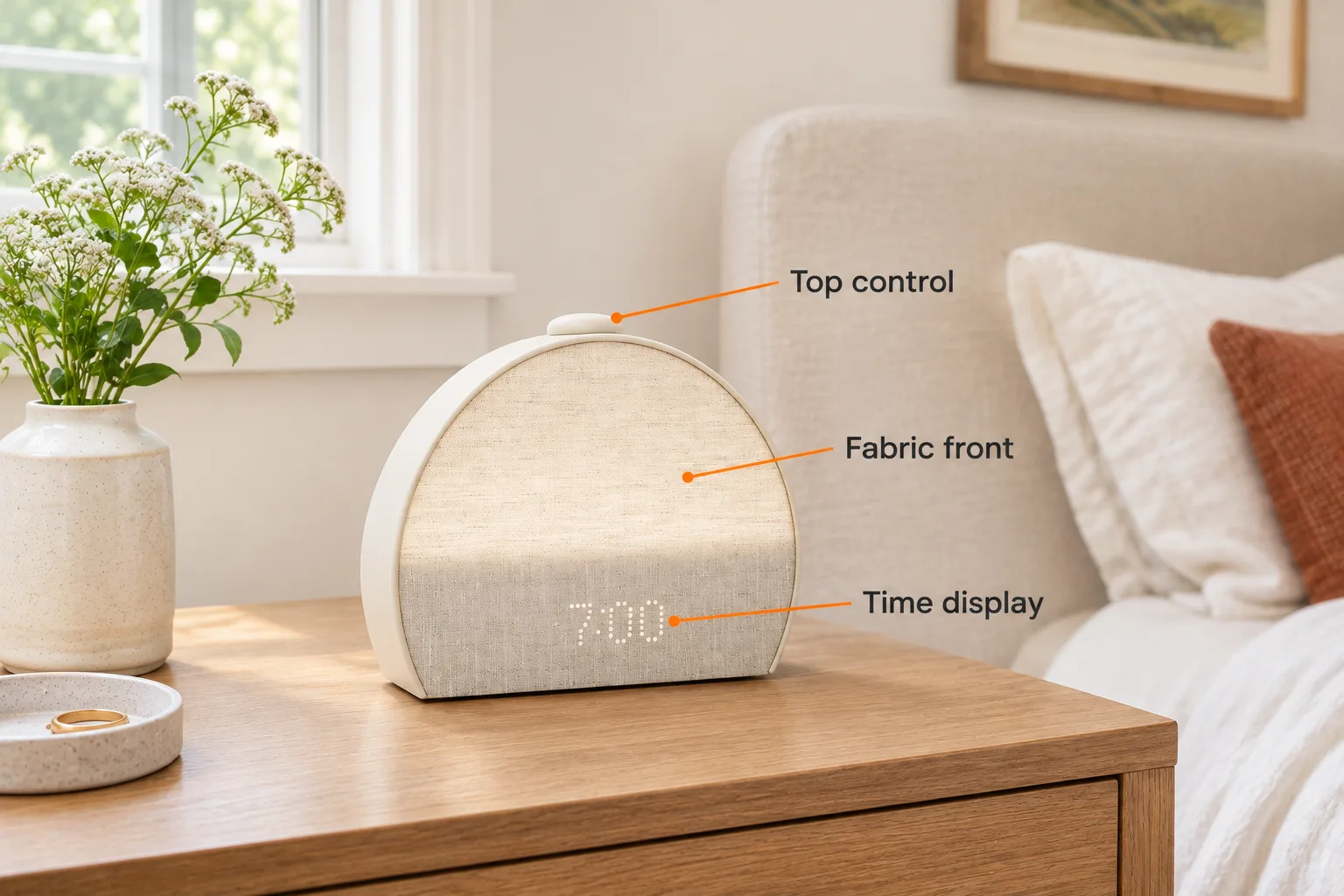
AI-generated illustration — One Restore 3 appearance example with orange labels for the top control, fabric front and time display; not a comparison of two clocks.
How do the selected-day settings differ?
Hatch’s Restore 3 sunrise-alarm guidance describes choosing the alarm time and repeat days in the Hatch Sleep app. Plan the weekday and weekend entries separately rather than assuming a new alarm automatically excludes days off. The published support article was readable in the search index; opening its support destination during this research led to sign-in. We also checked the current product FAQ directly.
Loftie’s current alarm guide says each alarm has its own days. New alarms default to every day, so checking the time alone is insufficient. Its guide describes highlighted days in the app and checked days on the clock. A one-time alarm is a separate choice. Check the next-alarm indicator after changing either schedule.
For a rotating shift pattern, selected weekdays are not the same thing as an automatically repeating multiweek roster. We did not establish that either model reproduces every irregular work calendar. If that is your requirement, get a model-specific answer before buying rather than treating “multiple alarms” as proof.
Can you actually leave your phone outside the bedroom?
You can separate setup from nightly operation. Hatch’s current Restore 3 FAQ says the companion app is required to register and customize the device; after registration, physical controls support phone-free use. That is useful for someone who wants fewer bedtime phone interactions, but it does not make the product an app-free clock.
Loftie’s checked Amazon description likewise requires its app, Bluetooth and 2.4 GHz Wi-Fi for initial setup. It then describes Offline Mode once the clock has the correct time. That is a documented feature, not our test that every connection loss or software revision behaves correctly. Confirm the schedule and time before relying on an offline setup.
If you want no companion app at any stage, skip both for that requirement. A conventional clock with a verified weekday/weekend mode may be a better match. We have not checked a current US offer for a cheaper alternative, so we do not invent a bargain or transfer these models’ features to an unnamed replacement.

AI-generated illustration — The same woman stages a light touch on the top control; this does not demonstrate a scheduled or sounding alarm.
Is Loftie’s light equivalent to Hatch’s sunrise?
No. Restore 3 combines an integrated gradual light sequence with a selected sound. Hatch’s current FAQ describes changing light before the sound plays. Whether that feels pleasant or wakes a particular person is an individual response, not a result we measured.
Loftie’s official alarm guide calls the Clock’s light a nightlight and explicitly says it is not designed as a sunrise light. It can come on with the first alarm tone. The separate Loftie Lamp supplies the gradual sunrise. Neither its price nor a Lamp is included in the $199.99 Clock comparison here.
That distinction matters more than a generic claim that both products “wake with light.” If light gradually brightening before your scheduled wake time is the reason you are spending more than a basic alarm-clock budget, compare the actual sequence and included hardware. Do not buy the Clock expecting the Lamp’s behavior.
What stands out, and what falls short?
Restore 3 puts the light, sound and physical controls in one device. Its quick-start controls page identifies a top control and an alarm toggle. Disabling the device’s alarms is a different action from editing one alarm’s repeat days. Verify the intended schedule after changing controls instead of assuming a physical switch manages only weekends.
Loftie’s two-stage sound sequence and on-clock controls can suit a buyer who dislikes opening an app to manage ordinary alarms. Its guide also states that alarm tones and volume apply across alarms: separate wake times do not necessarily mean separate tones for every schedule. Alarm volume is distinct from sleep-sound volume.
Hatch’s current product FAQ says basic features and core content remain available without Hatch+. Expanded content and experiences belong to the optional paid offering. The selected Loftie listing says its included sounds and alarm features have no subscription fee. Do not assume an old trial description or a different Loftie accessory establishes today’s terms.
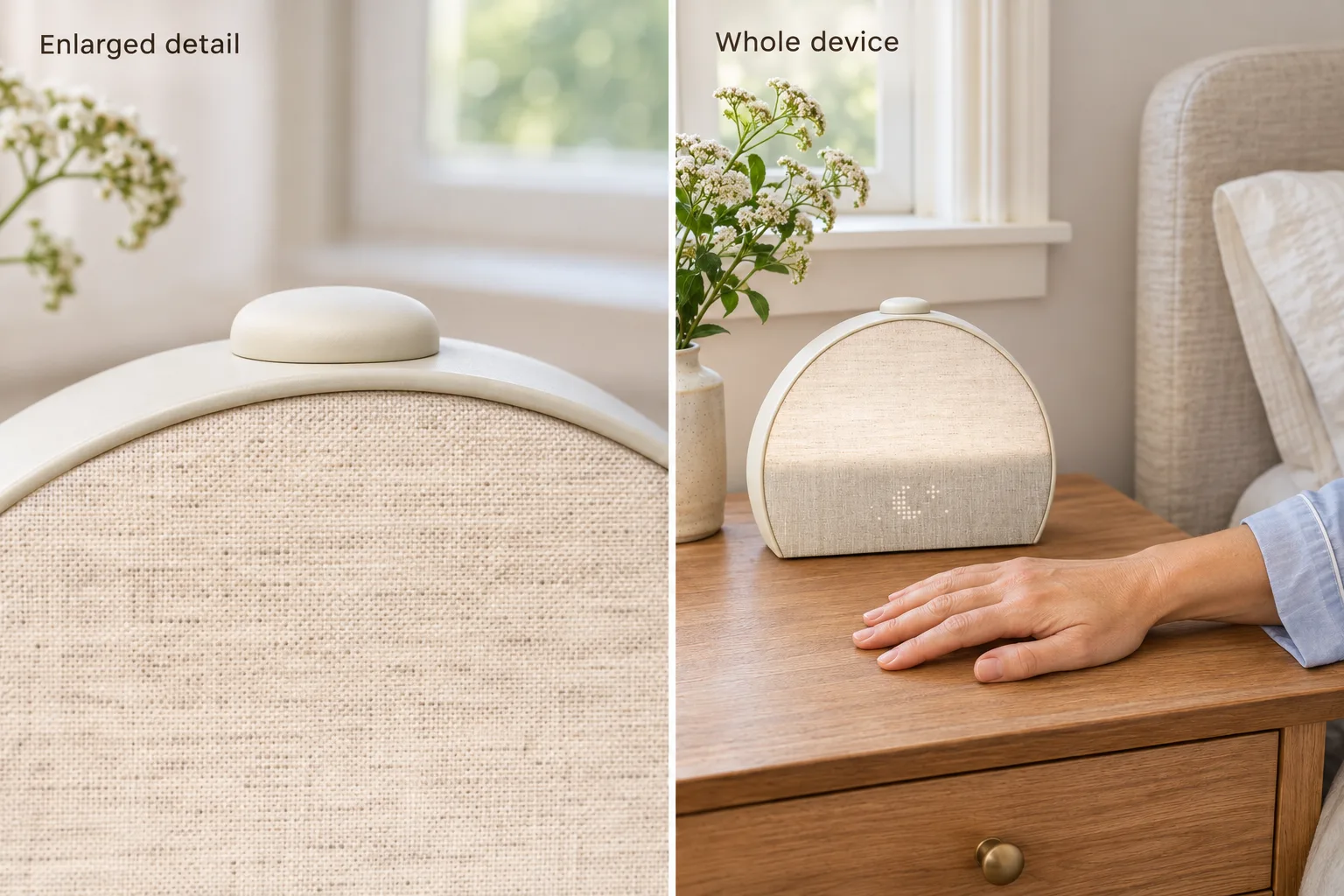
AI-generated illustration — Two panels show an enlarged top-control detail and the whole clock beside a right hand; not an exact dimensional diagram.
What do buyers and owners report?
These accounts cover different purchase dates, secondhand units and software versions. They are useful questions to investigate, not failure-rate data for the exact new offers above.
- The original buyer did not endorse either model. In the November 13, 2026 buying-request discussion, thosecrazygermans wanted an always-readable clock that excluded weekends. Their later reply disliked Hatch’s design/price and expressed concern about Loftie reviews. This was shopping feedback, not ownership or a comparative test.
- A Hatch problem report had a later improvement. Loose_Comfortable_59 reported missed alarms on August 19, 2026, then reported on August 30 that restarting it was followed by a working alarm the next morning. Keep that update with the complaint. A brand-associated account also replied; we do not count that response as independent owner praise or promise a universal repair.
- Loftie experiences conflict. v_pdx wrote on June 17, 2026 that they liked the tones and offline use after learning the buttons on a secondhand clock. In the same thread, thepobv reported app/Wi-Fi frustration on July 23. Those accounts do not establish the cause, frequency or current-firmware outcome of a problem.
Who should choose each, and who should skip them?
Choose Restore 3 when integrated gradual light is the feature you want, app configuration is acceptable and its basic or optional paid content suits your budget. Skip it if the only problem is excluding Saturdays and Sundays and you do not want a connected device.
Choose Loftie Clock when the two-stage sound sequence, included audio and on-clock alarm controls address your routine. Skip it if you require an integrated sunrise lamp or expect separate tones for each alarm. Neither set of reviews supports promising years of failure-free wake-ups.
Before depending on either for an important morning, follow the manufacturer’s setup guidance and check the selected days, next alarm and volume. We did not test power interruptions, daylight-saving changes or alarm audibility, and this comparison cannot certify those outcomes.

AI-generated illustration — The same woman poses beside a Restore 3 with hands separated on a notebook and lap; no sleep benefit or hands-on test is claimed.
How we researched this comparison
We matched the two selected Amazon offers, read current public product FAQs and Loftie’s alarm guide, and compared original dated Reddit accounts including follow-up corrections. We did not sleep beside, operate or test either clock. Five AI-generated illustrations use Restore 3 Putty only, guided by the official quick-start dimensions 7.5×2.75×5.75in; they do not show Loftie or verify a delivered unit’s measurements.
FAQ
Can both clocks use different weekday and weekend alarms?
Both document selected repeat days for alarms. Create or check separate weekday and weekend entries; Loftie says new alarms default to every day. We did not test the schedules ourselves.
Does Loftie Clock include a gradual sunrise light?
No. Its official guide distinguishes the Clock’s nightlight from the separate Loftie Lamp. The Clock light can turn on with the first alarm tone, but it is not a gradual sunrise lamp.
Can I use either without installing an app?
Both checked setups require an app initially. Hatch uses the app for registration and customization; Loftie requires its app, Bluetooth and 2.4 GHz Wi-Fi for setup before documented offline use.
Do the basic alarms require a paid subscription?
Hatch says Restore works with basic features and core content without Hatch+; expanded content is optional. The checked Loftie Clock listing says included alarm and audio features have no subscription fee. Verify current terms for the selected product.
Can every Loftie alarm have a different sound or volume?
Its current alarm guide says tones and alarm volume apply to every alarm on the clock. Separate repeat days and times should not be confused with per-alarm tone customization.