Knipex Cobra 180 vs 250: Which Fits Home Repairs?
Quick Verdict
Choose the 180 when its capacities cover your jobs and compact storage matters. Choose the 250 for the larger specified capacity in a home toolbox. Neither is a smooth-jaw substitute or an insulated electrical tool.
Good for
- Homeowners comparing a compact tool with a larger toolbox pair
- Buyers able to identify their typical pipe or nut sizes
Not for
- Work requiring insulated electrical tools
- Delicate finished surfaces that should not meet serrated jaws
- Anyone expecting a measured torque comparison
Buying Guide Notes · First published:
Compiled from public sources · Written using published specs and user feedback.
As an Amazon Associate I earn from qualifying purchases.

Choose the Knipex Cobra 180 for a compact kit when its specified capacity covers your jobs; choose the 250 when larger pipe and nut sizes are part of your home-toolbox needs. The 250 is 70 mm longer and has larger published capacities, while the 180 is easier to accommodate in a smaller kit. We have not tested their grip or torque, so neither is declared a universal winner.
Offers checked November 12, 2026; the 250 specifications were clarified on November 13, 2026. This comparison is compiled from public sources, including exact-model Amazon listings, Knipex specifications and dated owner discussion. It is a buying decision guide, not a hands-on tool test or repair tutorial.
Which exact Cobra versions are being compared?
The selected tools are 87 01 180, ASIN B000X4PU26, and 87 01 250, ASIN B000X4J2H0. Both use slim red dipped handles. They are not the different comfort-grip versions, and neither listing should be confused with a tool set that adds cutters or a pouch.
The 180 had a new $36.00 offer in stock, shipped by Amazon and sold by Industry Elements, with 4.9 stars and 8,025 ratings. The 250 had a new $39.48 offer in stock, sold and shipped by Amazon.com, with 4.9 stars and 30,228 ratings. These were selected offers for a sample US destination, not the differing prices shown in related-product carousels.
How do the useful specifications compare?
| Exact tool | Checked new price | Published size and capacity | Best for |
|---|---|---|---|
| Cobra 87 01 180 | $36.00 | 180 mm; current page 42 mm pipe / 36 mm nut; 18 positions | A smaller repair kit when the work fits |
| Cobra 87 01 250 | $39.48 | 250 mm; current page 50 mm pipe / 46 mm nut; 25 positions | A home toolbox with larger fittings |
| A smooth-jaw pliers wrench | Not price-checked here | Different jaw design; check its own capacity | Tasks where serrated jaws are unsuitable |
The capacities describe different workpiece shapes. Pipe diameter and nut size are not interchangeable measurements, and neither number guarantees access in a cramped location. The 180 figures above come from its current product page; we do not silently substitute smaller historical catalog figures for that current specification.
View Current Offers on Amazon →
View Current Offers on Amazon →
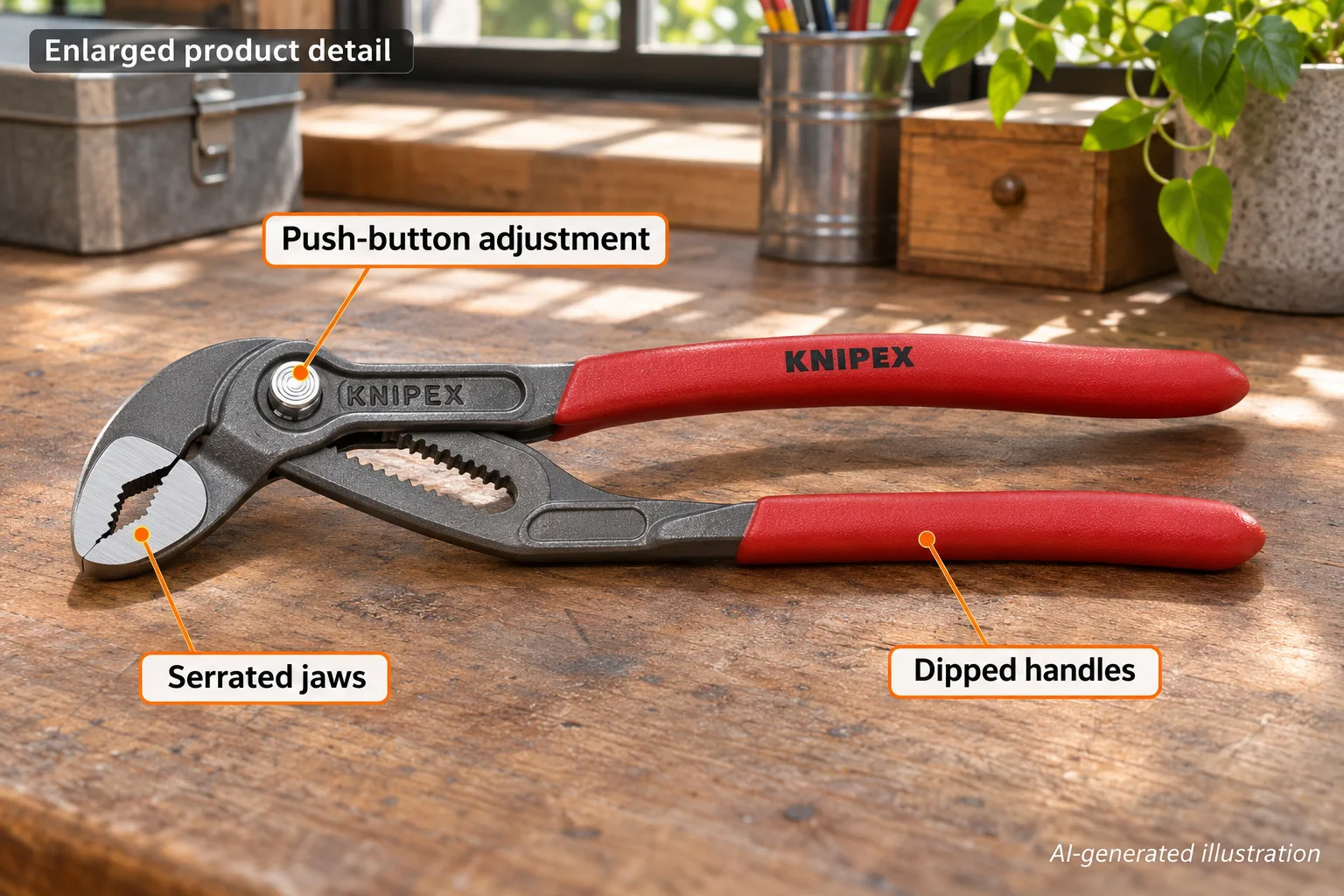
AI-generated illustration — enlarged 180 mm appearance example; it does not depict the 250 mm tool or establish tested gripping performance.
What makes the 180 attractive for a small kit?
The shorter overall length is its clearest advantage for storage. A tool that is 180 mm long asks less of a small pouch than one that is 250 mm long. That is a straightforward dimensional comparison, not evidence that either pair fits every pocket or can be carried comfortably all day.
Knipex’s current 87 01 180 page lists a weight of 170 g and dimensions of 180 × 42 × 14 mm. Together with its specified capacities, that gives buyers something more useful than the vague description “mini.” It is a distinct size choice, rather than just a color variation of the larger tool.
For a home kit, start by listing your ordinary tasks and the space available for the tool. If those tasks remain within the smaller pair’s documented range, compactness can be a sensible reason to choose it. If you repeatedly need a larger size, saving storage space on the initial purchase may simply send you back to the toolbox for another tool.
When does the 250 make more sense?
The 250 is the stronger shortlist choice when larger published capacity is the requirement. Knipex’s current 87 01 250 page confirms its 250 mm length, 25 adjustment positions and the pipe and nut capacities shown above. The listed weight is 335 g, compared with the 180’s 170 g; these are manufacturer specifications, not our measurements.
For a stationary home toolbox, extra length may be less of a storage burden than it is in a compact travel kit. That does not mean the larger tool always reaches a fitting more easily. Working room around the handles and head still matters. Check access as well as the workpiece dimensions before assuming the bigger specification solves the job.
The observed price gap was only $3.48, but a small gap is not a reason to buy the wrong size. Nor does it prove that the 250 is always better value. A tool that is unnecessarily awkward for your usual jobs is not made more appropriate by costing only a little more.

AI-generated illustration — a size-selection planning scene using one 180 mm example, not a repair demonstration.
Do more adjustment positions mean better performance?
Adjustment positions describe the available steps for setting the tool; they are not a grip-strength score. The 180 and 250 do not become directly comparable simply by counting settings, because they also differ in size and intended workpiece range. Treat the number as one part of the fit specification.
Both selected versions use the Cobra button-adjustment layout. A buyer who already owns suitable button-adjustable pliers should identify a real gap before upgrading. Our earlier Cobra 250 and alternative-tool analysis addresses a different comparison; this article specifically asks which of these two Cobra lengths better suits a home kit.
We did not measure slipping, required hand force or output torque. Longer handles may be relevant to how a task feels, but turning that general observation into a numerical performance advantage would require controlled conditions that are absent here. Owner impressions are useful for forming questions, not inventing test results.
Where do both tools fall short?
Serrated jaws are a meaningful limitation around delicate finishes. A tool intended to grip firmly is not automatically the right choice for a polished decorative fitting. If preserving the surface matters, consider the appropriate jaw design and the fitting maker’s instructions. Do not assume the red handles or premium brand make toothed jaws non-marking.
These slim dipped handles also should not be mistaken for an insulated electrical-tool rating. This comparison does not authorize electrical work or establish suitability for a hazardous repair. Likewise, a retailer field labeled “cutting width” does not turn water-pump pliers into cutters. Buy for the function the exact tool actually documents.
Handle feel is another uncertainty that specifications cannot resolve. Someone who prefers a different grip material or bulk may want to compare the corresponding handle versions in person. A combined online rating is not a substitute for that preference, and feedback about another length or handle version should be identified as such.
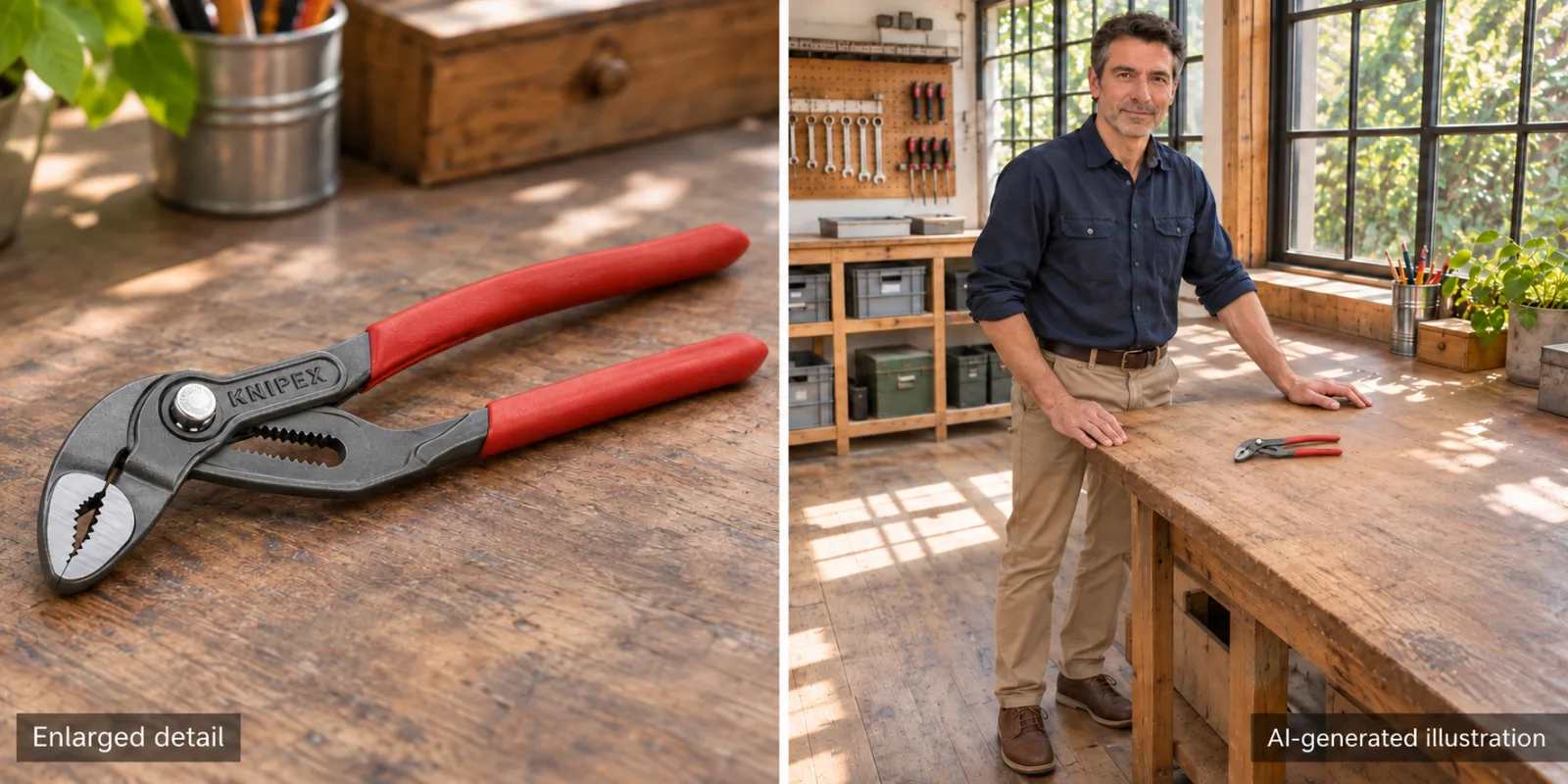
AI-generated illustration — left: enlarged 180 mm detail; right: approximate whole-tool scale. This is not a side-by-side 180/250 photograph.
What owners say about size and carrying compromises
- A clear preference for the 180. On January 31, 2024, fnfontana described the 180 as their preferred balance of compact carrying and usefulness after trying smaller sizes. In a February 1, 2024 follow-up, they personally felt its leverage approached the 250 for their use. That is a subjective impression, not measured equivalence between the two tools. Read the follow-up.
- Even the 180 can be more than someone wants to carry. On January 31, 2024, Jeffect said they carried the 125 mm version at work and preferred fetching a larger tool rather than carrying something bigger. This is explicitly a different-length experience: it illustrates a carry-size trade-off, not a defect in either selected ASIN. Read the comment.
Those reports do not create a consensus about the ideal homeowner size. They point to two legitimate priorities: keeping a capable tool close, or keeping the carried kit small and retrieving another tool when necessary. Your storage routine matters more than copying either person’s pocket preference.
Who should choose each size?
Choose the 180 if you can verify that its capacity covers your usual work and you value the shorter storage length. Skip it as your only pair if known larger fittings exceed that range. Compactness is useful when it still leaves you with the right tool for the actual task.
Choose the 250 if you are building a home toolbox and want its larger documented capacity. Skip it if the extra length conflicts with the kit or working spaces you regularly use. If the real requirement is avoiding marks on a finished surface, resolve the jaw-design question before choosing either length.

AI-generated illustration — the same person and one 180 mm example; not a torque test or evidence of non-marking jaws.
How we researched this
We checked both selected Amazon offers and the current official pages for the 180 and 250. The global 250 page initially showed a security check but later loaded normally; we then read its exact technical attributes directly and updated this guide. Owner dates and different-size limitations appear beside each linked report. All five images are AI-generated illustrations using one 180 mm tool as an appearance example, not pictures of the 250 or torque-test evidence.
Pros
- + Two clearly different lengths serve different storage needs
- + Published pipe and nut capacities support an informed choice
- + Both selected offers were available as new tools
Cons
- - The 180 has less specified capacity than the 250
- - Serrated gripping jaws can be unsuitable for delicate finishes
- - Owner leverage impressions are not controlled torque tests
Sources and verification status
Verification status: compiled from public sources
Data updated:
Verified on:
FAQ
Is the Cobra 180 enough for home repairs?
It may be if its listed capacities cover your work: the current 180 page specifies 42 mm pipe diameter and 36 mm nut capacity. Check the actual workpiece and access before choosing.
What extra capacity does the 250 provide?
Knipex’s current product page lists the 87 01 250 at 50 mm pipe diameter and 46 mm nut capacity, with 25 adjustment positions. These are shape-specific ratings, not a promise that every object of that size fits.
Are these the comfort-grip versions?
No. This comparison selects 87 01 180 and 87 01 250 with slim dipped plastic-coated handles. Different handle versions have different model identifiers.
Can I use them without marking a polished fitting?
Do not assume so. These are serrated gripping pliers, and suitability for a delicate finish needs separate consideration. A smooth-jaw tool is a different design, not an interchangeable Cobra feature.
Does the 180 provide the same leverage as the 250?
One owner described the difference as small for their use, but we did not measure leverage or torque. Do not treat that personal impression as an engineering equivalence or load rating.
You might also like
Tools & Home Improvement
Product comparisonMegapro vs Wera Kompakt 20 RA-R: Home Tool Choice
Compare exact bit profiles, telescopic access, storage and the current third-party Amazon offers before choosing a home tool gift.
Home & Kitchen
Product comparisonOutdoor Faucet Covers vs Foam: Which Fits Your Spigot?

Home & Kitchen
Product comparisonCrop-A-Dile vs Big Bite: Which Eyelet Tool Fits?
Crop-A-Dile vs Big Bite for eyelets: compare edge access, six-inch reach, setup demands, and storage tradeoffs before choosing a paper-crafting tool.

Beauty & Personal Care
Product comparisonWahl Peanut Corded vs Peanut Li: Which Fits Your Routine?
Compare Wahl Peanut corded vs Peanut Li for home grooming: charging, travel, guards, real owner complaints, and the limits of older durability stories.