Singer M1500 Stitch Length: What Can You Adjust?
Quick Verdict
The M1500 uses preset stitch length and width. It can suit basic projects, but buyers needing an independent adjustment should choose a machine that explicitly provides it.
Good for
- Basic projects compatible with the presets
- Beginners whose course supports this exact model
Not for
- Lessons requiring custom stitch length or width
- Buyers expecting 57 selectable stitch patterns
Buying Guide Notes · First published:
Compiled from public sources · Written using published specs and user feedback.
As an Amazon Associate I earn from qualifying purchases.
Pros
- + Preset choices can simplify suitable basic projects
- + Includes four-step buttonhole capability
- + Official model-specific manual and tutorials available
Cons
- - No independent custom stitch length or width
- - 57 applications are not 57 built-in stitches
- - Preset controls may not suit some classes or patterns
Sources and verification status
Verification status: compiled from public sources
Data updated:
The Singer M1500 has preset stitch length and width, so it is not the right buy if you need an independent dial for custom stitch dimensions. You select a stitch option on the pattern dial; the tension control and foot pedal perform different jobs. For basic projects that can be a simple starting point, but buyers following lessons with precise length settings should check another machine before ordering.
Checked November 14, 2026, Taiwan time. This article is compiled from public sources; we have not sewn with this machine or tested its seams. The US Amazon listing for M1500, ASIN B084ZR1PFW, showed $119.99, new and sold/shipped by Amazon.com, with 4.4 stars from 3,271 ratings. Prices, sellers and pooled rating counts may change.
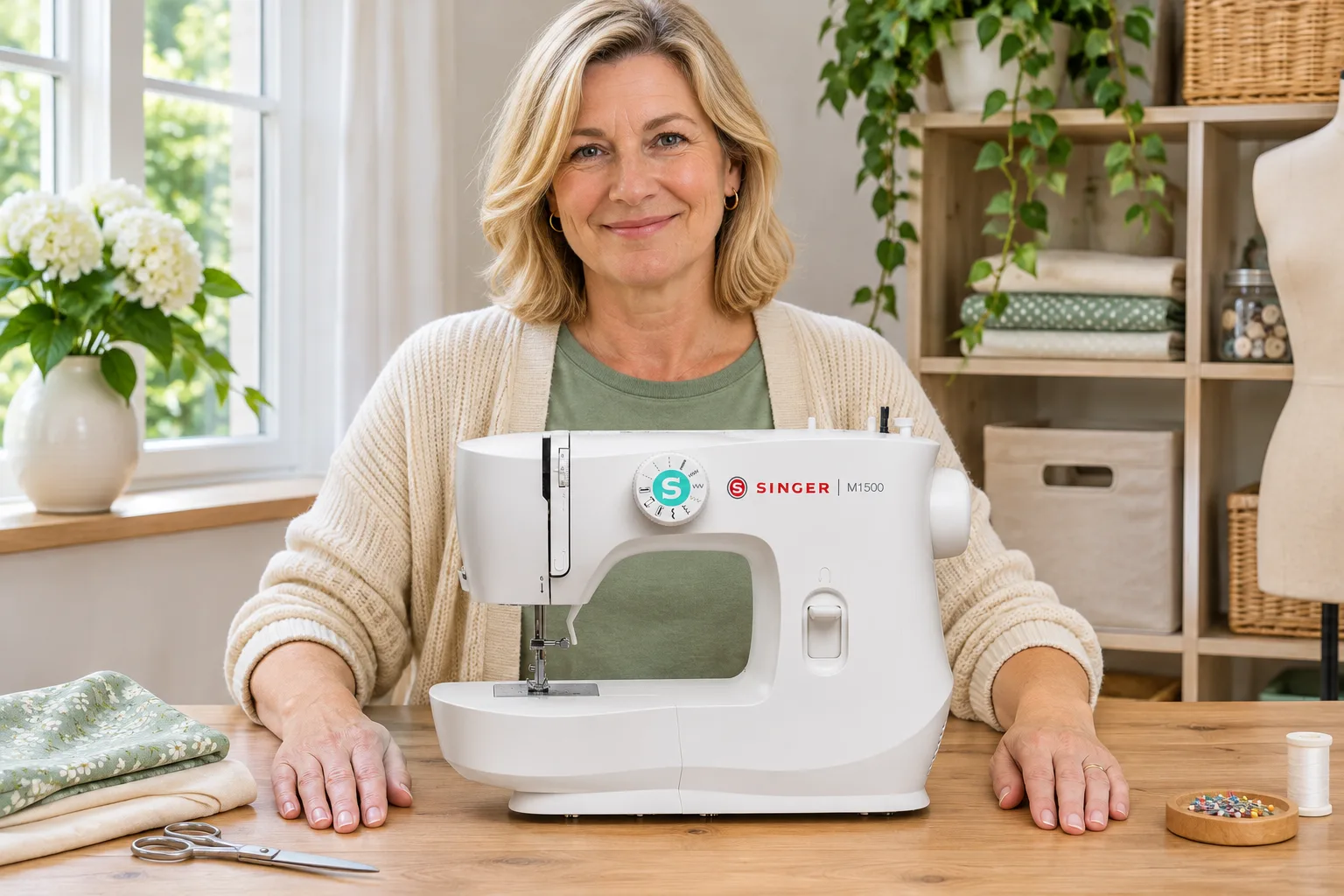
AI-generated illustration — A woman preparing fabric beside a switched-off M1500; no sewing result or hands-on test is shown.
Quick comparison: presets or independent adjustment?
Think about the control you need, rather than the number of techniques in a headline. This table compares buying approaches; we verified the exact M1500 offer, not current competing-machine prices.
| Choice | Price checked | Relevant control | Best for | Who should skip it |
|---|---|---|---|---|
| Singer M1500 | $119.99 | Preset length/width, stitch selector | Simple projects using the available presets | Buyers requiring custom stitch dimensions |
| Machine with independent length and width controls | Not checked | Verify both controls in its exact manual | Lessons requiring specific settings | Buyers who prefer fewer adjustments |
| Keep an existing adjustable machine | No new purchase if already owned | Depends on the machine | Owners whose present machine already meets the pattern requirements | Anyone needing a different capability or service |
View Current Offers on Amazon →
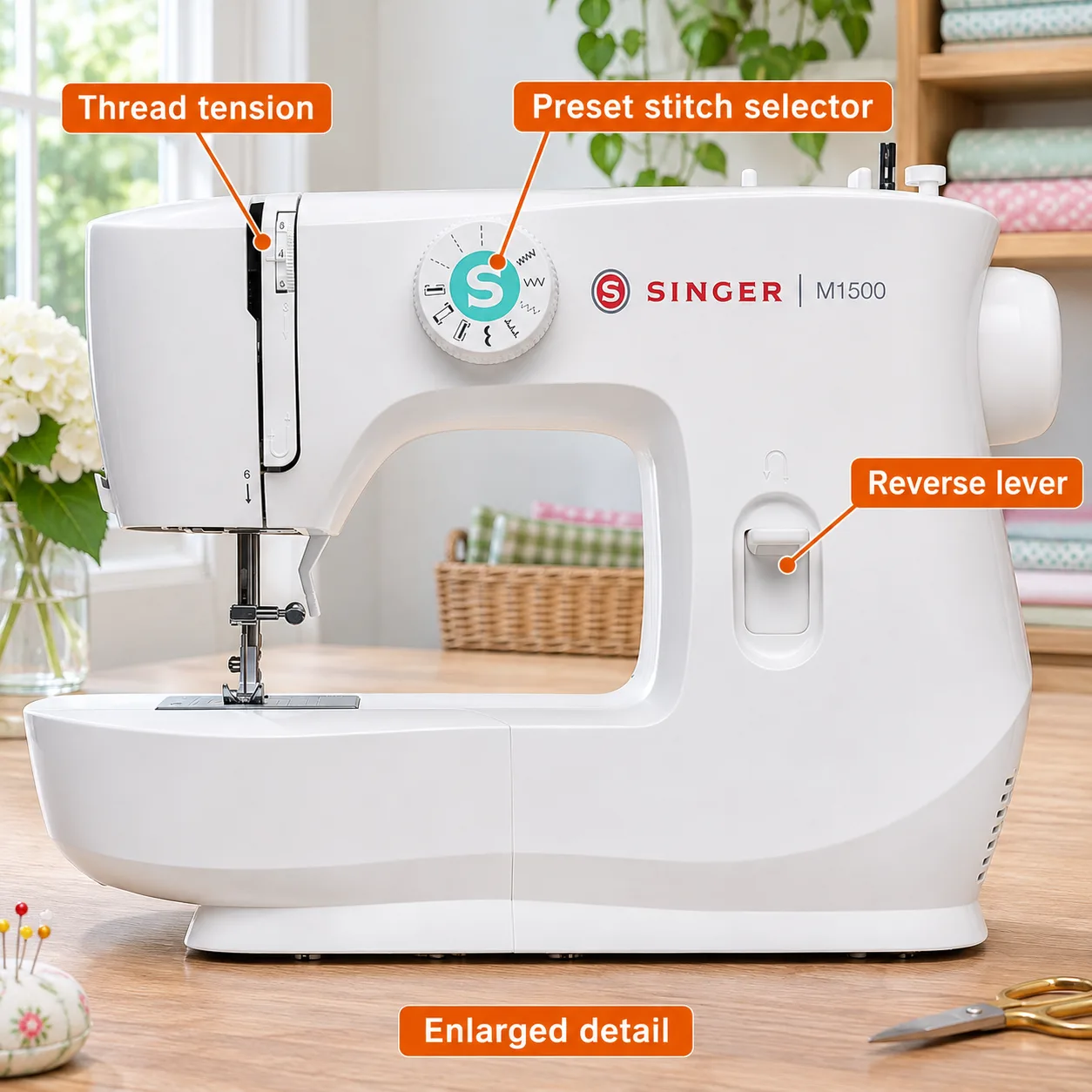
AI-generated illustration — Enlarged M1500 front view labels the preset stitch selector, thread tension control and reverse lever.
What can the stitch selector actually change?
Singer’s current US M1500 page explicitly describes preset stitch length and width. The important distinction is selecting among presets versus independently adjusting a setting. Choosing a different available stitch option is not the same as specifying an arbitrary length while keeping every other part of the stitch unchanged.
Look at the selector before buying. Ask whether its available options cover the projects in your planned class or pattern collection. If an instructor asks you to set an exact stitch length, do not assume a similar-looking symbol will provide an equivalent result. Ask about adapting that lesson to the M1500 or choose a machine with the stated adjustment.
We have not measured the length produced by each selector position. Accordingly, this guide does not attach invented millimeter values to the dial marks. The lack of a separately adjustable control is documented; the suitability of a specific preset for your fabric needs a sample and the proper setup.
Why won’t turning the tension dial solve this limitation?
The M1500/M1505/M1600/M1605 instruction manual identifies the thread-tension control separately from the pattern selector. It also describes the pedal as a speed control. Neither is an additional stitch-length dial.
This matters when a tutorial assumes a different machine. Before copying a number from a video, establish what the control in that video actually adjusts. A number on a tension scale and a length value are not interchangeable simply because both are printed near a dial.
Use the model-specific instructions for threading and tension, and work on scraps of the intended fabric before committing a garment. A troublesome seam is not proof that the preset-length design is broken, and changing unrelated settings randomly does not identify the cause. If a machine is malfunctioning, seek the manufacturer’s troubleshooting or service guidance rather than opening its housing based on an internet comment.
AI-generated illustration — The same woman plans a fabric project beside an unplugged M1500; this is not a seam-quality demonstration.
Do “57 stitch applications” mean 57 stitches?
No. Singer distinguishes six built-in stitches from 57 stitch applications. An application describes a technique using a selected stitch; it does not necessarily add a new selectable pattern or another adjustable control.
That makes a practical difference when comparing similarly priced machines. Create a short list of the operations you actually want: perhaps basic seams, a particular hem and buttonholes. Then verify the controls and accessories needed for each operation. A larger applications number is less useful than a clear answer about the one setting your next project requires.
The M1500’s four-step buttonhole is another example. It can offer a useful capability while still requiring the user to manage multiple stages. If you want a one-step automatic process, do not buy this model expecting that behavior. The included buttonhole foot does not change the documented four-step system.
Can you baste, mend or sew clothes with the presets?
Avoid an absolute answer based solely on the absence of a length dial. Whether a technique works acceptably depends on the available setting, fabric and project requirement. We have not tested basting, stretch seams or garment construction on the M1500, so we cannot promise that a preset will replace the setting required by your pattern.
For a beginner buying specifically to follow a course, send the instructor the exact model before purchase. Ask whether the preset options are sufficient and whether any exercises need adaptation. That answer is more useful than an assurance that every machine described as “beginner friendly” can follow every beginner lesson unchanged.
For an owner already learning on the M1500, first identify the available stitch choices and the project’s requirement. A separate adjustable machine may be the cleaner alternative when customization is essential; replacing the machine is not automatically necessary for every small repair. For a gift, a class budget or an agreed-upon model can prevent disappointment over a missing control.
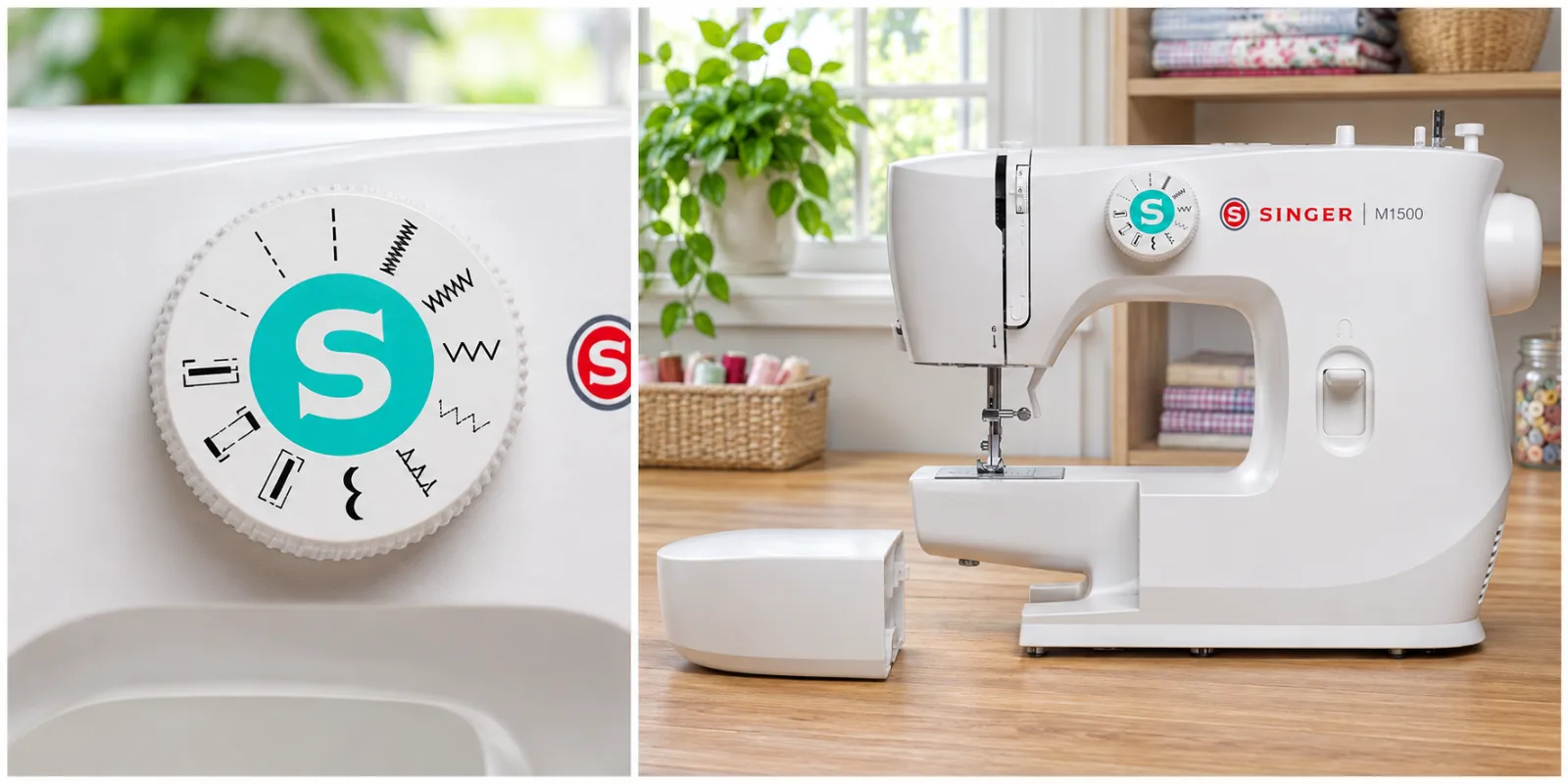
AI-generated illustration — Two panels show an enlarged selector and the M1500 with its front accessory compartment removed; not operating instructions.
What concerns do M1500 owners raise?
Public discussions help identify confusing expectations, but they do not establish a current defect rate. These posts do not verify our selected Amazon ASIN or a 2026 production revision.
- The missing adjustment surprises beginners. muchomikey asked on February 7, 2025 whether an M1500 without length/width dials could handle basting and stay stitching. This is a direct model-specific concern, not evidence that those techniques are universally impossible.
- A constructive reply distinguishes available choices. carmaaaa replied the same day that the selector appeared to offer different straight-stitch choices. They explicitly did not own the machine. We treat this as helpful discussion context, not measured stitch lengths or a verified owner endorsement.
- Setup problems can overshadow the buying decision. A now-deleted account reported on July 31, 2021 that an initially working M1500 stopped forming stitches while they were learning. We cannot diagnose that incident from the post, or turn it into a prediction about the current listing.
We did not find a reliable exact-current-version long-term positive assessment in these selected discussions. The positive case here is the documented simplicity of presets for suitable projects, not invented durability consensus.
Who should choose it, and who should skip it?
Consider the M1500 if you want a basic machine and have confirmed that its preset choices cover your intended work. The current offer is within a modest starter budget. Its front-loading Class 15 transparent bobbin arrangement and removable accessory compartment are worth learning from the manual before your first project; simplicity still involves setup practice.
Skip it if independent stitch adjustment is a requirement. This is the central drawback for this keyword, not an obscure accessory omission. Do not assume buying another foot will supply a missing length control. Compare an alternative’s actual manual, arrange a demonstration if possible, and include instruction or service support in the buying decision.
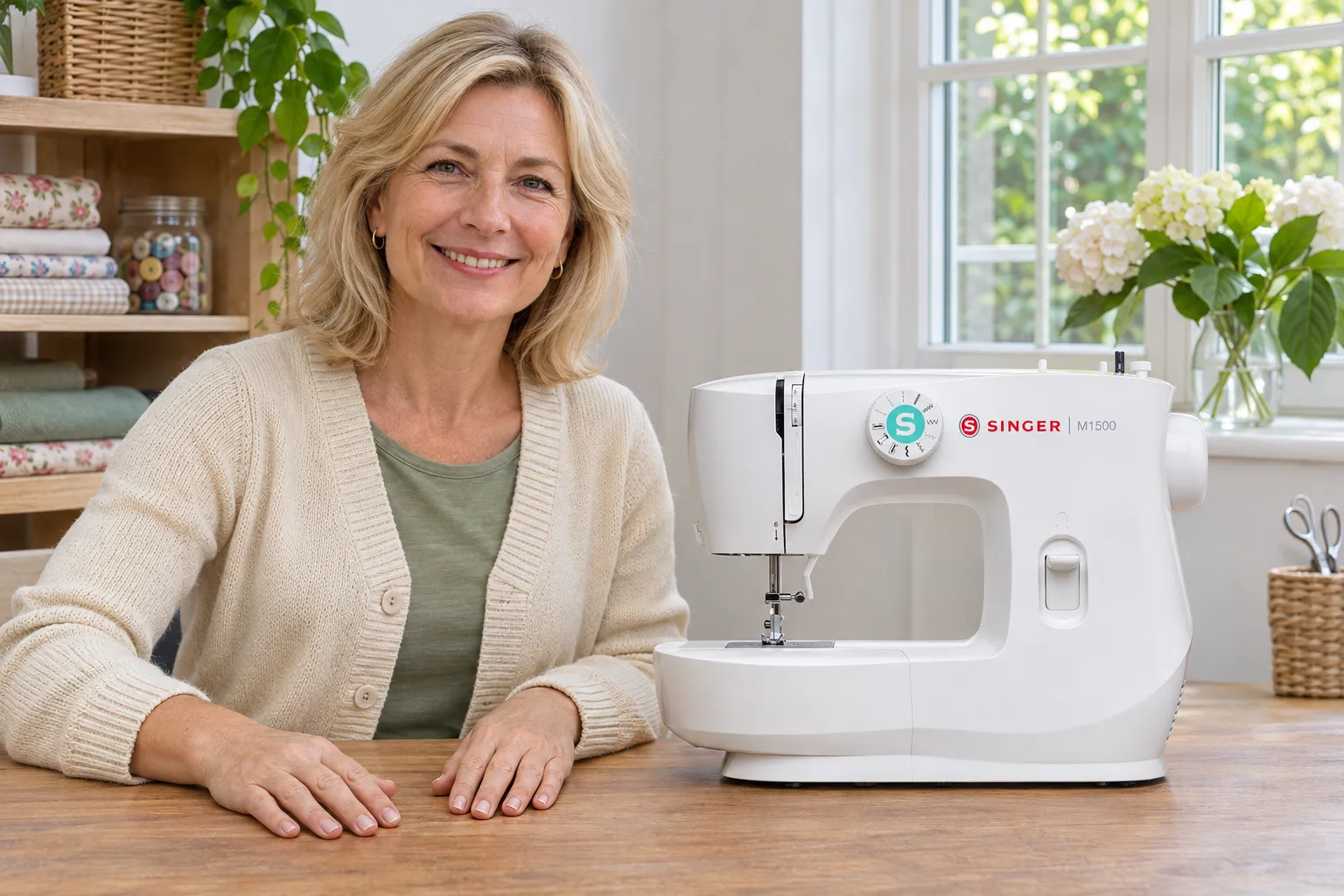
AI-generated illustration — The same woman poses beside the M1500 with both hands resting on the desk.
How we checked the controls and limitations
We compared the exact Amazon US M1500 offer with Singer’s product page, model-specific manual and dated public discussion. We used the official 5.6-inch needle-to-tower opening and reference appearance to guide illustration proportions. The US size field also lists “13 × 7 × 11.5” without explicit units in that field; these pictures are not exact storage-fit measurements.
The images do not demonstrate safe machine operation, stitching quality or ownership. Follow the manufacturer’s safety instructions around needles and moving parts. Our recommendation is based on control suitability: if you need adjustable stitch length, establish that feature before buying, rather than discovering the limitation during your first lesson.
FAQ
Can you set a custom stitch length on the Singer M1500?
The M1500 uses preset stitch length and width. You choose among the selector’s stitch options, rather than independently dialing in any length or width you want. Check the actual selector and model-specific manual before buying.
Is the tension dial a stitch-length adjustment?
No. Thread tension is a separate adjustment. Turning it does not add an independent stitch-length control to the M1500. Follow the manual’s tension guidance and practice on a scrap of the intended fabric.
Does the M1500 have 57 different built-in stitches?
No. Singer lists six built-in stitches and 57 stitch applications. Applications are techniques possible with the selected stitches, rather than 57 independently selectable stitch patterns.
Can it make buttonholes?
Yes. Singer specifies a four-step buttonhole selected using the pattern dial. It is not a one-step automatic buttonhole system. The manual recommends testing a buttonhole on the fabric you intend to use.
Should I buy it for garment sewing or adjustable basting?
Consider it for basic projects if the presets suit your work. If your lessons or patterns require specific adjustable stitch lengths or widths, choose a machine that explicitly provides those controls. We have not tested M1500 basting or garment performance.