Thermapen ONE vs Infrared Thermometer: Meat or Pan?
Quick Verdict
Buy the Thermapen ONE for quick internal spot checks if its premium price fits your budget. Choose an infrared instrument for pan surfaces; one does not replace the other.
Buying Guide Notes · First published:
Compiled from public sources · Written using published specs and user feedback.
As an Amazon Associate I earn from qualifying purchases.

The Thermapen ONE is the more useful purchase for checking the inside of a roast, while an infrared thermometer is for checking a surface such as a skillet. The ONE does not include an infrared sensor, and a hot exterior cannot tell you how warm the center of food is. Choose according to the measurement you actually need before paying for speed or extra functions.
Checked November 11, 2026. This guide is compiled from public sources; we have not cooked with, unboxed or tested these instruments.
AI-generated illustration: the cover depicts a cook beside a closed Dove Grey Thermapen ONE. The pictured roast is context, not evidence of a temperature test.
Which thermometer solves your cooking problem?
| Option | Price reference | Key distinction | Best for | Main limitation |
|---|---|---|---|---|
| Thermapen ONE, Dove Grey, B0DC8FWCDT | $125.00 Amazon offer at our check | Fold-out contact probe; backlit display | Internal spot checks in food | No infrared function; cannot stay in the oven |
| Infrared thermometer category | Current price not verified | Non-contact surface measurement | Comparing accessible pan or griddle surfaces | Cannot measure the center of meat |
| Purpose-designed leave-in probe category | Current price not verified | Probe remains positioned during cooking | Tracking changes over time | Different setup; not the same handheld tool |
The verified Amazon ONE listing showed new stock, sold by ThermoWorks and shipped by Amazon. Its displayed 4.6-star score and 1,436 ratings are a dated listing snapshot, not our assessment or a promise about the particular unit you receive. We have not verified a second Amazon infrared offer, so this comparison does not attach an invented price or ASIN to that category.
Why does a probe answer a different question from infrared?
Think about a thick piece of food: the outside and the center are different measurement locations. A contact probe lets you check an internal location; an infrared thermometer responds to radiation from the surface within its field of view. Pointing the latter at browned meat does not make it an internal food thermometer. That difference matters more than whether a display appears a second sooner.
An infrared device can be convenient when the question is whether one accessible cooking surface is warmer than another. It does not tell you the temperature of everything underneath that surface, and its reading depends on the target material and how you aim it. ThermoWorks’ infrared buying guide explains the roles of emissivity and distance-to-spot ratio. A measurement area grows as you move farther away; a laser marker should not be mistaken for the entire measured area.
For a buyer who regularly makes roasts but only occasionally wonders about a pan, our editorial preference is to solve the internal-checking task first. Someone already equipped with a suitable probe may instead gain a new capability from infrared. This is a use-case judgment, not a finding that one technology is universally more accurate.
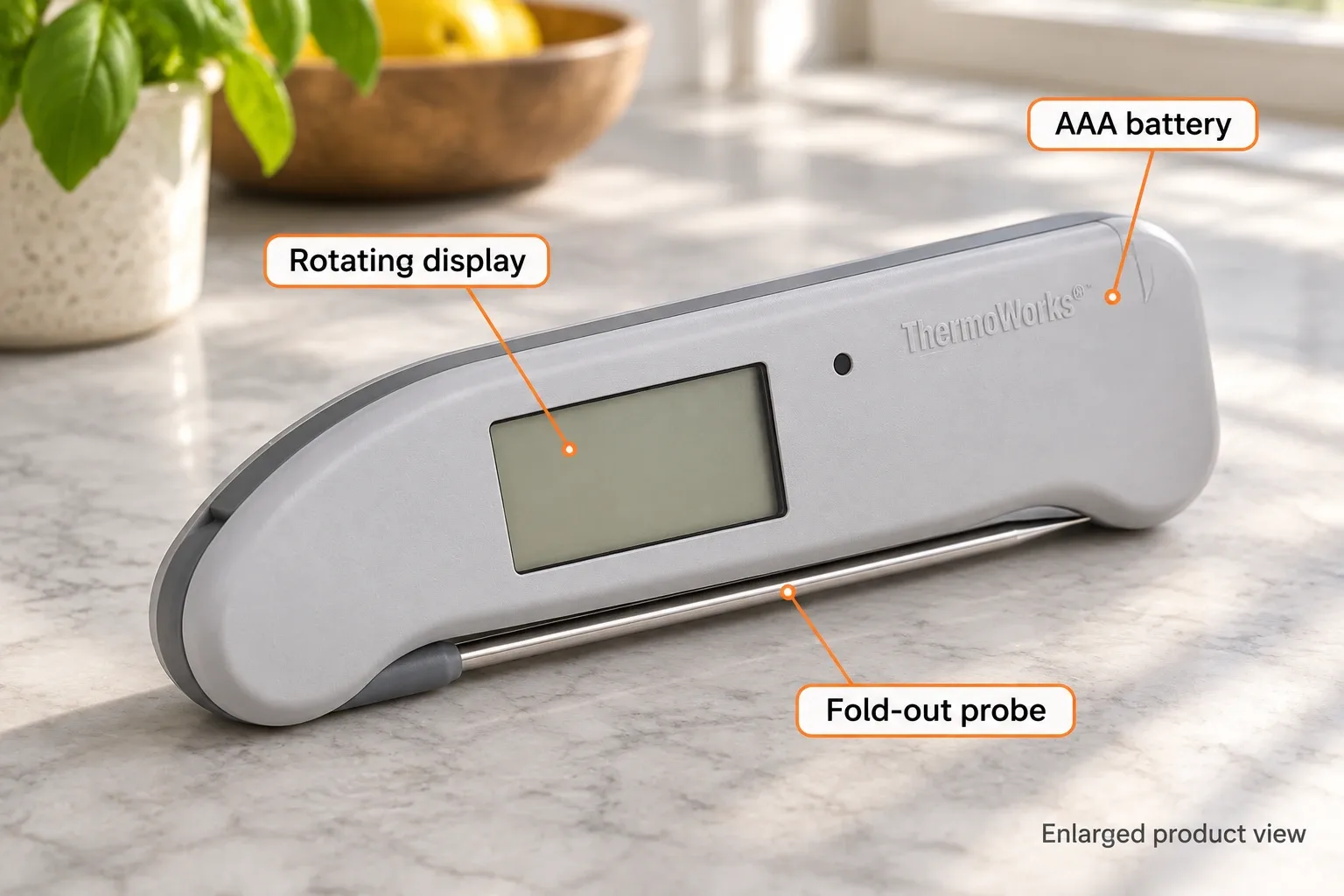
AI-generated illustration: Enlarged Thermapen ONE exterior with orange labels for the folded probe, display and battery-containing body; not a cutaway.
What stands out about the Thermapen ONE?
The ONE’s appeal is a focused handheld workflow: open the probe, position it for a spot check, read the display and remove it. ThermoWorks publishes a one-second response claim, a rotating backlit display and a replaceable AAA battery. Those features can make a premium instrument attractive to someone who checks food frequently, but they are manufacturer specifications rather than results from our kitchen.
The current Thermapen ONE product information lists a 4.3-inch probe and an operating range of -58 to 572°F. Its quoted ±0.5°F accuracy applies over -4 to 248°F; the rest of the published range has a different tolerance. Avoid reading the most favorable accuracy number as an unconditional statement across every temperature. We did not perform calibration checks.
The folding format also has a practical storage benefit: the probe can close against the body when the tool is put away. It still needs a place where it will not be mistaken for an oven-safe utensil. A higher purchase price does not change the handling restrictions.
Where does the ONE fall short?
It is a spot-check tool. It cannot give you an ongoing temperature trace while you are elsewhere, and it should not remain inside a hot oven. If continuous monitoring is your missing capability, compare purpose-designed leave-in probes before buying another handheld instrument.
It does not add surface scanning. The similarly named Thermapen IR is a different device. The ONE’s display, battery, sealing and response specifications should not be copied into an IR comparison as if the two names described a single package.
The premium may buy more convenience than you need. An occasional cook with a working food probe may not benefit enough from the ONE’s ergonomics to justify $125. We have not verified a cheaper alternative’s current offer in this research, so there is no fabricated budget winner here. Start with the task and the features you would actually use.

AI-generated illustration: Kitchen context showing the closed thermometer on a counter beside a resting roast; no measurement is demonstrated.
What do owners say about speed and the missing IR function?
These are individual accounts, with no evidence that they describe this exact Dove Grey ASIN or today’s production batch. The discussion includes both ONE and IR owners; it is not a controlled comparison or a reliability survey.
- Readability can drive the choice. KushFlows, October 5, 2022, favored the ONE because its backlight suited cooking in darkness. Their follow-up that day retained interest in infrared versatility. This is one person’s preference, not two independent endorsements.
- Surface checks can be useful. therealmanbat, October 5, 2022, liked an IR model for pans but found its upper range limiting for pizza-stone use. That is an older, different instrument; we do not transfer the commenter’s temperature limit to current IR products.
- Response can vary by situation. sotos1480, September 29, 2023, described fast meat readings but a slower response in hot oil. We cannot verify the setup or reproduce that result, so it is a reason to avoid promising identical response times in every task.
How should you compare infrared options before buying?
Write down the surface you want to measure, its expected temperature range and the distance available for aiming. Then check that exact model’s published range, distance-to-spot ratio and emissivity settings. A specification suitable for one pan task may be a poor match for a hotter pizza surface. Do not choose by the word “laser” alone.
Also compare the workflow. An integrated probe-and-infrared instrument reduces the number of tools to store, while separate instruments let you choose each function independently. Neither approach is automatically better for a small kitchen. Our table deliberately leaves infrared pricing unverified rather than implying every infrared gun has the same capability or cost.
If a gift recipient already owns an instant-read probe, ask what it fails to do before duplicating it. An infrared instrument may answer a different question; a premium replacement probe may simply make an existing task more pleasant. That distinction produces a more useful gift than buying the most impressive specification on the box.
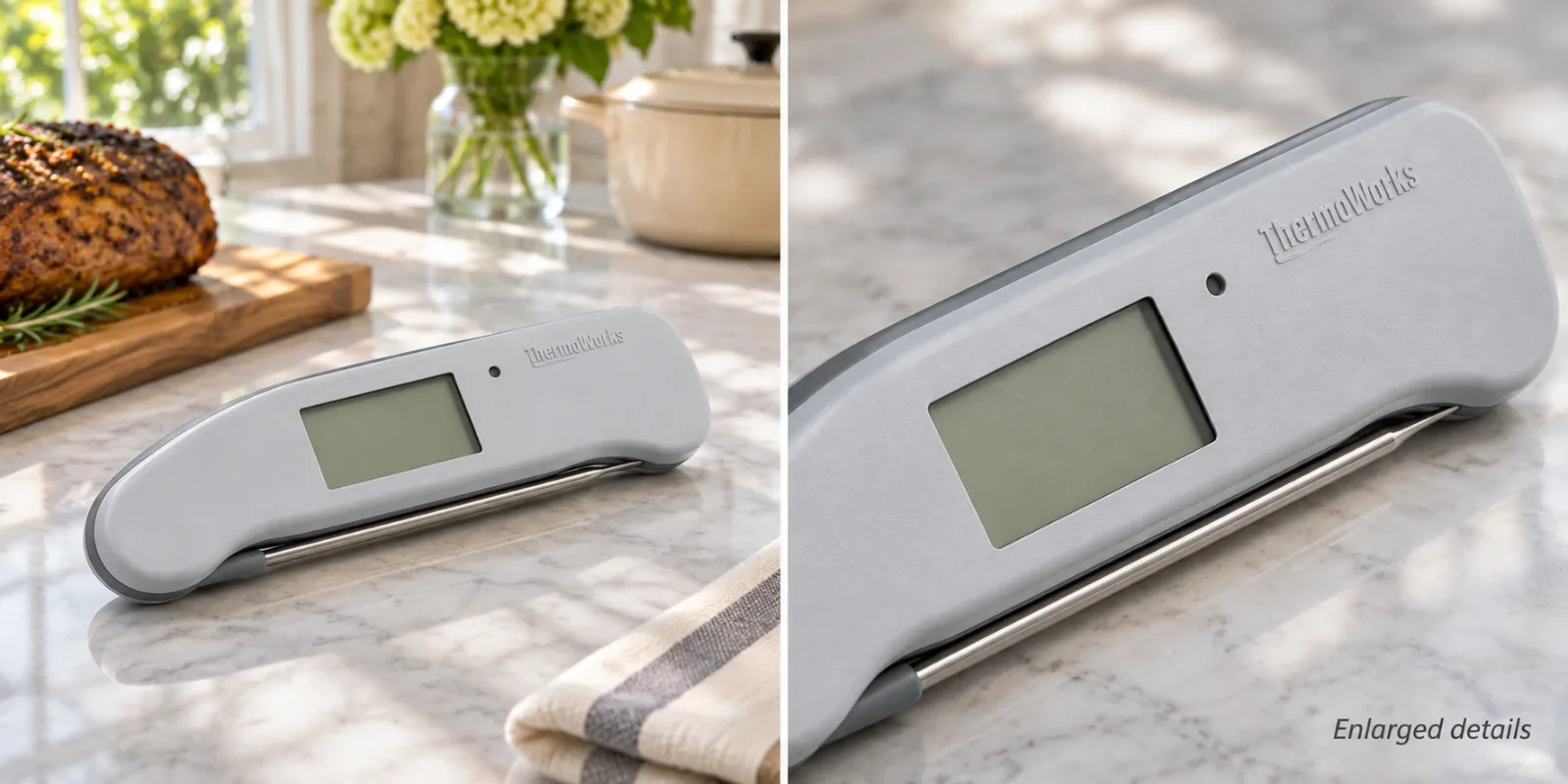
AI-generated illustration: Two enlarged exterior views of the folded probe and blank display; not a cleaning procedure.
What cleaning and storage restrictions matter?
The ONE operating instructions distinguish cleaning from exposing the tool to oven heat or a dishwasher. Clean the probe after use and maintain the body according to that document. IP67 is not permission to wash it in a dishwasher or leave it on a hot cooking surface.
The same instructions caution against rotating the probe while it is submerged or under running water. Follow the exact model’s instructions rather than a forum shortcut. If damage or inconsistent readings appear, consult ThermoWorks support rather than treating a generated picture or a commenter’s timing estimate as a troubleshooting test.
Who should buy it, and who should skip it?
Consider the ONE if frequent internal food checks, an easy-to-read display and a handheld folding format justify the observed price. Skip it as your only purchase if your actual problem is surface scanning or unattended monitoring. Buyers satisfied with an existing suitable food probe can also wait rather than replacing it purely because a faster claim exists.

AI-generated illustration: The same cook and closed thermometer in a wider kitchen portrait; illustrative scale, not testing.
How we researched this comparison
We checked the selected Amazon offer, ThermoWorks product information, the ONE operating instructions and the manufacturer’s infrared guidance on the stated date. We also read the linked Reddit discussion, separating older IR reports from ONE reports and retaining their limitations. The user-suggested kitchen-tools discussion supplied a useful buying question, not a verified popularity ranking.
This article is compiled from public sources. We did not measure response time, pan temperature, food safety, accuracy or long-term durability. Prices and sellers can change; verify the selected color and model at checkout. Our recommendation is about matching the instrument to the question, rather than declaring a tested winner.
Pros
- + Fold-out probe measures inside food rather than only the surface
- + Backlit rotating display supports awkward reading angles
- + Replaceable AAA battery and published cleaning instructions
Cons
- - The ONE has no infrared surface-measurement function
- - Premium price for an instrument you must hold and remove
- - Not dishwasher safe or a leave-in oven probe
Sources and verification status
Verification status: compiled from public sources
Data updated:
Verified on:
FAQ
Can an infrared thermometer tell whether chicken is cooked inside?
An infrared instrument reads surface radiation, so it cannot establish the temperature at the center of chicken. Use an appropriate food probe and follow current food-safety guidance; a hot surface does not establish a safe center.
Does the Thermapen ONE include an infrared sensor?
No. The Thermapen ONE is a fold-out probe thermometer. Thermapen IR is a different product; specifications, waterproofing and batteries should not be transferred between them.
Can I leave the Thermapen ONE in a roast in the oven?
No. ThermoWorks instructs users not to leave this handheld instrument in an oven or on a hot surface. Choose a purpose-designed leave-in thermometer for continuous monitoring.
Is the Thermapen ONE dishwasher safe?
No. Its IP67 rating does not make dishwasher cleaning acceptable. Follow the ONE operating instructions, cleaning the probe and wiping the body rather than putting the instrument in a dishwasher.
Will a one-second specification apply to every reading?
Do not assume that it will. It is the manufacturer’s performance claim under its specified conditions, not our test result. Placement, the material being measured and waiting for a stable reading still matter.
You might also like

Kitchen & Dining
Product analysisTempPro TP19H vs Thermapen ONE: What Does the Upgrade Buy?
Both claim a one-second read. Compare TP19H's conflicting specifications with ONE's accuracy, sealing and calibration paperwork.

Pet Supplies
Product analysisKONG Extreme vs Classic: Does Your Large Dog Need the Black One?
KONG Extreme Large is $14.96 on Amazon. See how it compares with Classic Large and who should skip it.