WideLife Mini 2S Tire Inflator Review: Accurate Enough?
30-second verdict
Scooter tires a few PSI low and no time to queue at the gas station? Check the WideLife Mini 2S auto-stop, battery and accessories before you buy.
Who it suits
It suits scooter riders who sometimes top up a car and want fewer gas-station trips, and households with bikes or balls to pump.
It doesn't suit people who often fill fully flat large tires, or who want a unit that lives in the car without ever thinking about charge. A plug-in car inflator is simpler for that.
Buying Guide Notes ·
Compiled from public sourcesCompiled from official specs and user feedback.
Pros
- Auto-stop at your target pressure, so you don't have to watch the numbers
- 6000mAh battery (official spec), plus a car power cable for when the battery is empty
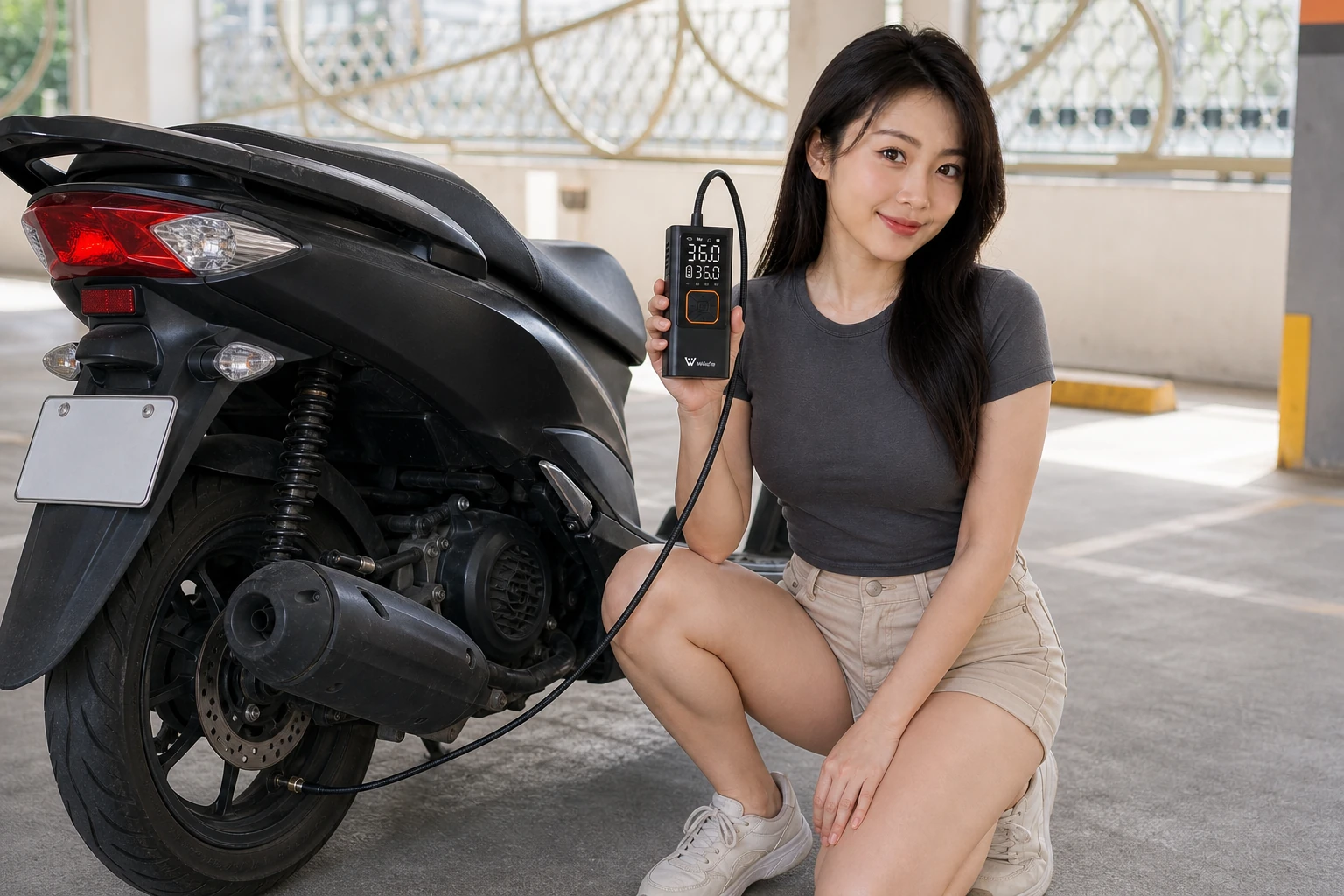
- Four adapters cover scooters, cars, bikes and balls
Cons
- The maker says to rest it 8 minutes after 8 minutes of use, so big jobs come in rounds
- No long-term Taiwan user reviews of this model yet; check accuracy yourself
- The shop is a reseller, so check warranty and shipping terms at checkout
Price and purchase links
Scooter tires a few PSI low and no time to queue at the gas station? Check the WideLife Mini 2S auto-stop, battery and accessories before you buy.
Price updated 2026/11/04
Where to buy
The WideLife Mini 2S is about NT$998, with 30,000+ sold. Prices change, so check the amount and accessories again before you pay.
NT$998 | See the lowest price →
UnboxRank compiles official specs and user feedback.
Some images are AI-generated illustrations
Specs
| Item | Detail |
|---|---|
| Product | WideLife WPump Mini 2S cordless tire inflator |
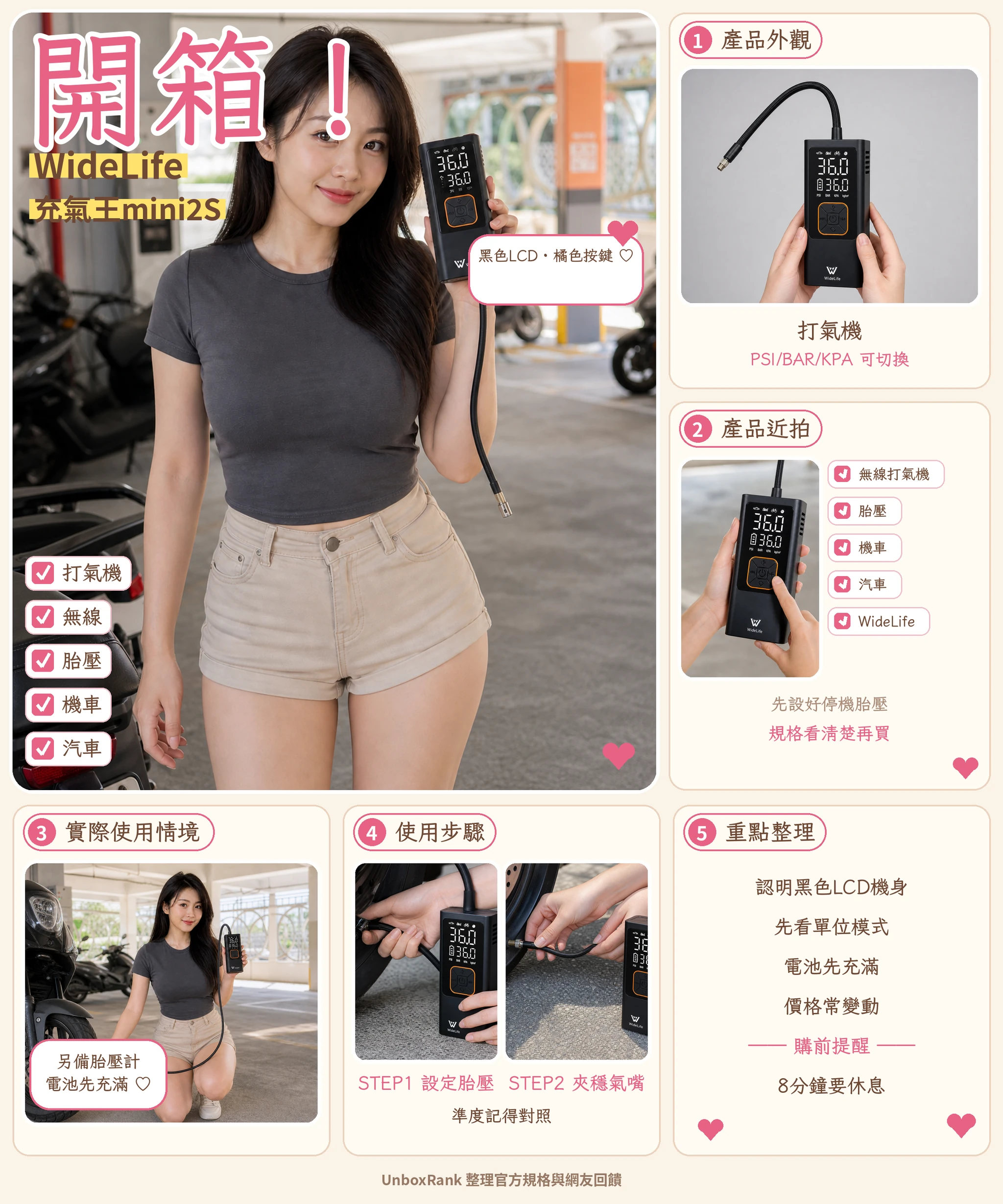
| Look | Black rectangular body, large black LCD with white digits, orange-ringed buttons, hose on top |
| Pressure | 0–150 PSI; PSI/BAR/KPA/kg/cm² |
| Battery | 6000mAh, USB charging; first charge about 5–6 hours |
| Modes | Car, scooter, bike, ball; custom target pressure |
| Weight/size | About 598g, about 17×6.9×5 cm |
| In the box | Braided nylon hose, four adapters, USB cable, car power cable, pouch |
| Price | About NT$998; prices change |
The tire warning lights up on the scooter dashboard and the gas-station pump has a queue. If you're looking at the WideLife Mini 2S, you probably want to know two things: whether the reading is accurate, and whether one unit works for both a scooter and a car.
What the WideLife Mini 2S looks like
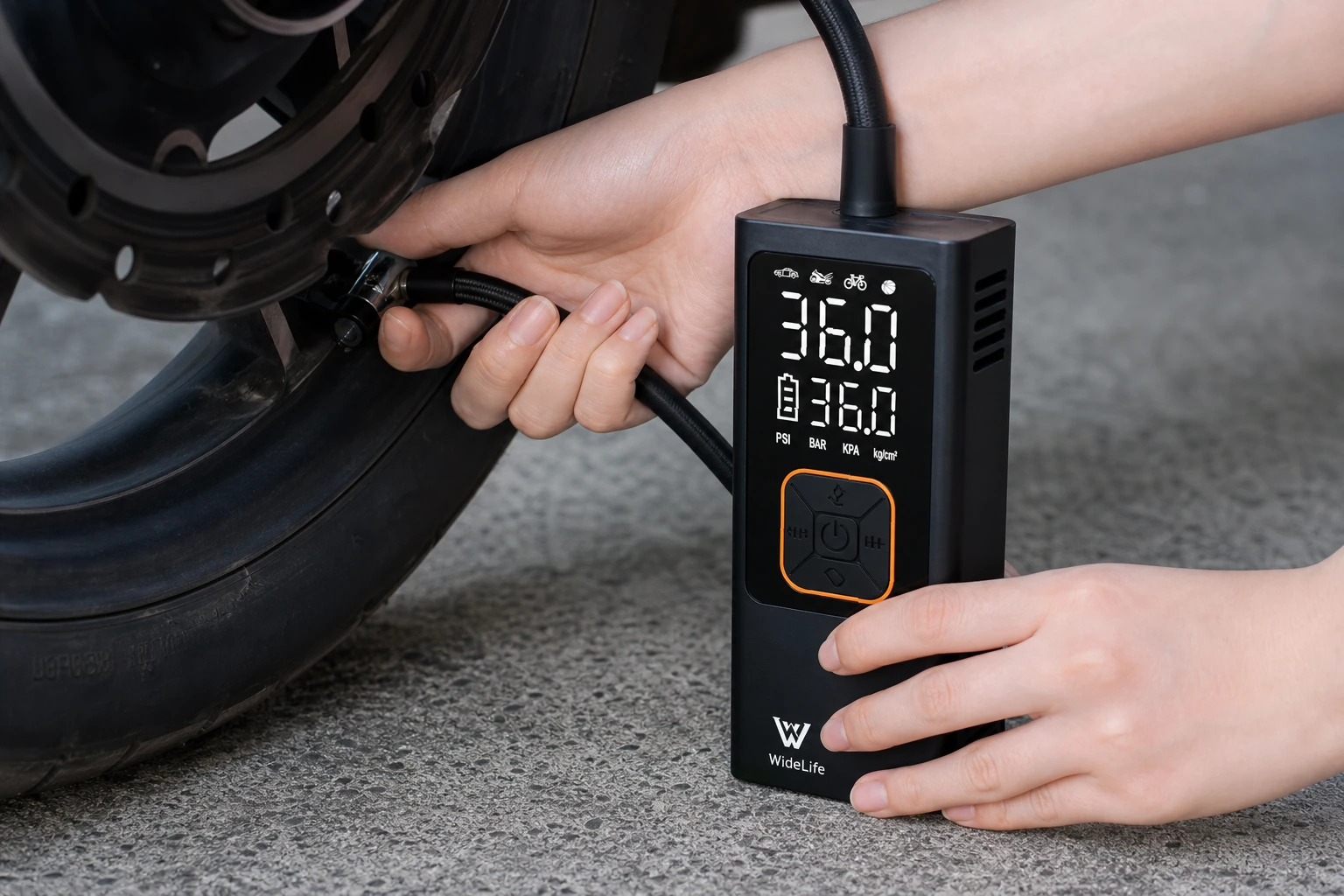
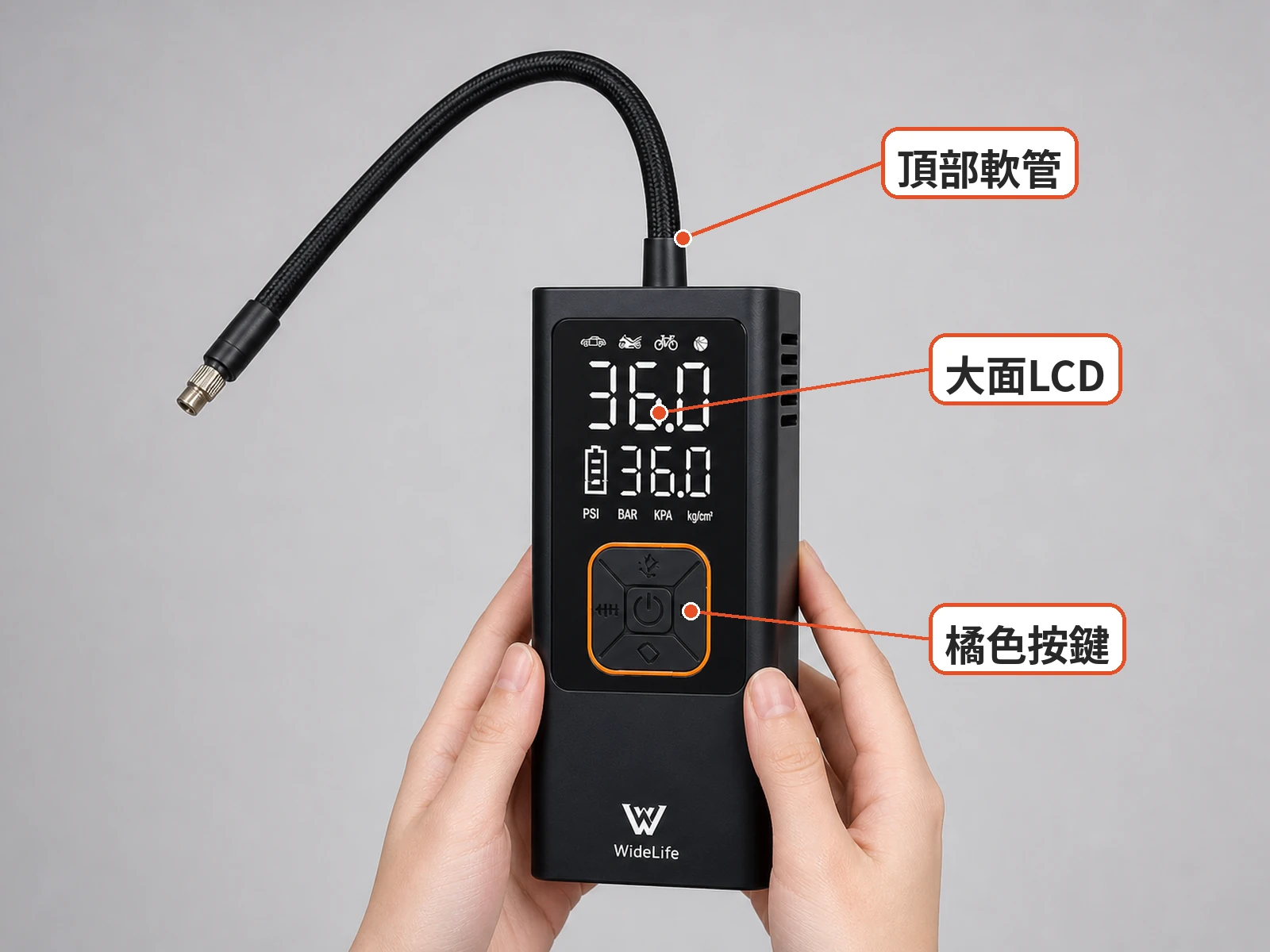
It's a black rectangular unit with a large black LCD. The top row shows car, scooter, bike and ball mode icons, the buttons sit in an orange ring below, and the hose comes out of the top. The WideLife logo is printed at the bottom.
The official specs list a 6000mAh battery, up to 150 PSI and about 598g, roughly the weight of a 600ml bottle of water. It fits in a scooter seat box or a car glovebox. Ad text on the product images, such as claims about beating Xiaomi, is marketing; compare the specs instead.

Is the pressure reading accurate?
The maker lists an accuracy of ±1.5 PSI. You set a target and it stops when it gets there. Most scooter tires sit around 28–36 PSI, so a 1–2 PSI difference matters little day to day, but if you care about exact numbers, check it once against a separate gauge.
In PTT scooter-forum threads on cordless inflators, auto-stop is what people value most: you don't have to watch a gauge and you're less likely to overfill. Watch the units, though. Mixing up BAR and PSI makes a big difference, so check the unit on screen before you start.
Scooters and cars: how long does it take?
Scooters, bikes and balls are easy. For cars, the maker says topping up a typical sedan tire from 30 to 36 PSI takes a little over a minute. A completely flat tire takes much longer and uses more battery.
The maker also says to rest the unit 8 minutes after 8 minutes of continuous use, so give it a break between car tires. The metal hose fitting gets hot, so take care when you remove it.
A Mobile01 user noted that a cordless inflator in the car is convenient, but useless if you forget to charge it. This one comes with a car power cable, so you can plug it into the cigarette lighter when the battery is empty.
Check it on arrival
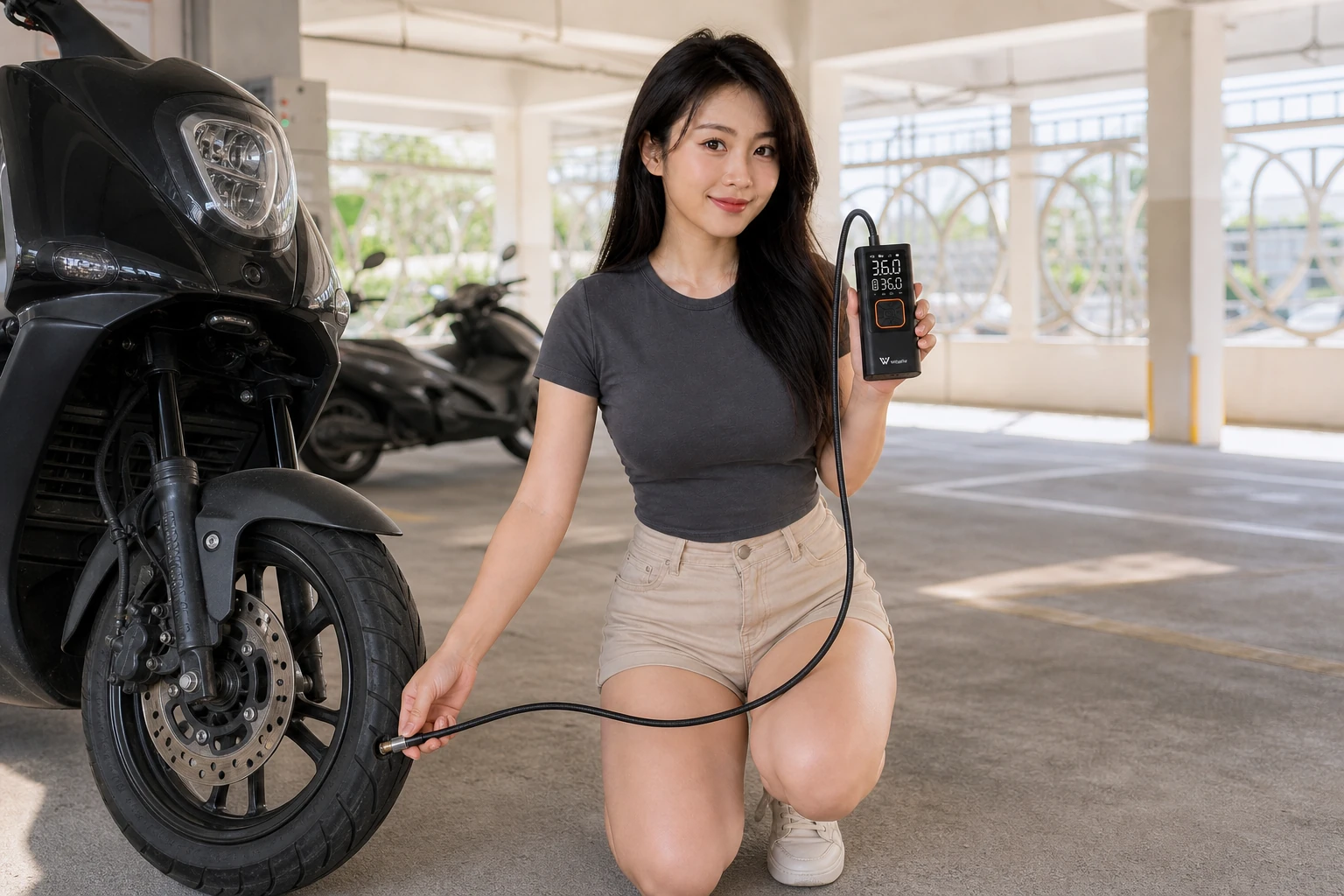
When it arrives, check the hose for cracks, make sure the LCD turns on and the buttons work, and confirm all four adapters are there. Then add 1–2 PSI to your scooter and compare the reading with a separate gauge. If it won't power on or the fitting leaks, take photos first, then start a return.

What users say
We couldn't find long-term Taiwan reviews of the WideLife Mini 2S. These are threads on similar cordless inflators: Mobile01 Xiaomi 2 Pro unboxing, Mobile01 which car inflator to buy, PTT Michelin inflator, PTT ML1288 vs Xiaomi 2.
The shared view: auto-stop and a digital reading are convenient, topping up a few PSI on a scooter or car is fine, and a fully flat car tire is slow.
What's the right pressure? Check this before inflating
The right pressure isn't the maximum printed on the tire sidewall but the maker's recommended figure. For cars it's usually on a sticker in the driver's door frame or inside the fuel flap; for scooters it's in the owner's manual, and front and rear figures often differ.
Measure when the tires are cold, after the vehicle has been parked for a while and before you ride. Right after a ride the tires are warm and read high, so topping up then can leave them underinflated.
Pressure also drops when the weather turns cold, so check again when the season changes. If one tire loses a lot every few days, there may be a nail or a leaking valve. An inflator only buys time; get it checked at a shop.
Care and storage
After use, let the body and chuck cool before packing the hose into the pouch. If you won't use it for a while, charge it every month or two so it isn't flat when you need it. Cars get very hot in summer, so don't leave lithium-battery devices baking under the windshield for long.
Pre-purchase checklist
- Black body, large LCD, orange-ringed buttons; model WPump Mini 2S
- Switchable PSI/BAR/KPA/kg/cm² and four modes
- Hose, four adapters, USB cable and car power cable included
- Check the warranty and shipping origin before you pay
- Compare against a separate gauge the first time
Similar alternatives
- Xiaomi electric inflators: the most user reviews if you want lots of real-world feedback
- Michelin cordless or plug-in inflators: more talk about speed, usually pricier
- Plug-in car inflators: live in the car with no charging, but are awkward to use on a scooter
FAQ
Is the pressure reading accurate? Will it overfill?
The maker lists ±1.5 PSI accuracy, and it stops at your target pressure. Check it once against a separate gauge, and confirm whether the screen shows PSI or BAR.
Does it work for both scooters and cars?
Yes. It has car, scooter, bike and ball modes. Top-ups are quick; a fully flat car tire is slower, and it needs an 8-minute rest after 8 minutes of use.
What if the battery runs out?
It comes with a car power cable for the cigarette lighter. If you keep it in the car, charge it regularly.
How does it compare with Xiaomi or Michelin?
Xiaomi and Michelin have more user reviews on PTT and Mobile01, with more detail on speed and battery life. The WideLife costs about NT$998 and includes more accessories, but long-term Taiwan reviews are still few.
You might also like

Appliances
Shop owner's pickMini Piggy Ceramic Fan Heater Review: Warm Enough Under the Desk? Does It Cut Off When Tipped?
Cold hands and feet but no need for a big heater? This piggy ceramic fan heater is built for spot heat at the desk—check the tip-over cutoff and wattage first.

Appliances
Shop owner's pickUpright Mini Dehumidifier Review: Is This 5-in-1 Compact Model Strong Enough for a Small Room?
This white upright mini tower is better as local damp-control help beside a closet or bookshelf; if your goal is whole-room drying or laundry drying, lower expectations first.
Appliances
Shop owner's pickDyson V8 Cyclone SV55 Cordless Vacuum Review: Is a Power Button Better Than a Trigger?
The Dyson V8 Cyclone SV55 focuses on one-button power without holding a trigger, making floors, sofas and hair cleanup easier, though Boost runtime is short.

Sports & Outdoors
Shop owner's pickCard-Style Folding Stool Review: Steady Enough for Tired Legs in Line? Does the Thin Sheet Tip?
Queue-sore feet but hate hauling a moon chair? This card folding stool packs flat with a hand hole—think about stability and load before you buy.
Some images are illustrative.