Mr. Bento for School: Hot Lunch Without a Microwave?
Quick Verdict
A practical option for a hot main dish plus separate sides, provided you preheat and pack correctly. Only the soup and main bowls are insulated; the top sides stay at room temperature.
Good for
- Teachers or students without a lunch microwave
- People who want a divided main meal and small sides
- Buyers willing to preheat, pack and hand-clean several parts
Not for
- Four hot or refrigerated compartments
- A large single serving of soup
- Anyone expecting the container to reheat cold food
Buying Guide Notes · First published:
Compiled from public sources · Written using published specs and user feedback.
As an Amazon Associate I earn from qualifying purchases.
Pros
- + Four separate bowls and an included carrying bag
- + No outlet or lunchtime microwave needed for heat retention
- + Current official replacement soup bowl and valve packing listed
Cons
- - Only the two lower bowls receive thermal insulation
- - Nine-ounce soup bowl may feel small
- - More lids and parts to clean than a single food jar
Sources and verification status
Verification status: compiled from public sources
Data updated:
Zojirushi Mr. Bento can suit a school lunch without a microwave when you pack a hot main meal correctly, but it does not heat food. Its insulated lower section serves the soup and main bowls; the two upper side bowls stay at room temperature. That distinction matters more than the headline 41-ounce capacity if you expect every part of lunch to stay hot.
Checked November 14, 2026. This guide is compiled from public sources, not our temperature, leak or school-day test. We verified the Stainless SL-JBE14XA, ASIN B07PWNJSB7, as new and in stock on Amazon.com for US ZIP 10001: $64.73, sold and shipped by Amazon.com. The page showed 4.3 stars and 3,016 ratings, pooled across listing options. These figures can change and do not describe a controlled thermal test.
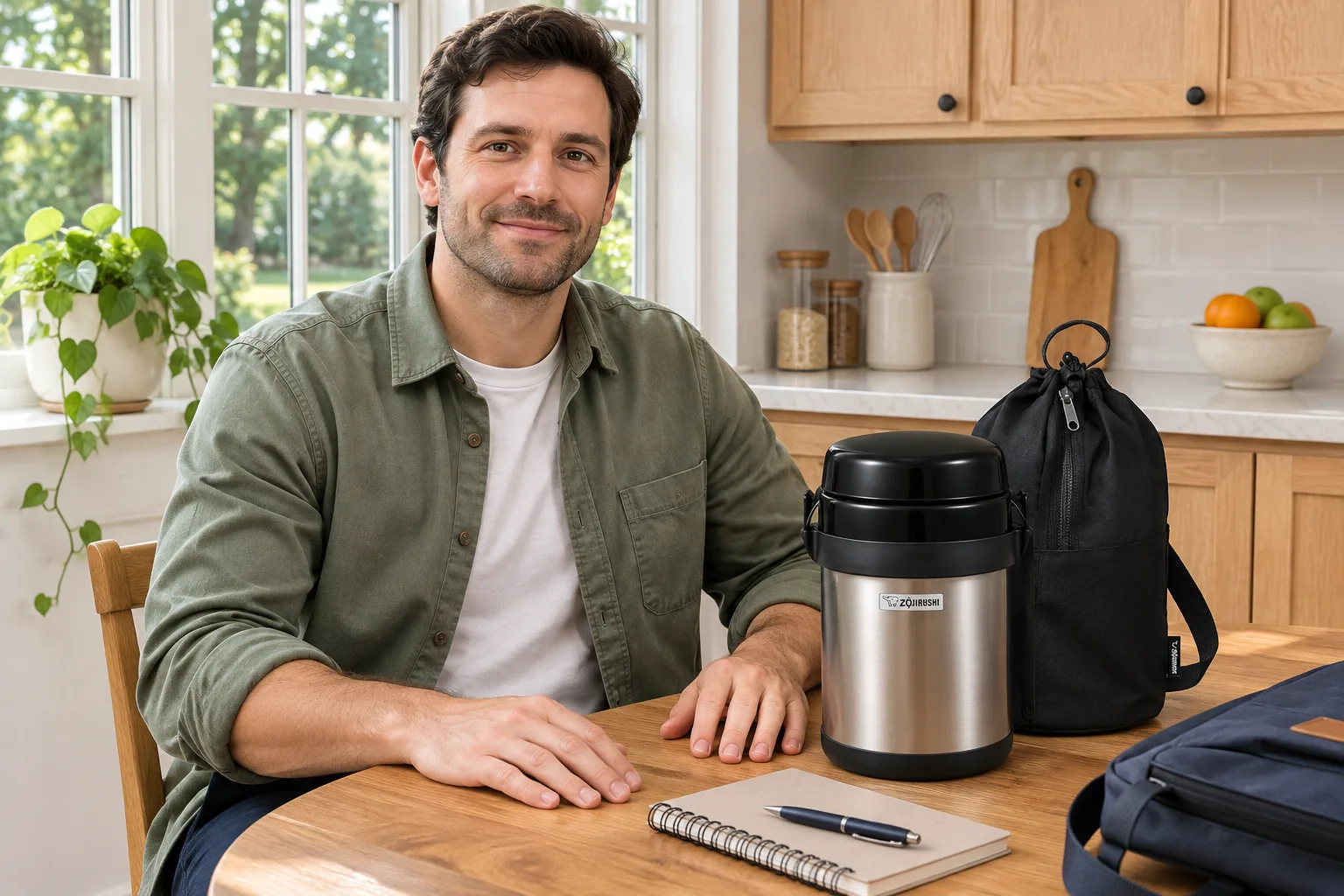
AI-generated illustration — A fictional man prepares to carry a closed SL-JBE14XA lunch jar; no food-temperature test is shown.
Which lunch setup fits a school without a microwave?
The useful comparison is between keeping food hot, keeping food cold and warming it later. Mr. Bento belongs to the first group. It can reduce your dependence on a crowded shared microwave, but requires preparation before leaving home. For a teacher with a fixed lunch break, that tradeoff may be worthwhile; for an unpredictable late meal, the timing deserves more scrutiny.
| Setup | Price status | Key capacity or requirement | Best for | Main limitation |
|---|---|---|---|---|
| Mr. Bento SL-JBE14XA | Checked new offer $64.73 | Four bowls: 15, 10, 7 and 9 oz | A divided meal with a hot main dish | Only main and soup bowls are insulated |
| Single insulated food jar | Current offer not checked | One chamber; choose its actual capacity | A generous soup or stew portion | Separate sides need their own containers |
| Insulated lunch bag with cold sources | Current offer not checked | Cold packing, not heating | Chilled lunches eaten without reheating | Does not deliver a hot meal |
| Plug-in lunch warmer | Current offer not checked | Suitable outlet and workplace permission | Someone who can warm food before lunch | Unsuitable where electrical appliances are prohibited |
View Current Offers on Amazon →
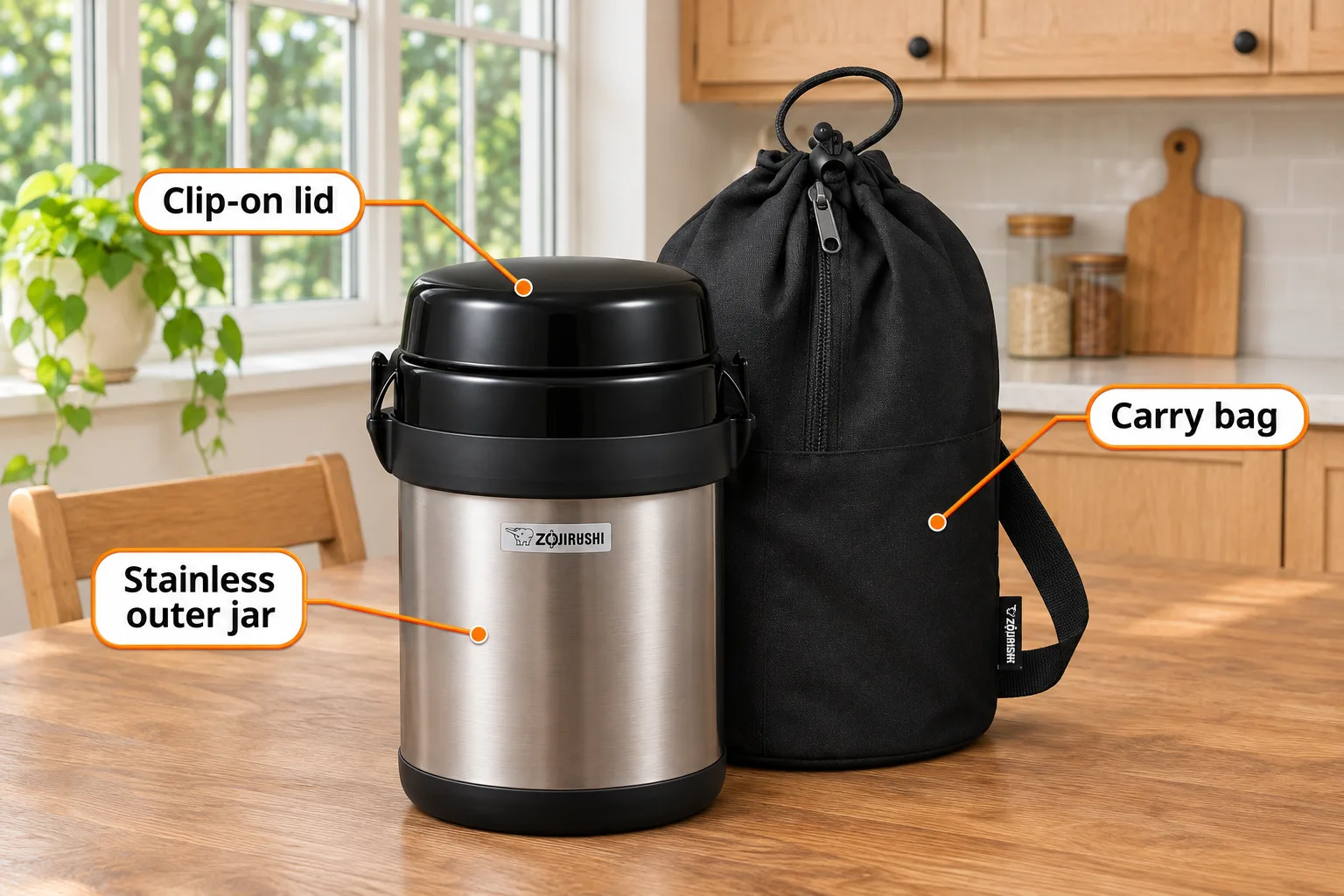
AI-generated illustration — Orange labels identify the closed lid, stainless outer jar and carrying bag; the internal bowls are not pictured.
Are all four compartments insulated?
No. The current SL-JBE14 product page states that vacuum insulation keeps the soup and main bowls hot or cold. An insulating inner lid divides those lower bowls from the two room-temperature side bowls. Think about your actual menu before treating the four-container design as four equivalent thermoses.
The main bowl holds 15 ounces, the soup bowl 9 ounces, and the large and small side bowls 10 and 7 ounces. Their sum is 41 ounces, but it is divided storage. You cannot pour a 41-ounce soup lunch into one chamber, and the upper capacity is not an additional hot-food allowance. The 9-ounce soup portion may work as an accompaniment while disappointing someone who wants soup as the whole meal.
The manufacturer's packing explanation, published September 11, 2019, places soup at the bottom, then the main bowl with its insulating lid, followed by the large and small sides. Preserve that intended arrangement. An attractive stacked-container photograph cannot establish equivalent heat retention for a different packing order.
What does the six-hour heat rating actually mean?
Zojirushi publishes 153°F after six hours under a water test starting at 203°F, with room temperature 68°F. It is a specified test condition, not a promise that a partly filled bowl of your chosen food will reach the same lunchtime temperature. We have not reproduced it or measured this jar in a backpack.
The company also lists a cold-retention result of 50°F after six hours. That number should not be repackaged as proof that refrigerated perishables remain safely chilled. The upper bowls are explicitly room-temperature storage, and the supplied carrying bag is not a refrigerator. Choose foods and a separate cold-packing system appropriate to the meal instead of relying on the word “insulated” alone.
AI-generated illustration — The same man stands beside the closed lunch jar and a school-work backpack; no heating or leak demonstration is implied.
How should you approach a hot lunch safely?
USDA's school-lunch guidance, checked during this research, calls for hot foods to stay at 140°F or above. It describes preheating an insulated container with boiling water, emptying it, adding hot food and keeping it closed until lunch. Follow the product's own instructions when applying that preparation to its parts; use care around hot water and hot lids.
USDA separately recommends cold sources with chilled perishables. Those instructions do not turn Mr. Bento's top two bowls into cold storage. Avoid assigning a perishable side to a room-temperature bowl simply because another compartment contains a hot meal. Check appropriate food-handling guidance for what you actually pack.
This jar's job is to slow temperature change. Starting with cold food and expecting a hot lunch reverses that function. If you need active heating, a different system and permission to use it are required. For a younger student, also consider whether they can carry the set and open its parts independently; we have not tested child usability.
What stands out, and where does it fall short?
The strongest feature is meal organization without a lunch-break outlet. Four covered bowls, a forked spoon with cover and the carrying bag are included. Someone bringing a main dish, a little soup and shelf-stable sides can keep those portions separate rather than mixing everything into one wide-mouth jar.
The official dimensions, excluding the bag, are 5-7/8 × 5-3/8 × 8-5/8 inches. Measure available bag space rather than relying on the illustrations. The published weight uses lbs.oz. notation: “1.15” means 1 pound 15 ounces, not 1.15 decimal pounds. Food and other school supplies add to what you carry.
There is also a material distinction: stainless steel describes the outer construction, not four stainless food bowls. The manufacturer specifies BPA-free plastic and stainless steel. Its current product page allows microwaving the four inner bowls without their lids; the steel outer jar is not a microwave vessel. We did not verify a blanket dishwasher-safe claim, so follow the exact supplied care instructions rather than a third-party shorthand.
Several bowls and lids mean more parts to wash, dry and reassemble than a single jar. The official store currently lists replacement SL-JBE14 soup bowls and valve packing, which is useful serviceability information. It does not promise every part will remain available indefinitely or establish that a latch will never break.
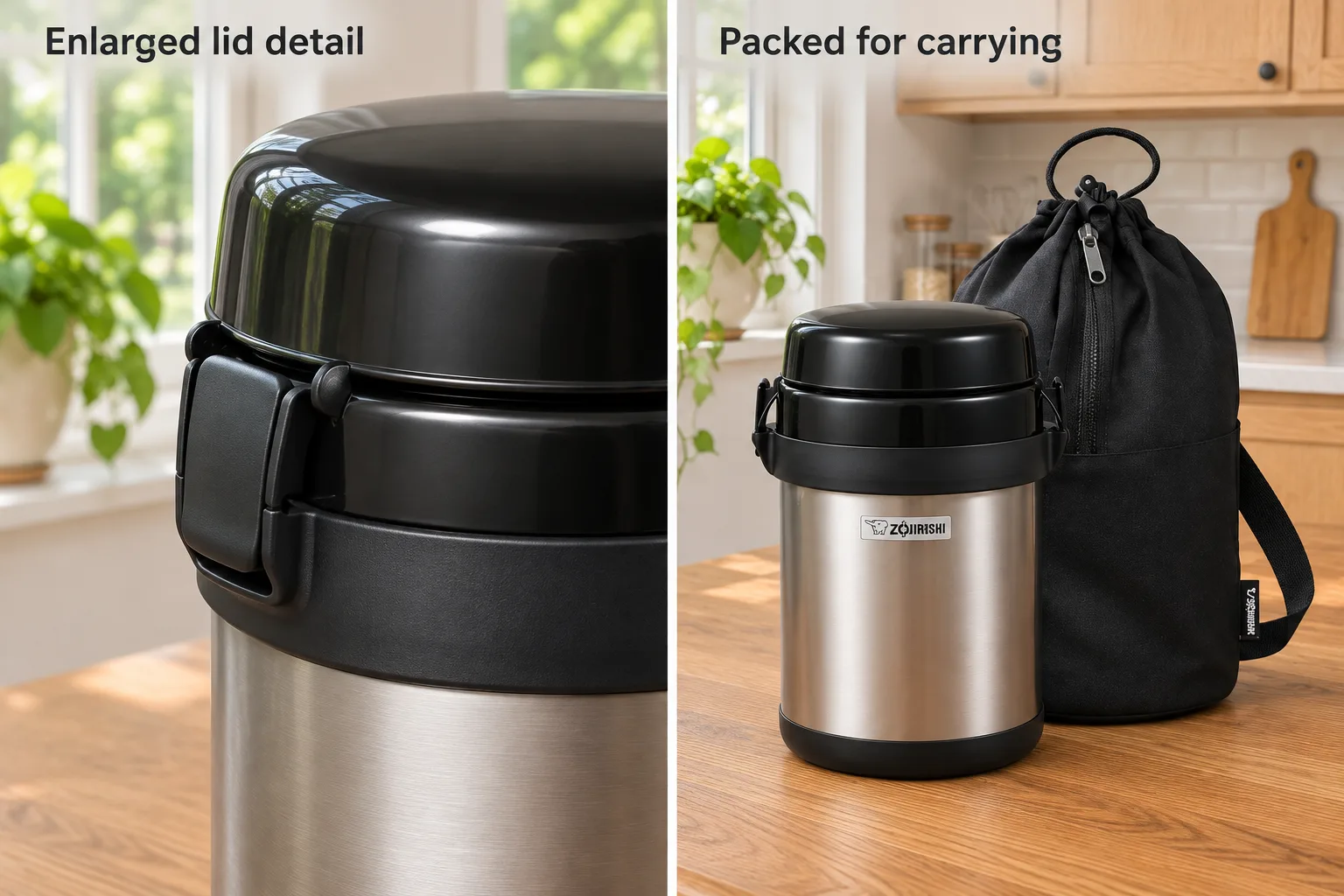
AI-generated illustration — Two panels show an enlarged closed-lid detail and the whole jar beside its bag; no packing sequence or leak test is shown.
What do owners say about warmth and daily use?
The following are individual accounts, not measured food-safety results or failure rates. The older discussion does not identify the exact current ASIN, and one reply concerns a smaller model.
- Useful after a commute, but not piping hot. FreakyWifeFreakyLife wrote on March 11, 2024 that their meal remained warm after three hours driving and three hours working. They liked the arrangement but said it was not piping hot. No measured temperature was given, so the account cannot certify safe holding for your lunch.
- Capacity and cleaning created reservations. In that same March 11 post, the same owner found the soup bowl small and described conflicting dishwasher information between a listing and their instruction book. This is one person's mixed experience, not two independent owners. Their speculation about exterior material does not override the current manufacturer's stainless-steel specification.
- A teacher's experience concerned Ms. Bento. idiosyncrisia replied on March 11, 2024 that a smaller, possibly Ms. Bento model helped their wife avoid a shared school microwave. They worried about thin latches but did not report a latch failure. The different version limits what this tells us about SL-JBE14XA durability or capacity.
Who should buy it, and who should skip it?
Choose this model if your lunch has a main hot portion, small separate sides and a routine that allows preparation and cleaning. It is a more specific fit than a generic “best school lunch box”: the bowl layout is the reason to choose it over one larger chamber.
Skip it if you want four hot compartments, a large soup-only meal, all-metal food containers or active reheating. For chilled lunches, assess a proper cold-packing setup instead. Before gifting one, ask what the recipient eats and whether the school permits the relevant lunch system; a premium jar does not solve a mismatch between food and compartment design.
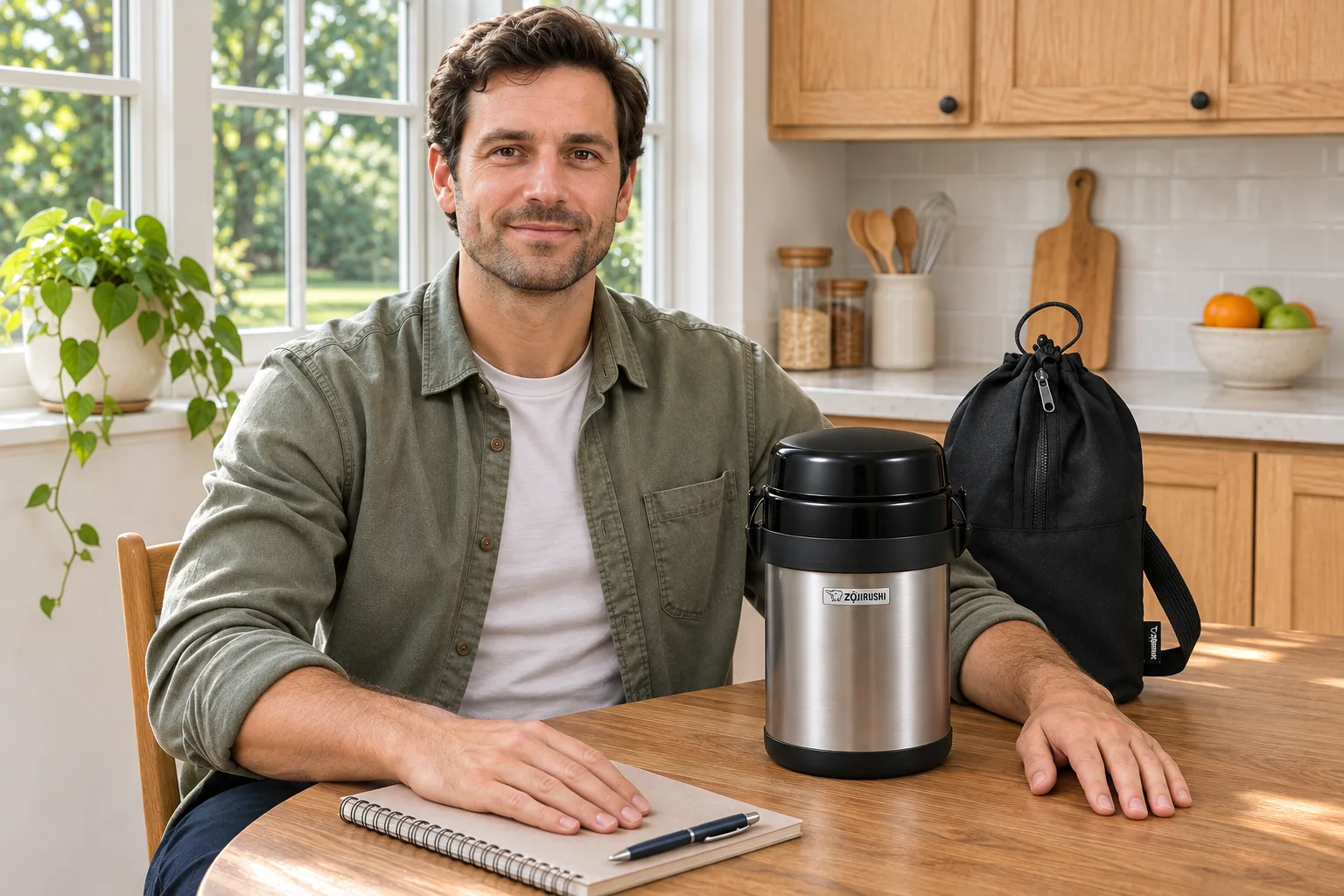
AI-generated illustration — The same man poses beside the closed jar with hands separated; this is an appearance illustration, not a user testimonial.
How we researched this guide
We matched the selected Amazon offer to the current SL-JBE14 manufacturer page, specifications and packing explanation, consulted USDA lunch guidance, and read the original dated community discussion. The older user-supplied ASIN redirected to a different color/model listing; the selected Stainless SL-JBE14XA offer above is the version covered here. We did not conduct thermal, leak, dishwasher or classroom tests. Five AI-generated illustrations show the closed Stainless appearance only, guided by official external dimensions; they do not demonstrate internal packing or safe food temperature.
FAQ
Will all four bowls keep food hot?
No. Zojirushi says the soup and main bowls are insulated. The two side bowls above the insulating inner lid stay at room temperature. They are not refrigerated compartments either.
Can the bowls go in a microwave?
The current SL-JBE14 product page allows the four inner bowls in a microwave, excluding their lids. Never microwave the steel outer jar. Follow the instructions supplied with your exact unit.
Does the 41-ounce capacity mean a 41-ounce hot-food jar?
No. It totals the 15-ounce main bowl, 9-ounce soup bowl and 10- and 7-ounce side bowls. Only the main and soup sections form the insulated lower arrangement.
Does the six-hour rating guarantee a safe lunch?
No. The published 153°F result is a water test starting at 203°F in a 68°F room. Your food, filling level and handling differ. USDA guidance calls for hot lunch foods to stay at 140°F or above; warmth alone does not establish that.
Which Mr. Bento model and accessories are covered here?
The checked offer is Stainless SL-JBE14XA, ASIN B07PWNJSB7. It includes four bowls, a forked spoon with cover and a carry bag. The older supplied SL-JAE14 listing redirected to another version, so we matched the selected current model instead.