ThermoPro TP829 vs TP20: Probes, Range & App Limits
Quick Verdict
The TP829 makes sense when you will actually use three or four channels; the TP20 costs less for a two-channel cook. Both are receiver-based RF systems with wired probes, not phone-connected wire-free probes. Treat advertised range as an upper claim rather than a guaranteed path through your house.
Buying Guide Notes · First published:
Compiled from public sources · Written using published specs and user feedback.
As an Amazon Associate I earn from qualifying purchases.
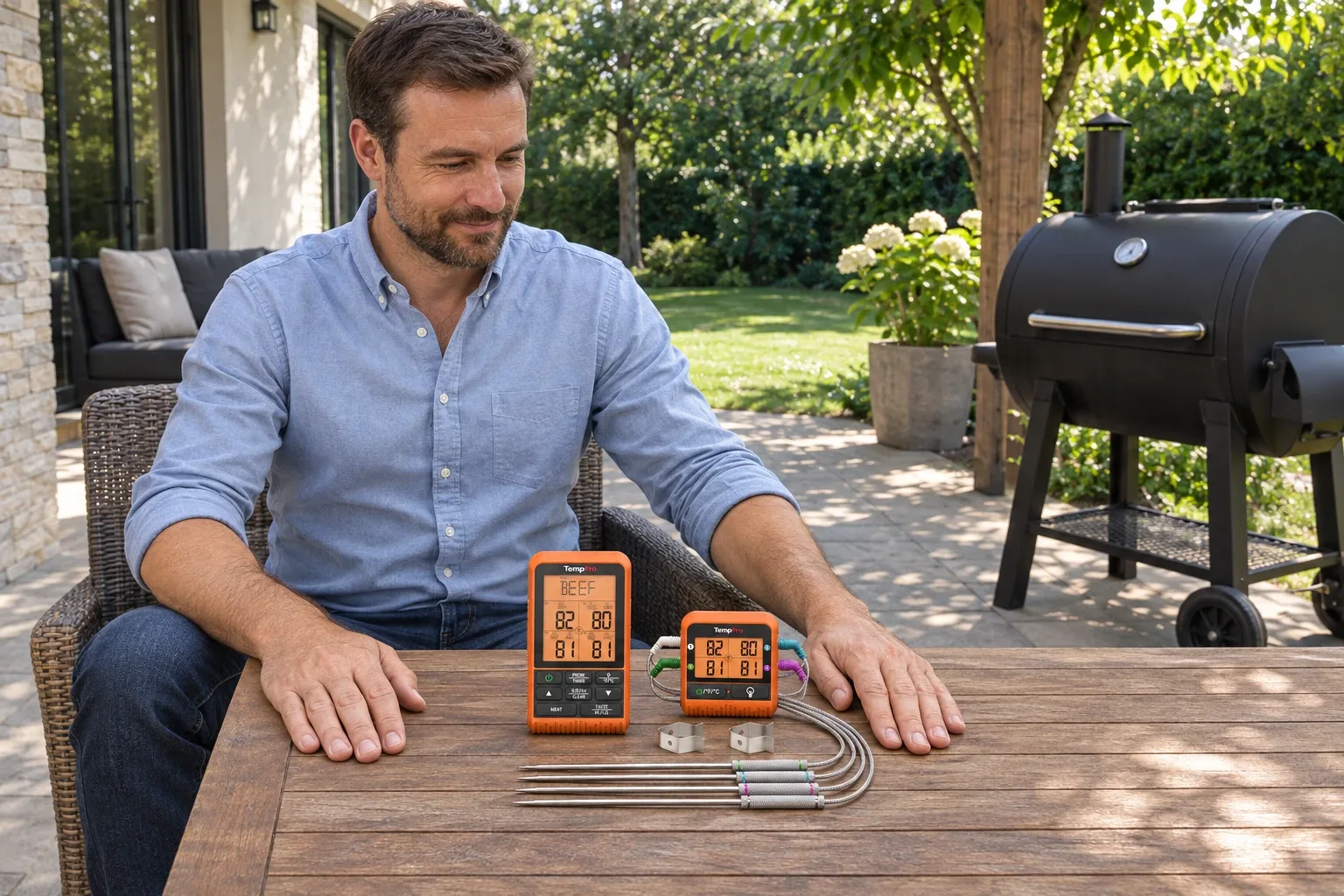
For smoking, the ThermoPro TP829 is the more useful option when two channels are not enough, while the TP20 is the cheaper choice for a simpler cook. The current offers use TempPro branding and dedicated RF receivers; neither is a phone-connected, completely wire-free probe system. The TP829’s advertised longer range does not establish that it will work through every wall in your house.
Compiled from public sources, checked November 11, 2026. We did not cook with, calibrate or range-test either thermometer.
AI-generated illustration: a dry tabletop setup, not a temperature or radio-range test.
Which versions and prices are being compared?
Amazon identifies the four-probe offer as TempSync PLUS TP829, part TP829, ASIN B08KZR4F23. Its new offer was $49.99, sold by TempPro Inc and shipped by Amazon, with 4.5 stars from 7,341 ratings. The two-probe comparison was TempSync CORE TP20B, part TP-20, ASIN B01GE77QT0, new at $35.99 from the same seller and shipper, with 4.6 stars from 33,173 ratings.
Those rating counts are listing snapshots, potentially pooled across variations and older branding, not controlled measurements. TempPro’s current site explicitly explains the ThermoPro-to-TempPro name change and possible older-name packaging. The four-probe manufacturer page uses the suffix TP829B, whereas the Amazon model field says TP829; check delivered labeling and instructions rather than silently assuming every historical revision is identical.
| Option | Checked Amazon price | Main difference | Best for | Who should skip it |
|---|---|---|---|---|
| TP829 / current TempSync PLUS | $49.99 | Four color-coded wired probes; advertised up to 1,000-ft RF link | Several food measurements or food plus pit monitoring | A buyer expecting phone graphs or no probe cables |
| TP20B / current TempSync CORE | $35.99 | Two wired probes; advertised up to 500-ft RF link | A simpler two-channel setup | Someone who already needs three or four simultaneous readings |
The observed difference is $14.00, before checkout-specific charges. We did not apply a coupon, purchase either product or establish a historical low. The comparison uses the displayed new offers, not a cheaper mixed used-and-new price.
TP829: View Current Offers on Amazon →
TP20: View Current Offers on Amazon →
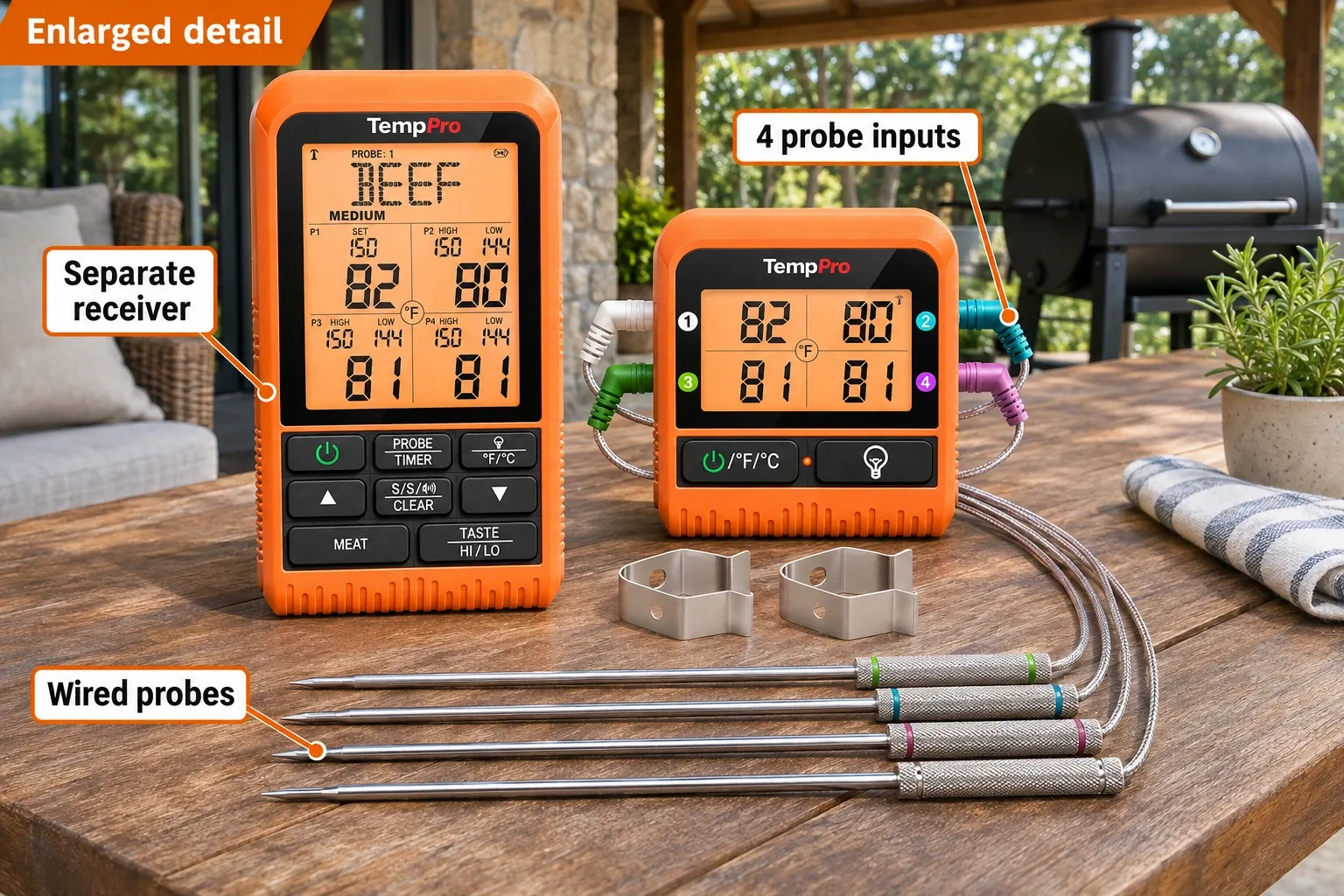
AI-generated illustration: enlarged visible features; displayed numbers are illustrative.
When do four probes matter more than two?
Count the measurements you actually want during a normal session. Two separate pieces of food can occupy both TP20 channels. If you also want a separate pit reading, you would need another channel or a different monitoring arrangement. The TP829 gives you four available channels, making that allocation less restrictive.
For example, one ambient channel plus two food channels uses three inputs. That is a concrete reason to consider the TP829 rather than simply paying for a bigger number on the box. Conversely, someone who consistently uses one food measurement and one ambient measurement may find no practical benefit in owning two extra channels.
More channels also mean more cables to identify, route and put away. Color coding helps distinguish the TP829 probes, but it cannot decide which measurement belongs to which food. Plan your channel labels before a busy gathering, and follow the delivered manual for positioning and handling. Our illustrations do not demonstrate safe placement in food or a cooker.
Does wireless mean there are no probe cables?
The wireless part is the link to the handheld receiver. The metal probes still connect by wires to the transmitter. That distinction matters if you are comparing these products with a completely wire-free probe, especially for a cooking arrangement where a cable would interfere with movement.
Both selected listings describe RF technology and no required app. That can suit a cook who wants to glance at a dedicated screen without involving a phone. It is a drawback if your buying requirement is smartphone notification delivery, remote internet access or a graph stored in an app; those features are not established for these selected models.
Amazon’s TP829 page also contained generic promotional wording about notifications on “smart devices,” while its own comparison table marked the product App Required: no. The dedicated receiver description is consistent with the current brand documentation. We would not interpret that isolated promotional phrase as evidence of phone support.
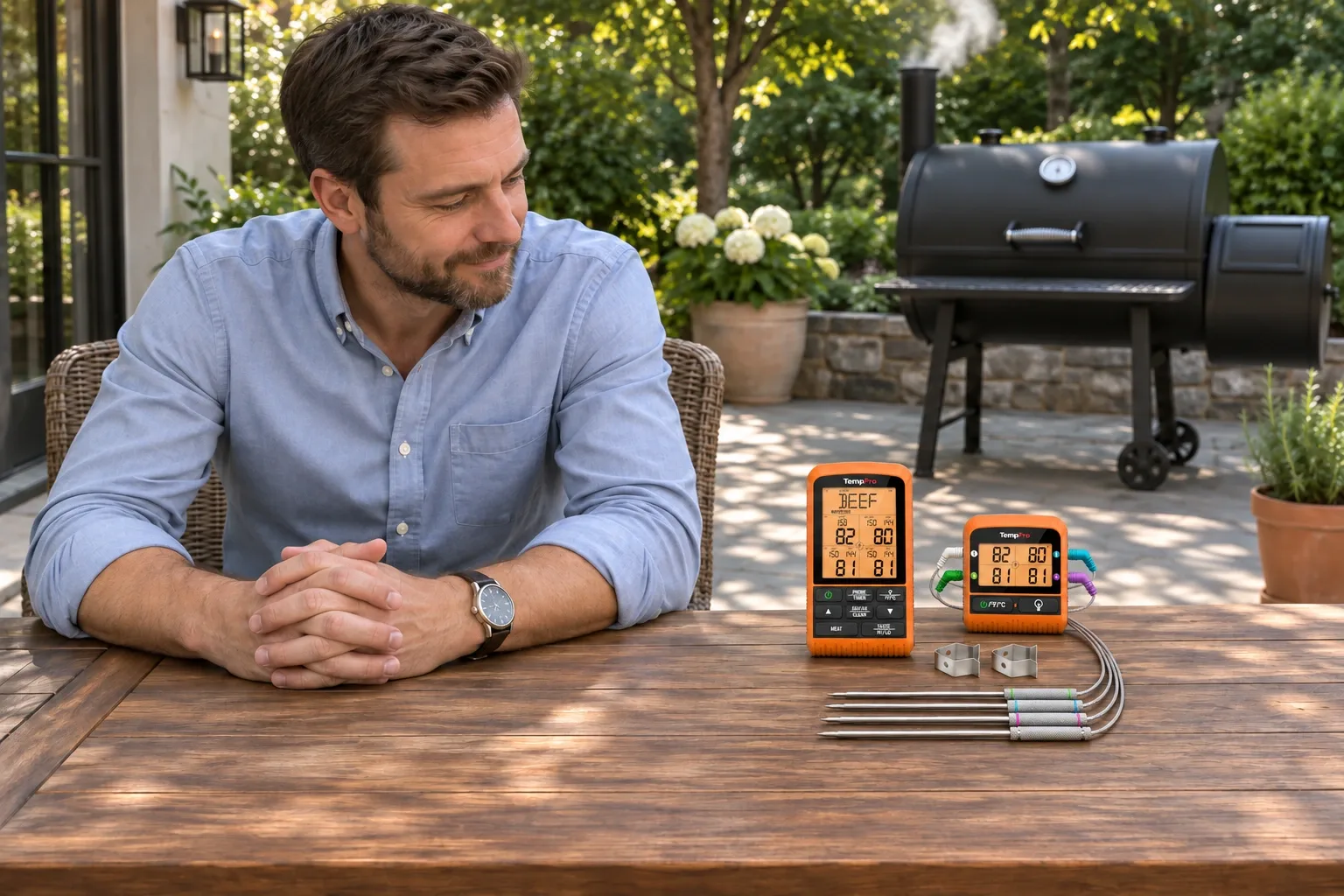
AI-generated illustration: receiver-checking scenario; no food safety or connection performance is demonstrated.
Is the TP829’s 1,000-foot claim twice as useful?
The two current offers advertise up to 1,000 feet for the TP829 and up to 500 feet for the TP20B. These are product claims, not distances we measured. A doubled headline number does not demonstrate doubled coverage through your kitchen, brick walls, patio doors or particular placement.
If staying within a certain room is essential, evaluate that actual path while the seller’s applicable returns remain available. Do not assume that a receiver seeing the transmitter outdoors proves the same connection will survive through every indoor location. Neither our AI images nor an owner’s successful backyard setup establishes performance at your address.
For a small patio where two channels are enough, the TP829’s extra advertised distance alone may be a weak reason to spend more. For a cook already needing four channels, the range claim is an additional specification to consider, not the only reason for choosing it. We have no measured dropout comparison establishing a reliability winner.
What do accuracy specifications and probe problems tell you?
The current manufacturer pages specify temperature measurement from 14°F to 572°F and accuracy of ±1.8°F for these families. Those are manufacturer specifications, not our calibration results. They do not mean that every probe, connection and placement will produce the correct reading indefinitely.
A reading at the probe tip and an instant-read measurement taken somewhere else need not be directly comparable. Before declaring a fault, check the relevant manual and ask support about its approved verification procedure. We have not established a user-adjustable calibration control or a guaranteed repair for either selected unit.
The probe wires are also a practical ownership consideration. We did not verify replacement-probe compatibility or include a replacement set in the price comparison. Matching the brand name alone is insufficient to promise that an arbitrary probe will work. Follow the current instructions for the delivered revision rather than applying community cleaning or heating experiments to the device.
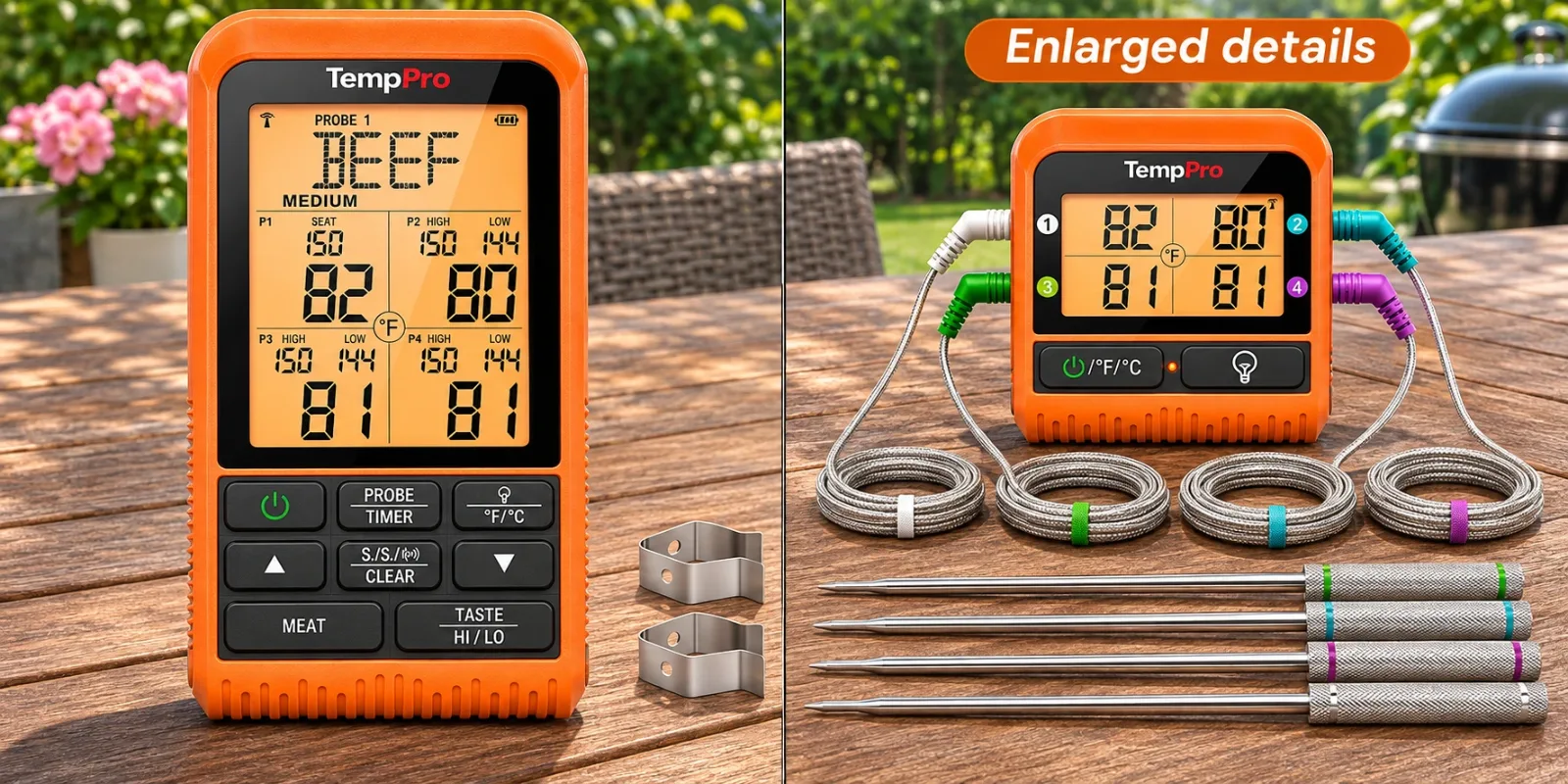
AI-generated illustration: enlarged controls and connection details, not installation or calibration instructions.
What owners say, including an important correction
-
One owner liked the TP829B set over several years. Bassmasa, June 28, 2025, described three years with the set and no issues. Their reply was in a TP829B discussion, but it did not identify the current TempPro-branded Amazon production run. It supports one positive experience, not a measured durability advantage over the TP20.
-
An accuracy concern was later reconsidered. NoMoFoMo_, June 28, 2025, initially questioned TP829B readings during an ice-water check. In a June 29 update, the same poster reported a more normal result with another check and said they no longer thought there was an issue. Reporting only the initial complaint would falsely turn an unresolved test setup into a confirmed defect.
-
Old TP20 durability reports are mixed. A February 13, 2023 discussion includes a commenter reporting two TP20 units failing within about a year and receiving replacements. The original post has since been removed, and we accessed that specific comment through indexed public text rather than a current exact-SKU comparison. Its age and unspecified revision prevent treating it as the failure rate of today’s TP20B offer.
We exclude deal-bot posts and do not turn these anecdotes into consensus. We also do not adopt suggested boiling, baking or recalibration procedures from the comments as manufacturer instructions. The useful lesson is to preserve updates and version limits when evaluating complaints.
Who should buy each one, and who should skip both?
Choose the TP829 if you can name three or four simultaneous measurements you will use, want a dedicated receiver and accept wired probes. At the checked $14 premium, the additional channels are a clear functional difference. Skip it if the extra channels will remain unused or if your requirement is phone-based monitoring.
Choose the TP20B if two inputs cover your normal cooking and the lower checked price matters. Skip it if reserving one channel for the smoker would leave too few food channels. Buying a two-channel model now and immediately needing another monitoring device may undermine the initial saving.
Compare another product category if you require wire-free probes, a rechargeable-only setup, internet access or automatic historical graphs. We have not selected an unverified alternative ASIN just to fill a table. Confirm those requirements explicitly instead of assuming the word “wireless” includes all of them.
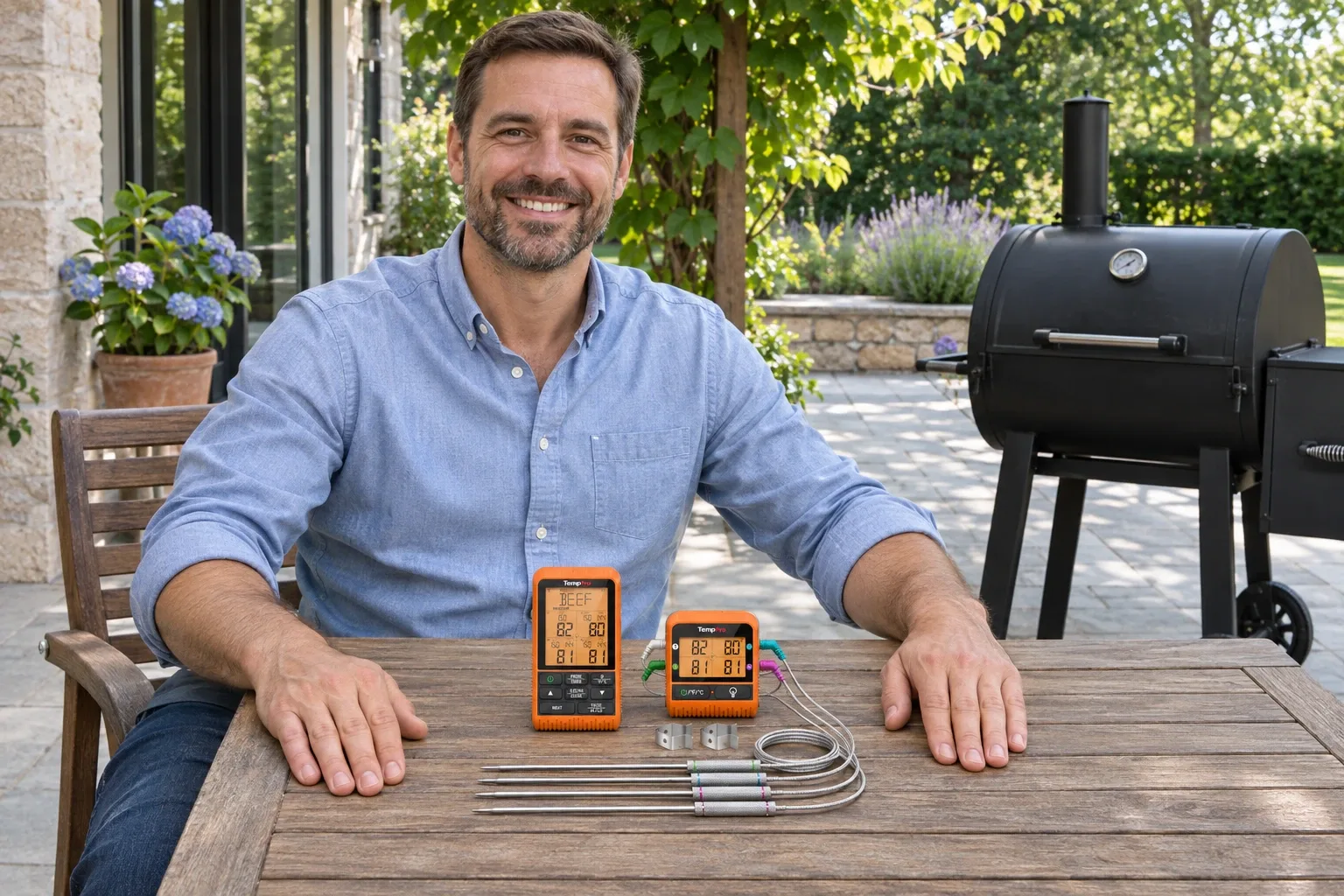
AI-generated illustration: person and product portrait; not firsthand ownership.
How we researched this comparison
We checked the exact US Amazon model fields, new offers and reference appearance, current TempPro manufacturer pages, its linked TP829B manual and dated Reddit discussion including the original poster’s correction. The brand’s current receiver dimensions supplied nominal illustration scale; Amazon’s isolated item-length field was not treated as a measured receiver height.
This article was compiled from public sources. No smoking session, ice-bath calibration, food-safety test or radio-distance trial was performed. All five images are AI-generated illustrations using the TP829 appearance as the single example; displayed readings and surrounding equipment do not prove performance.
Pros
- + TP829 provides four color-coded probe channels
- + TP20 offers two-channel monitoring at a lower checked price
- + Standalone receivers avoid requiring a phone app
- + Current manufacturer manuals and model details are available
Cons
- - Probe wires still need routing and care
- - RF distance claims do not guarantee indoor coverage
- - No temperature accuracy or range tests were performed
- - Older ThermoPro reports may describe earlier revisions
Sources and verification status
Verification status: compiled from public sources
Data updated:
Verified on:
Sources
- Selected TP829 offer and selected TP20B offer, checked November 11, 2026.
- Current TP829B manufacturer specifications and linked instructions and TP20B specifications.
- Dated owner discussions and the correction are linked individually above; they do not establish current-ASIN defect rates.
FAQ
Are the TP829 and TP20 Bluetooth thermometers?
The selected TempSync TP829 and TP20B offers use dedicated RF communication between a transmitter and receiver. Their wireless description does not mean Bluetooth, Wi-Fi, a phone app or wire-free food probes.
How many channels remain if one probe measures the smoker?
On the four-probe TP829, assigning one channel to ambient monitoring leaves three for other measurements. On the two-probe TP20, it leaves one. That is channel arithmetic, not a guarantee about where or how to install an ambient probe.
Does the TP829 guarantee a 1,000-foot connection indoors?
No. The listing advertises up to 1,000 feet, compared with up to 500 feet for the selected TP20B. Walls, placement and interference can affect real coverage; we did not test a house, patio or smoker setup.
Why does Amazon say TempPro instead of ThermoPro?
The current brand site states that ThermoPro is now TempPro and that older-name packaging may still arrive. Amazon identifies the selected four-probe model as TempSync PLUS TP829 and the comparison model as TempSync CORE TP20B. Do not confuse either with TempSpike products.
Can a concerning ice-water reading prove a faulty probe?
Not on its own. One June 2025 TP829B poster questioned accuracy, then updated the discussion after a different check and said they no longer thought there was an issue. Follow the manufacturer’s relevant checking and support procedure; we do not provide a calibration result or a universal repair.
You might also like
Sports & Outdoors
Product comparisonAquatabs vs LifeStraw for Emergency Kits: Key Limits
Compare Aquatabs 397mg and the original LifeStraw for an emergency kit: batch size, waiting time, virus limits and the extra gear each approach needs.

Electronics
Product comparisonAnker C200 vs C920 for Mac: Focus & Low-Light Limits
Compare the C200 and original C920 for a Mac desk: resolution, autofocus, framing, USB connections and dated owner reports, without pretending to test picture quality.