Channellock 460 vs 440: Jaw Size and Weight
Buying Guide Notes · First published:
Compiled from public sources · Written using published specs and user feedback.
As an Amazon Associate I earn from qualifying purchases.
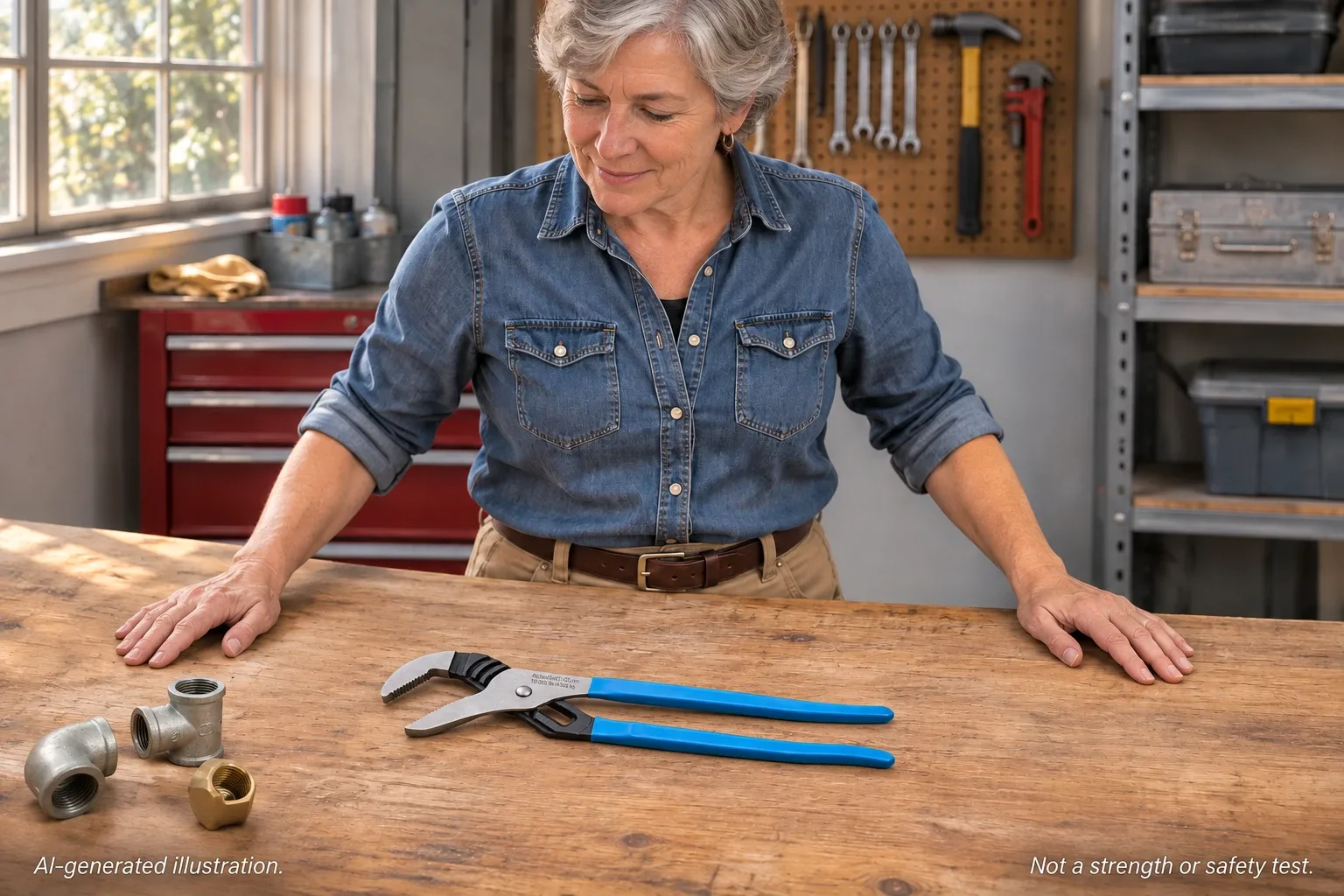
Choose the Channellock 440 for a shorter, lighter straight-jaw plier when its published 2.25-inch capacity covers your work. Choose the 460 when you specifically need its larger current listed 3.75-inch capacity and can accommodate a 16.5-inch tool. The 460 is not automatically the better everyday purchase: its extra reach, head size and weight have to earn their place in your kit.
Checked November 15, 2026. This comparison is compiled from public sources, not gripping or torque tests. Amazon showed new 460 ASIN B00004SBCW at $31.95, sold and shipped by Amazon. The new 440 offer, ASIN B00004SBCU, was $23.97, sold by Hearthshire and shipped by Amazon; the two offers therefore had different sellers.
AI-generated illustration: all five images use a 460-style tool only. They do not show a measured side-by-side comparison with the 440 or a completed work test.
What changes between the 460 and 440?
Both are traditional straight-jaw tongue-and-groove pliers with blue comfort grips. The main purchasing difference is size, rather than one model adding an entirely different adjustment mechanism. Check the plain 440 and 460 numbers: similarly named push-button or other jaw-shape versions are separate comparisons.
The table uses the manufacturer’s current product pages. These are published values, not our measurements of the units in Amazon’s warehouses.
| Specification | Channellock 460 | Channellock 440 |
|---|---|---|
| Observed new price | $31.95 | $23.97 |
| Overall length | 16.5 inches | 12 inches |
| Listed jaw capacity | 3.75 inches | 2.25 inches |
| Jaw length | 2.56 inches | 1.5 inches |
| Joint thickness | 0.59 inch | 0.5 inch |
| Listed weight | 2.67 lb | 1.64 lb |
| Best fit | A known need for a larger opening | A smaller general-use tool when capacity is sufficient |
At these checked prices, the 460 costs $7.98 more. The listed weight difference is 1.03 pounds. Those are calculations from the observed prices and current specifications, not measurements or a permanent price relationship.
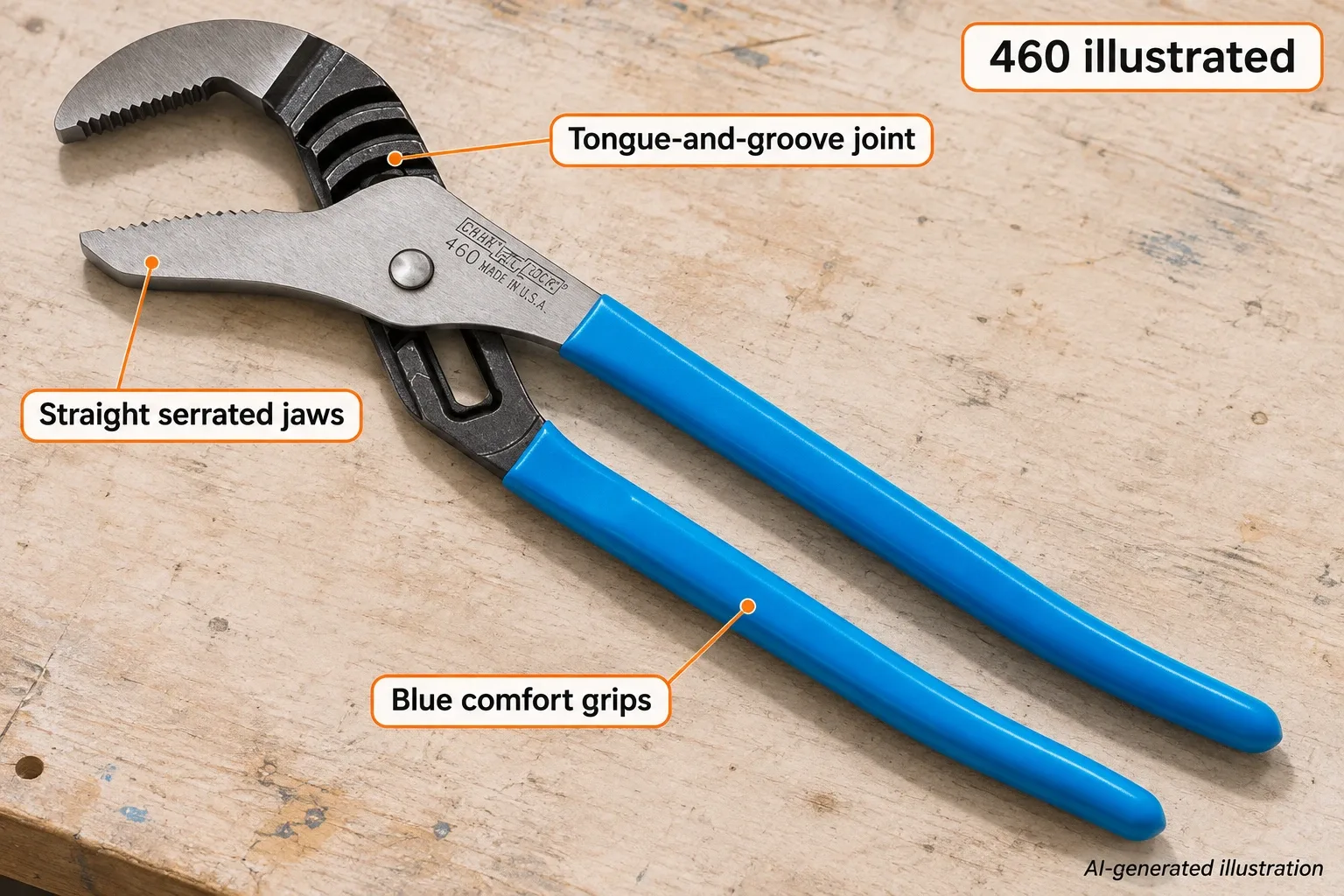
AI-generated illustration: enlarged 460 features only. The illustrated opening is not a calibrated maximum-capacity demonstration.
Why do older listings give the 460 a different capacity?
The current manufacturer page lists 3.75 inches and 2.67 pounds. Older official catalog entries surfaced in search show different numbers: a 2023 catalog excerpt lists 4.25 inches and 3.14 pounds, while an updated 2023 excerpt lists 3.75 inches but retains the older weight.
We could read those indexed manufacturer excerpts, but full catalog retrieval was limited by PDF size. We have not established whether the differences represent corrections, production changes or another cause. Do not combine the largest opening from one document with the lowest weight from another and call that a verified unit.
For this comparison, the current product page is the primary specification source. If your project depends on a close capacity limit, confirm the exact current product with Channellock before ordering. We cannot guarantee which historical geometry or measured weight an individual retail unit will have.
A familiar model number is useful, but it does not justify ignoring conflicting documentation. The sensible response is to acknowledge the discrepancy and ask a targeted question, not invent an explanation about steel quality or manufacturing changes.
When is the larger 460 worth carrying?
The 460 makes sense when a specific task requires an opening beyond the smaller tool’s documented capacity, and the surrounding workspace allows its larger body. Buyers who already know the size of the objects they need to grip can make a more useful decision than shoppers choosing the biggest tool on principle.
Its longer handles and larger head also affect where you can position it. An object may fit between the jaws while nearby obstructions leave little room for the handles. Measure the actual work area as well as the object; maximum capacity alone is not an access guarantee.
The added weight matters most when you carry the tool routinely rather than leave it on a bench or in a vehicle. We have not measured fatigue or tested leverage. Our inference is simply that a longer, heavier tool is a different carrying commitment, even when the purchase-price difference is modest.
Skip the 460 if you cannot identify a need for the larger opening and already find a 12-inch tool sufficient. Buying extra capacity that stays unused can make your bag heavier without making ordinary jobs easier.
Who is better served by the 440?
The 440 is the more manageable starting point between these two when its capacity is enough. It is shorter, has a thinner listed joint and weighs less according to the current specifications. Those differences are relevant to storage, access and carrying, not a promise that it will fit every confined space.
For a home toolkit, start with the tasks you actually do and the tools you already own. If another tool already handles large openings, the 440 may fill the more useful gap. For a trade apprentice, follow the actual employer or training-program tool list rather than substituting advice from a different job or local.
Skip the 440 when your known requirement exceeds its 2.25-inch listed opening, or when you need a different jaw profile or tool type altogether. This article does not make a straight-jaw plier the best answer for every material or fastener.
The cheaper price also comes from a different seller in the offer checked here. Review the current seller, condition and delivery information before checkout instead of assuming both listings share identical purchasing terms.
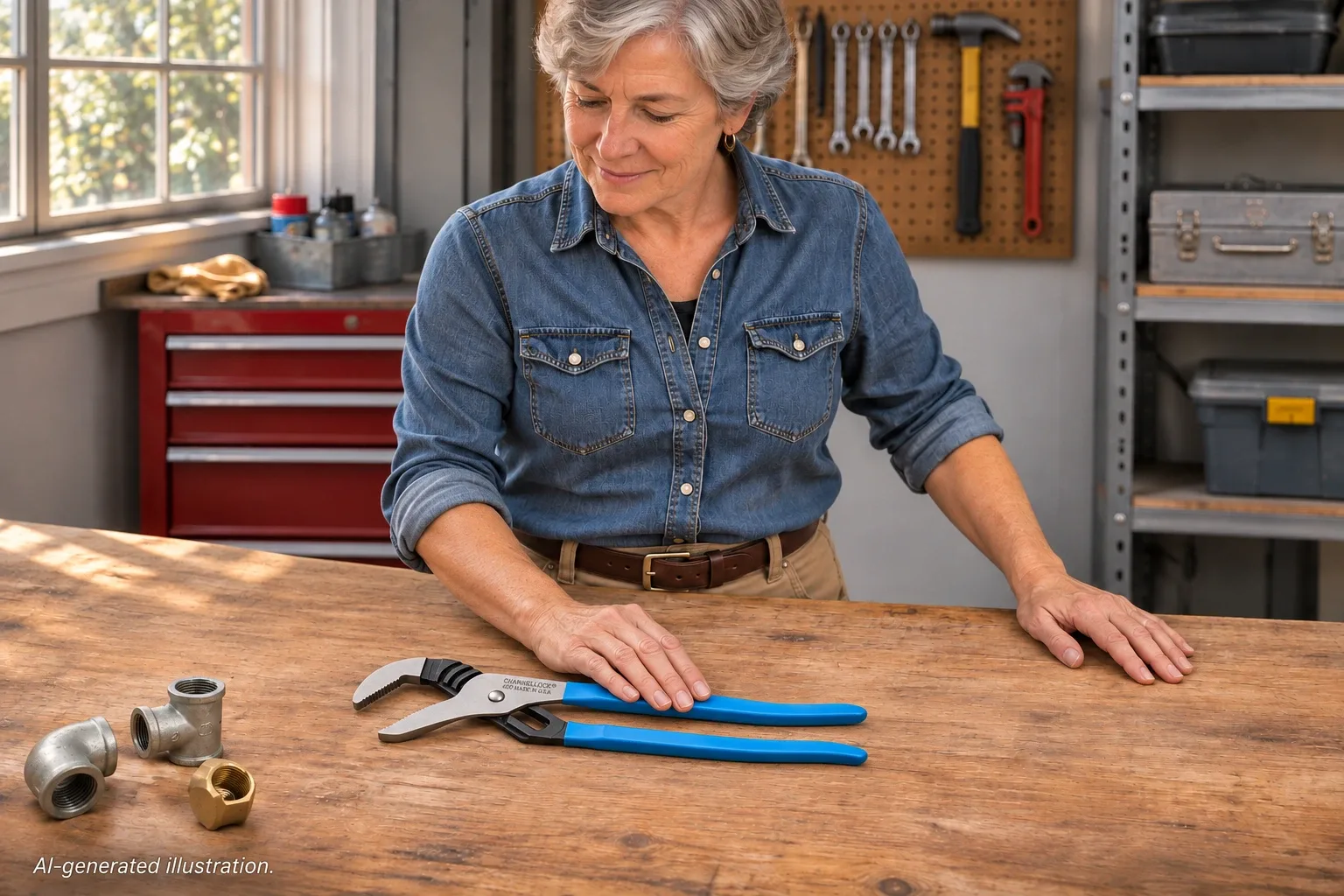
AI-generated illustration: tool-selection context with loose fittings, not an instruction for applying force or completing a plumbing repair.
What do both tools leave out?
Neither model becomes a smooth-jaw, non-marring tool merely because it has familiar blue grips. The teeth are a deliberate part of the design. If preserving a finished surface is the priority, investigate the appropriate tool for that surface rather than assuming this comparison proves damage-free gripping.
Similarly, the two blue grips are described by Channellock as comfort features. We are not treating them as an electrical-insulation rating or recommending either tool for energized work. The photographs contain no electrical work or load testing.
Both models also require choosing an adjustment position and a workable grip for the object. This is a buying comparison, not a substitute for manufacturer instructions or task-specific training. We have not verified a safe torque limit, maximum pulling force or universal handle position.
If your real objection is the traditional adjustment mechanism, the next comparison should involve a different documented mechanism, not just a larger version of the same kind of tool. We have not verified another model’s current US offer here, so we are not adding an unresearched purchase link.
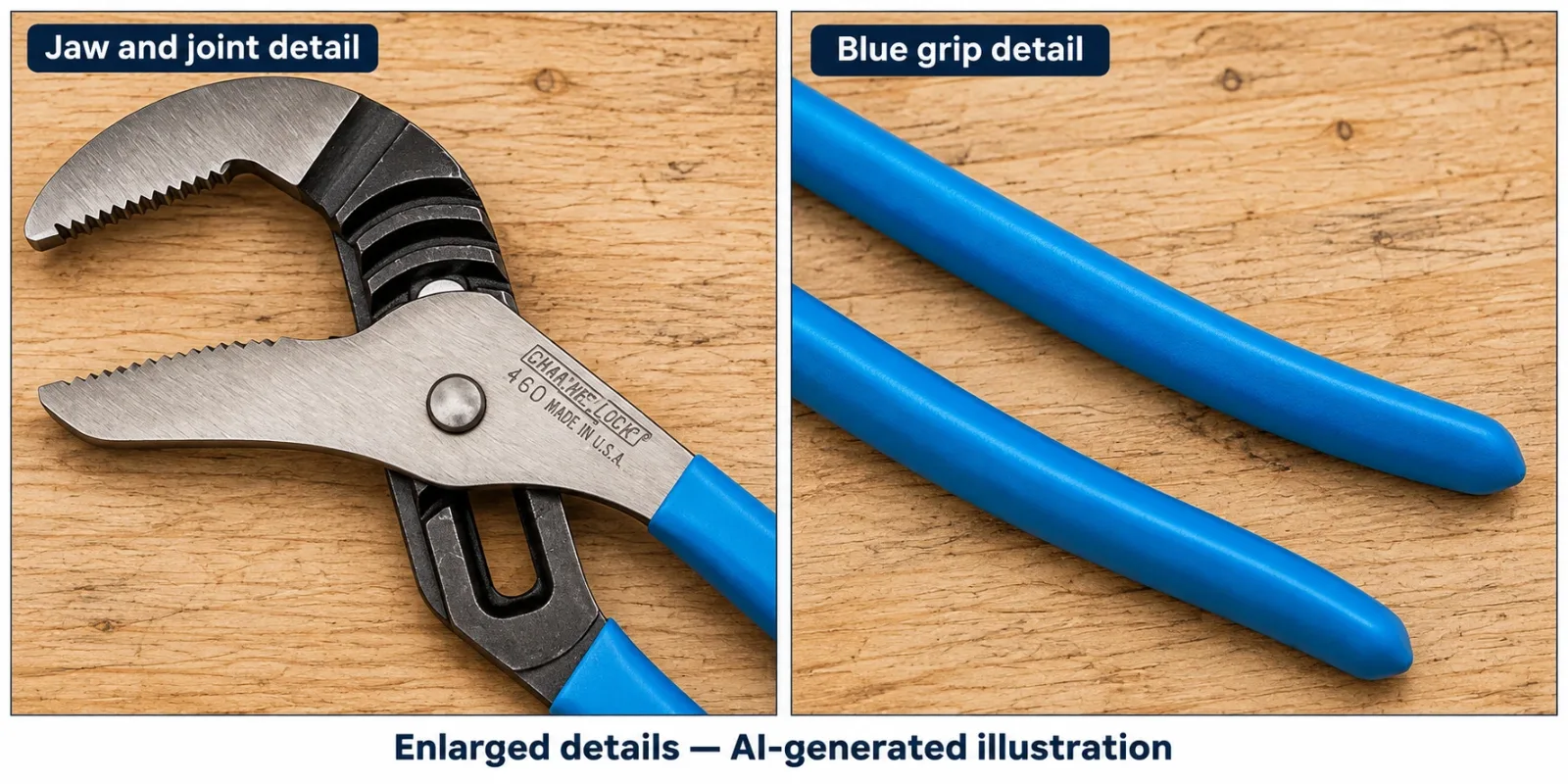
AI-generated illustration: exterior details of one tool. Close-ups do not establish tooth hardness, maximum opening or electrical safety.
What owners say about durability and design
- An owner was comfortable buying the 460 again. In an October 28, 2022 post, slycoder compared older 460 pliers with a pair they dated to around 2015. They described broadly similar use and said they would buy them again. That is a personal comparison of older examples, not proof of current stock’s weight or a lifetime guarantee.
- A mixed brand-level assessment. Paul_The_Builder wrote in a reply on October 28, 2022 that Channellock tools they had used were durable and reasonably priced, while criticizing slow innovation and perceived quality changes. The comment does not identify every model or establish a defect in today’s 440 or 460.
- Some workers choose the large size deliberately. In a June 23, 2023 discussion, max1mx said they used 460s alongside another 12-inch plier. That supports treating sizes as complementary choices for an individual’s work, not a consensus that every buyer needs the largest model.
We did not turn speculation about steel changes into a material specification. The older reports are useful context, with clear limits on generation, application and personal preference.
How we researched this comparison
We checked both exact Amazon new offers, the current 440 and 460 manufacturer pages, indexed older official catalog entries and dated public owner discussions. We kept seller differences and specification conflicts visible. No gripping, torque, corrosion, fatigue or durability tests were performed.
The purchase rule is to buy sufficient capacity for a known task with a size you can comfortably store and use. Between these two, that often points to the 440 for general carrying and the 460 for a deliberate larger-opening need; it does not make either a universal winner.
Channellock 460 — larger opening:
View Current Offers on Amazon →
Channellock 440 — shorter and lighter:
View Current Offers on Amazon →
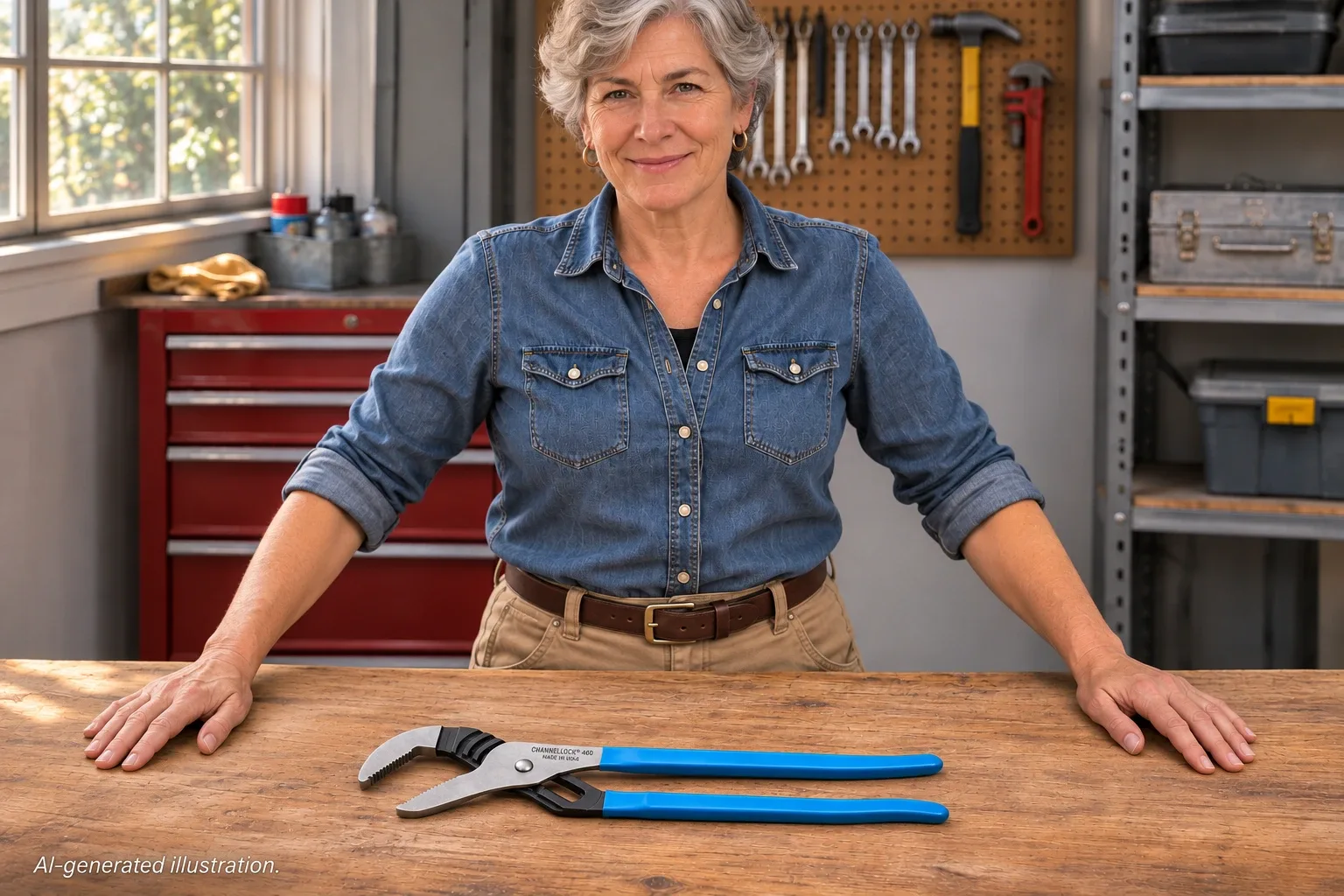
AI-generated illustration: approximate scale based on the 460’s published length. No 440 appears in these images.
Pros
- + 460 offers larger currently published jaw capacity
- + 440 is shorter, lighter and cheaper in the offers checked
- + Both use high-carbon steel and traditional straight-jaw construction
Cons
- - 460 adds length and weight for carrying and confined access
- - Old 460 catalog numbers conflict with current page
- - Serrated jaws are not a universal non-marring solution
Sources and verification status
Verification status: compiled from public sources
Data updated:
Verified on:
- Current official Channellock 460 specifications
- Current official Channellock 440 specifications
- Older 2023 official catalog; indexed excerpt reviewed, full PDF retrieval limited
- Updated 2023 official catalog; indexed excerpt reviewed
- slycoder older 460 comparison October 28, 2022
- Paul_The_Builder mixed brand-level experience October 28, 2022
- max1mx using 460 June 23, 2023
- Exact new 460 offer November 15, 2026
- Exact new 440 alternative offer November 15, 2026
FAQ
What is the main difference between Channellock 460 and 440?
Current manufacturer pages list the 460 at 16.5 inches long with 3.75-inch jaw capacity, versus 12 inches and 2.25-inch capacity for the 440. Choose around the actual opening and access your work requires.
How much heavier is the 460?
The current pages list 2.67 pounds for 460 and 1.64 pounds for 440, a calculated 1.03-pound difference. We have not weighed samples, and older 460 catalog figures differ.
Why does an older 460 catalog show 4.25 inches?
Older official catalog excerpts surfaced in search show different capacity and weight numbers. We use the current 3.75-inch product-page value and have not established the cause or measured individual retail units.
Which model is better for carrying every day?
The 440 is shorter and lighter between these two when its capacity is sufficient. That is a size-based buying inference, not a fatigue test. Follow any actual workplace tool requirements.
Are the two Amazon offers sold by the same seller?
Not in the offers checked November 15, 2026. The $31.95 new 460 was sold and shipped by Amazon; the $23.97 new 440 was sold by Hearthshire and shipped by Amazon. Recheck seller, condition and delivery before ordering.
You might also like
Sports & Outdoors
Product comparisonTeton Oasis 18 vs 22: Space, Water and Weight

Home & Kitchen
Product comparisonOXO Compact vs Regular Cold Brew: Batch Size & Cleanup
Compare actual recipe yields, space, draining controls and cleaning before choosing an OXO cold brew size. The Compact and regular labels describe different capacities.
Home & Kitchen
Product comparisonCricut EasyPress SE vs 3: Bluetooth & Size Differences
Compare the 12-by-10-inch EasyPress SE and EasyPress 3 for manual controls, Bluetooth workflow, useful plate size, cost and the limits of owner reports.

Pet Supplies
Product analysisBlue Buffalo Small Breed vs Pro Plan: Look Beyond Bag Size
Blue Buffalo costs less per pound than Pro Plan; choose the recipe that suits your adult small dog.