Disposable vs Rechargeable Hand Warmers: All-Day Use
Buying Guide Notes · First published:
Updated
Compiled from public sources · Written using published specs and user feedback.
As an Amazon Associate I earn from qualifying purchases.

For a continuous day outside, disposable hand warmers are the simpler choice when you cannot recharge, while rechargeable warmers make more sense for repeated, shorter outings with convenient charging. The two current examples below also show why a two-pack battery headline should not be read as the runtime available to both hands simultaneously.
Checked November 13, 2026. This guide is compiled from public sources. We have not measured heat output, battery endurance, charging behavior or durability. Prices below are observed US Amazon offers for ZIP 10001, before any applicable tax, and can change.
AI-generated illustration: cover shows the black UT5 Nano as a visual example. Body dimensions were not independently established; this is not measured fit or heat-test evidence.
Quick Verdict
Safety update — November 15, 2026: We are withholding an OCOOPA purchase recommendation and its buying link pending confirmation of the exact device model. The CPSC notice names UT3053, UT3056, ZLS-118, ZLS-118S, ZLS-118D, H01 and H01(PD). UT3042R is not named in that notice; that is not safety certification or proof that every UT5-branded unit is unaffected. Recalled-device owners should follow CPSC stop-use and remedy instructions.
Neither choice is an excuse to ignore the exact product instructions. Rechargeable hand warmers also require a model-specific recall check. A familiar brand name, a high star rating or a safety claim in a listing is not a substitute for that check.
What exactly are you comparing?
| Product | Observed Amazon price | Verified distinction | Best fit |
|---|---|---|---|
| HotHands Hand Warmers, 40 pairs, B0007ZF4OA | $24.95 new; sold and shipped by Great Shoppe | Air-activated, disposable; manufacturer advertises up to 10 hours | Sharing pairs at events and outings without charging |
| OCOOPA UT5 Nano two-pack, B0FHKW3LHR | $18.99 new; sold by Fuaxin, shipped by Amazon | Listing identifies model UT3042R; three heat levels; bullet advertises up to seven hours | Historical comparison only; purchase recommendation withheld |
Both selected offers were available as new at the check. HotHands showed 4.8 stars from 52,811 ratings, and the OCOOPA listing showed 4.4 from 3,088. These are displayed retailer aggregates, not independent endurance tests or a measure of the chance that your particular unit will fail.
The HotHands pack contains 40 pairs, rather than 40 individual warmers. Treat the entire pack price and the price of one pair as different numbers when comparing it with a reusable two-device set.
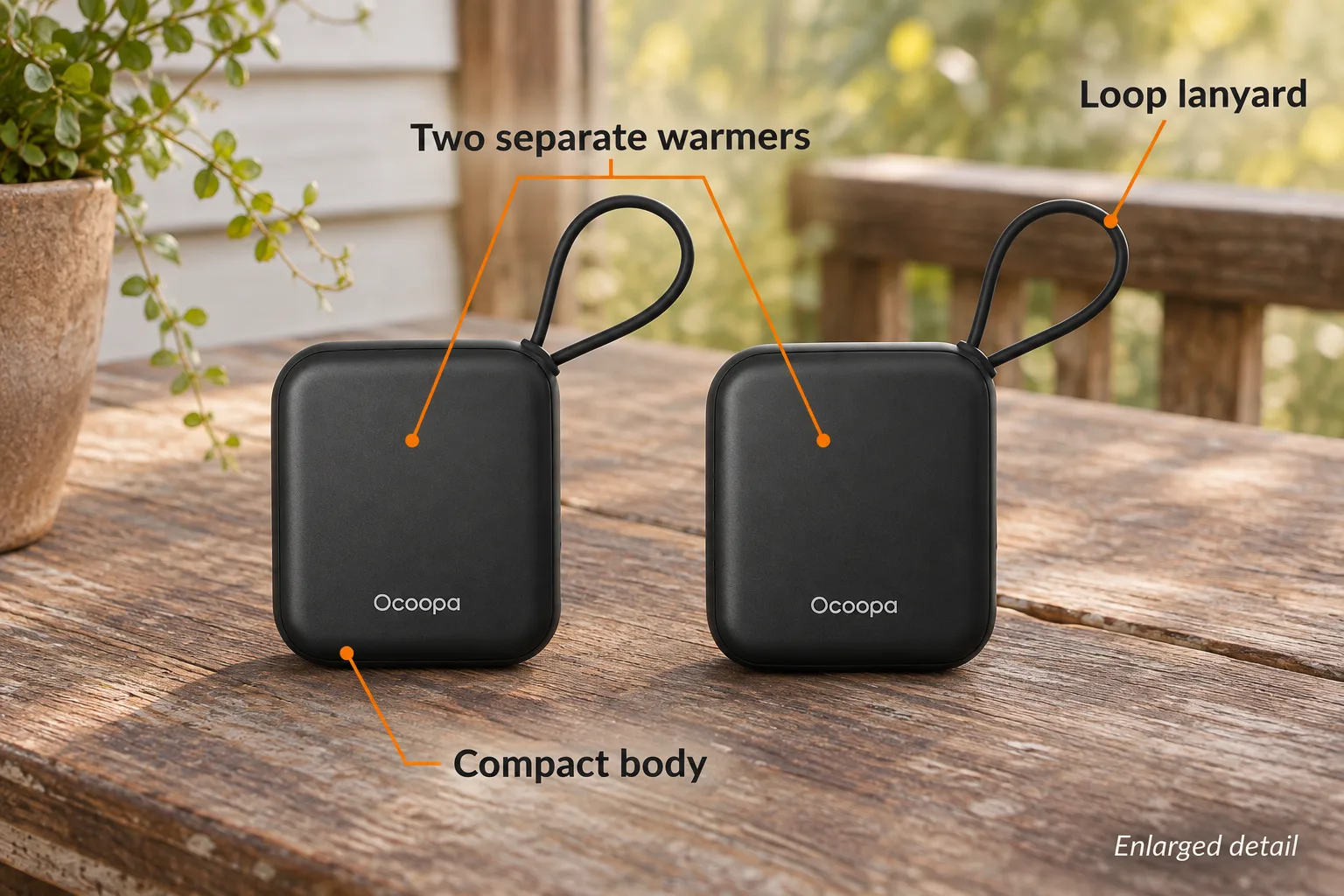
AI-generated illustration: orange labels identify the two-piece format, body and loop. Enlarged detail; no performance measurement.
Will either option actually cover an entire day?
HotHands' official hand-warmer page advertises up to ten hours of heat. Its Amazon description identifies the selected product as air-activated. That makes it useful when you want a fresh sealed pair without first finding a charger. The maximum is a manufacturer claim, not a duration we verified in winter conditions.
The selected UT5 Nano page presents a less straightforward runtime story. Its extended title or item highlight says 14 hours, while the main product bullet says up to seven hours. The purchase includes two units. We therefore do not interpret the larger number as a verified fourteen-hour session for each hand, or promise that both devices deliver their maximum at the highest heat level.
Ask the more practical question: how long must both hands have warmth before you can get back indoors or recharge? Alternating devices between two separate sessions is a different use from running one in each hand continuously. If your plan depends on the maximum possible duration, get the exact setting-specific runtime from the manufacturer before buying.

AI-generated illustration: planning an autumn outing. Product size is illustrative; the scene does not demonstrate heating or operating instructions.
When do rechargeable warmers become cheaper?
At the checked $24.95 pack price, one HotHands pair costs about $0.62: $24.95 divided by 40. Comparing that with the $18.99 rechargeable set gives a simple purchase-price crossover after approximately 31 pairs of disposable warmers.
That calculation assumes you would otherwise open one new pair for each outing. It is not a complete ownership-cost comparison. It excludes electricity, shipping differences, a power adapter if one is required, replacement devices and any lost or damaged warmers. It also assumes the rechargeable set remains usable for enough outings and supplies the amount of warmth you need.
The cost arithmetic is a historical comparison, not a current safety endorsement or a recommendation to buy the rechargeable example.
What stands out about disposable HotHands?
Simple distribution is the main advantage. A bulk pack can be divided among family members or companions without coordinating chargers or explaining buttons. The selected listing advertises a maximum ten-hour duration and identifies common outdoor uses such as fishing, skiing and spectator events.
The drawbacks are ongoing consumption and limited control. You need another unopened pair when the current pair is spent. Buying a large pack also makes less sense if you rarely use them or cannot use the supplies within the packaging's stated life. Check the actual package rather than assuming that an old packet in a drawer is ready indefinitely.
Consider these for occasional outings, event kits and people who prefer consumable supplies. Skip them if the recurring need to replace pairs is the inconvenience you are specifically trying to eliminate. Keep the manufacturer's handling and placement instructions with any pairs you give away.
What stands out about the UT5 Nano?
Selectable heat and reuse are the reasons to consider it. The manufacturer's UT5 Nano page describes a two-pack and USB-C charging. Amazon's selected listing describes three heat levels and identifies UT3042R in its model field. This guide does not silently substitute specifications from the UT5 Sway, UT5 DuoHeat or older UT3 and UT4 devices.
Charging and identification are real obligations. You must have charged devices when you leave and a plan for the next outing. A reusable product is less convenient if the charging step is the task you tend to forget. We have not confirmed battery replacement options, measured actual charging time or verified that the selected variant can power a phone, so those are not promised benefits here.
Consider the Nano for repeat short outings when its handheld format suits you. Skip or postpone it if you require independently verified all-day high-heat endurance, want a disposable supply to distribute, or cannot establish which model a seller will supply.
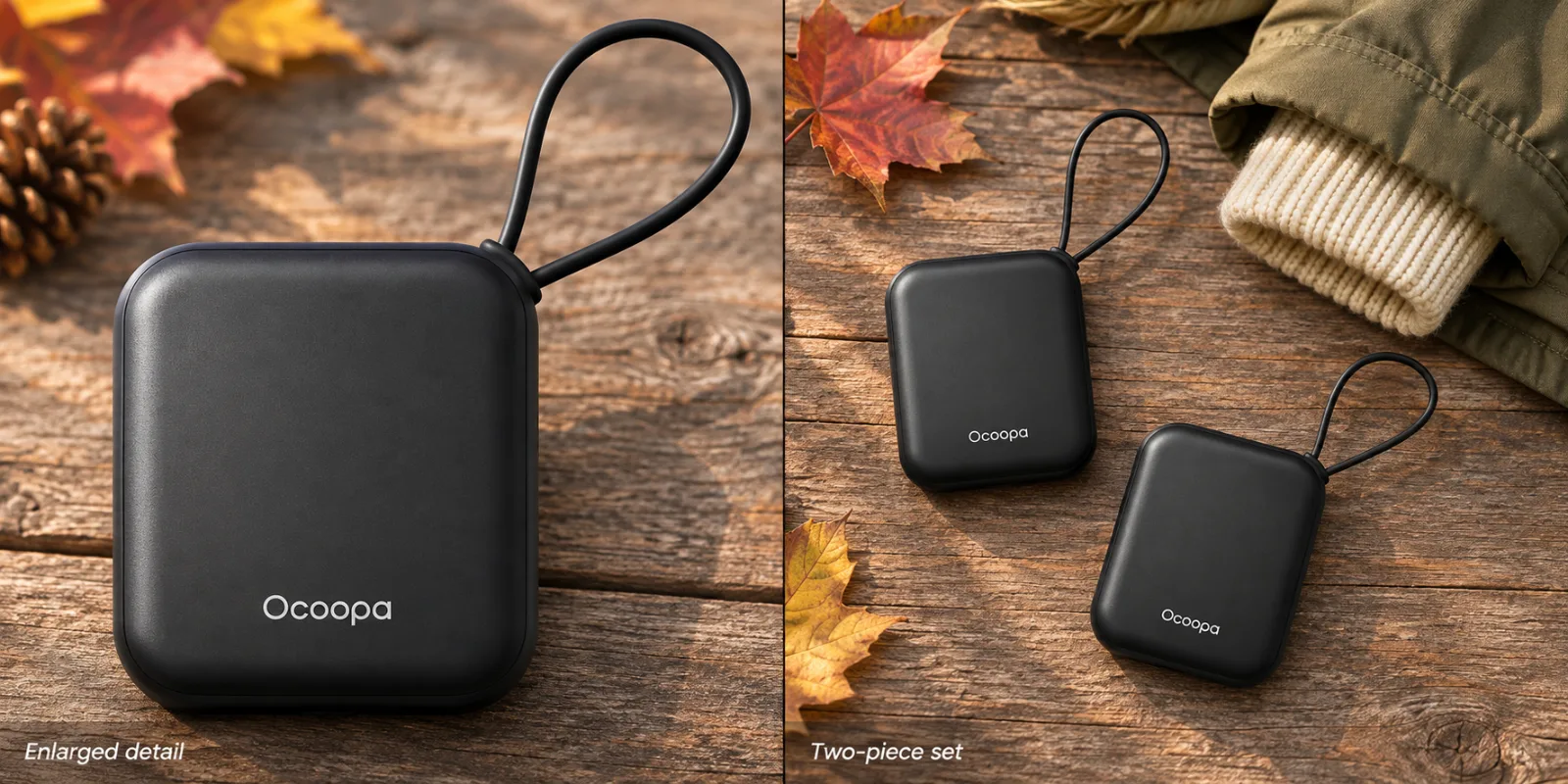
AI-generated illustration: two-panel exterior detail and separate devices. Left panel enlarged; no charging or temperature test.
Does the OCOOPA recall apply to this comparison?
The CPSC notice dated July 30, 2026 identifies OCOOPA models UT3053, UT3056, ZLS-118, ZLS-118S, ZLS-118D, H01 and H01(PD). The stated hazard is overheating and ignition of the lithium-ion battery.
UT3042R, the model displayed for the selected Amazon Nano listing, is not named in that particular notice. That observation is not a guarantee of safety or proof that every product sold under a UT5 name is unaffected. Check the model printed on the actual device and current recall information. Owners of a recalled model should follow the CPSC stop-use and remedy instructions, rather than buying advice for another model.
What do owners say about the trade-off?
- Two devices can support different sessions. CapnHunter, October 29, 2024, described using one rechargeable warmer on low and switching to the other later. The model was not established; this illustrates a routine, not a UT5 Nano runtime test.
- A long outing changes the calculation. ScandiacusPrime, October 29, 2024, found their gifted rechargeable warmer too short-lived for a long hunt. This was one older, unidentified unit, not a current ASIN failure rate.
- Access to charging matters. MickeyTettleton, October 29, 2024, liked rechargeable warmers but found off-grid charging inconvenient. Their following-day update mentioned obtaining a power station, without reporting a completed charging test.
These accounts describe different devices and routines. We found no controlled owner comparison of these exact two ASINs. They should help you frame questions, not establish which product produces more heat or lasts longer in identical conditions.
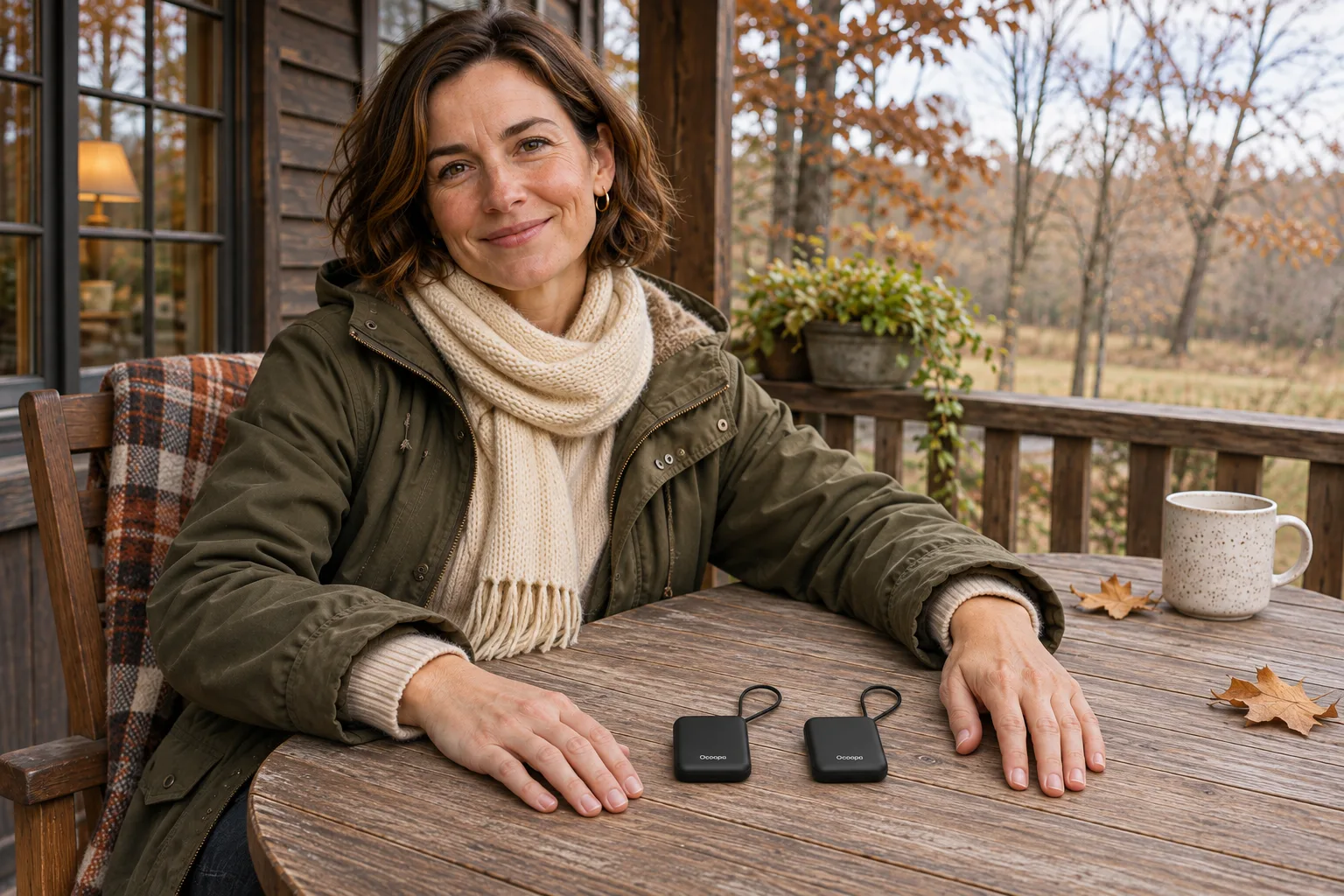
AI-generated illustration: portrait with the two-device set. Hands and arm connections checked; no firsthand ownership or testing implied.
How we researched this
We checked the exact Amazon variants, new-stock offers, sellers, displayed prices and rating counts. We read manufacturer information, the current CPSC notice and dated individual Reddit comments. The editorial preference depends on duration, charging access, control and recurring purchase cost. It is not an Amazon sales ranking or a claim that we tested a winner.
The five AI-generated illustrations use the black UT5 Nano as a single visual example. Exact manufacturer body dimensions were not available in the sources checked, so the images are not a fit or storage-size guide. They do not depict measured heating performance or demonstrate operating instructions.
Pros
- + Sealed disposables avoid a charging step
- + Rechargeable two-pack offers selectable heat
- + Current prices support a transparent per-pair cost comparison
Cons
- - Disposable pairs require repeat purchases
- - Rechargeable headline runtime is ambiguous
- - No exact-ASIN controlled owner comparison or personal tests
Sources and verification status
Verification status: compiled from public sources
Data updated:
FAQ
Does the HotHands 40-pair pack contain 80 warmers?
The selected listing describes 40 pairs, meaning two warmers per pair. Check the selected pack count rather than relying only on Amazon’s per-count price.
Does the UT5 Nano provide fourteen hours to both hands?
That is not established. The selected page has a fourteen-hour headline but an up-to-seven-hour bullet and includes two devices. We do not promise fourteen hours per unit or simultaneous high-heat endurance.
How many disposable pairs equal the rechargeable purchase price?
At the checked $24.95 for 40 pairs and $18.99 rechargeable set price, the simple purchase-price crossover is about 31 pairs. This excludes electricity, replacements, shipping and differences in usable warmth.
Is the selected UT5 Nano named in the July 2026 OCOOPA recall?
Amazon displays model UT3042R, which is not named in that specific CPSC notice. Verify the actual device and current recalls; the absence of that number from one notice is not a safety guarantee.
Are these products personally tested by UnboxRank?
No. This comparison is compiled from public sources. We have not measured temperature, runtime, charging speed or long-term durability, and the cited owners used older or unidentified devices.
You might also like
Sports & Outdoors
Buying guideRechargeable Hand Warmer Safety: What to Check First

Sports & Outdoors
Buying guideThermacell E55 vs E90: Do They Use the Same Refills?
Thermacell E55 vs E90 refill compatibility explained: identify the right liquid cartridges, compare battery runtime, and avoid fuel-and-mat packs.

Tools & Home Improvement
Product comparisonMegapro vs Wera Kompakt 20 RA-R: Home Tool Choice
Compare exact bit profiles, telescopic access, storage and the current third-party Amazon offers before choosing a home tool gift.

Electronics
Product comparisonP-touch Cube vs Cube Plus: Tape, Power & PC Use
Choose between the 12 mm CUBE and 24 mm CUBE Plus by tape width, power and the computer workflow you need.